Le Grand Jugement dernier
Pierre Paul Rubens · 1617
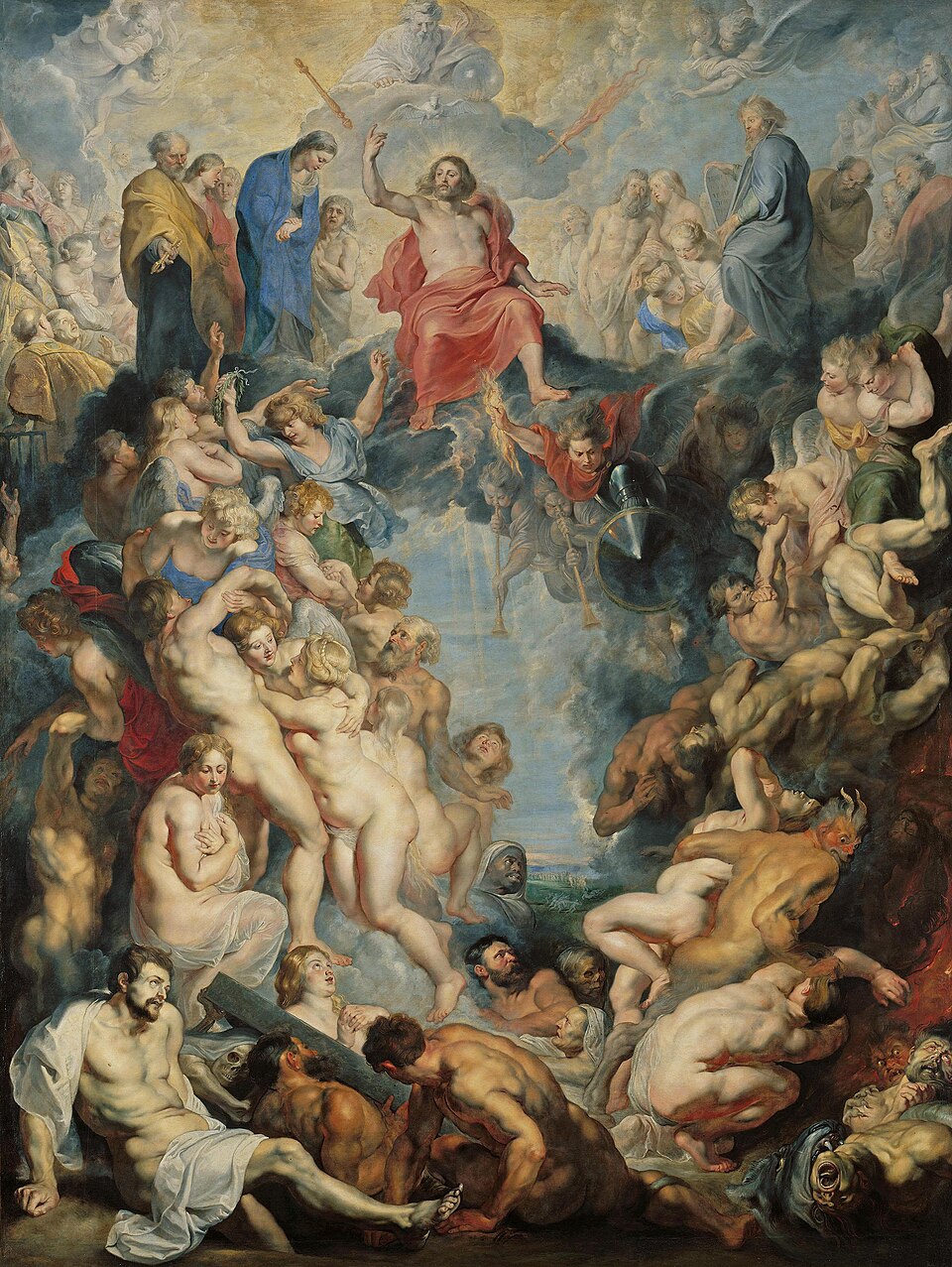
More than six metres tall, the blessed rising on one side and the damned tumbling into hell on the other. Rubens signed it alone, yet up to twenty hands may have helped paint it, and for decades it was partly covered up.
The story behind the painting
Rubens painted this altarpiece between 1614 and 1617. It was one of four altarpieces commissioned by Wolfgang William, Count Palatine of Neuburg, and with two side panels it was meant for the high altar of the court church in Neuburg an der Donau, handed to the Jesuits in 1618 as part of the Counter-Reformation. Rubens created the composition and the final touches, and his is the only signature, but it is believed that many studio assistants worked on it. The English article gives nine to nineteen in one place and ten to twenty in another. Its name distinguishes it from his Small Last Judgement of 1619 and his Fall of the Damned of 1620.
What to look for
God the Father sits at the top centre, with Jesus just below him. To Jesus' right is his mother, the Virgin Mary, and to his left is Moses, holding the tablets of the Ten Commandments. Up the left side of the picture, at Jesus' right hand, rise the blessed, while on the right side the damned fall into hell. Along the base lie the dead, the dying and those just resurrected. The scale is overwhelming: about 608.5 by 463.5 cm, so the bodies in the lower zone are close to the size of the people looking at them.
Meaning and intent
The colossal size and the programme belong to a moment of rising tension, shortly before the Thirty Years' War, when the Counter-Reformation was being pushed with great severity in the Principality of Palatinate-Neuburg. The Last Judgement was the most popular image of Counter-Reformation propaganda, together with the fall of the angels by the Archangel Michael. Yet the naked bodies that carry the drama caused offence, and the painting was partially covered up. A picture made to warn the faithful became, for a time, too much for those who prayed before it.
Legacy
In 1692 the donor's grandson, Johann Wilhelm, Elector Palatine, brought it to the Düsseldorf gallery. After the Palatine collections moved to Munich, the Düsseldorf gallery followed in 1805 and 1806. Today the work is in the Alte Pinakothek, the largest painting in the museum, placed in Hall VII, the Rubens Hall, which was designed for it and is itself the museum's largest hall. It is the only painting still in the same place as when the museum opened in 1836. The two side panels, the Adoration of the Shepherds and the Outpouring of the Holy Spirit, are in the Neuburg State Gallery.
Le saviez-vous ?
- Painted by Rubens and his studio, 1614 to 1617.
- Commissioned for the Jesuit court church in Neuburg an der Donau.
- About 608.5 x 463.5 cm, the largest painting in the Alte Pinakothek.
- In the same hall since the museum opened in 1836.
À propos de l'artiste
Pierre Paul Rubens (1577-1640)
art religieux · Collection de peintures de l'État de Bavière · Jugement dernier
Autres œuvres de Pierre Paul Rubens
.jpg) L'Érection de la croix - Peter Paul Rubens (1609)
L'Érection de la croix - Peter Paul Rubens (1609) L'Enlèvement des filles de Leucippe - Peter Paul Rubens (1618)
 Sous la tonnelle de chèvrefeuille - Peter Paul Rubens (1600s)
 Samson et Dalila - Peter Paul Rubens (1600s)
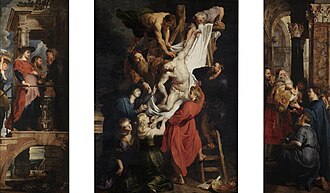 La Descente de Croix - Peter Paul Rubens (1611)
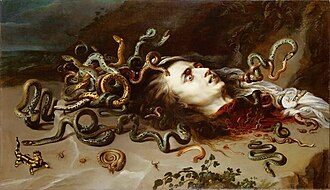 Tête de Méduse - Peter Paul Rubens (1618)
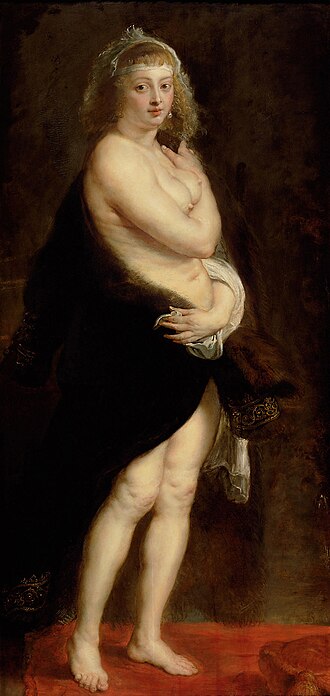 Hélène Fourment sortant du bain - Peter Paul Rubens (1638)
.jpg) Le Jardin d'Amour - Peter Paul Rubens (1632)
Le Jardin d'Amour - Peter Paul Rubens (1632)
Œuvres d'artistes liés
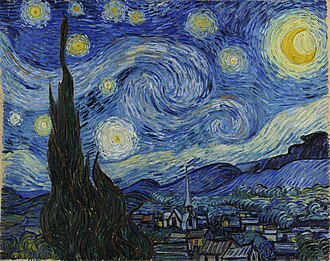 La Nuit étoilée - Vincent van Gogh (1889)
.jpg) Terrasse du café le soir - Vincent van Gogh (1888)
Terrasse du café le soir - Vincent van Gogh (1888) Le Souper à Emmaüs - Caravaggio (1601)
 La Vocation de saint Matthieu - Caravaggio (1609)
 Les Ménines - Diego Velázquez (1656)
 La Reddition de Bréda - Diego Velázquez (1635)
%20-%20Google%20Art%20Project.jpg) Triple portrait de Charles Ier - Anthony van Dyck (1635)
Triple portrait de Charles Ier - Anthony van Dyck (1635)%20with%20M.%20de%20St%20Antoine%20-%20Google%20Art%20Project.jpg) Charles Ier à cheval avec Monsieur de Saint Antoine - Anthony van Dyck (1636)
Charles Ier à cheval avec Monsieur de Saint Antoine - Anthony van Dyck (1636) La Ronde de nuit - Rembrandt van Rijn (1642)
 Autoportrait - Rembrandt van Rijn (1659)
 La Jeune Fille à la perle - Johannes Vermeer (1665)
 La Laitière - Johannes Vermeer (c. 1658)