La Descente de Croix
Pierre Paul Rubens · 1611
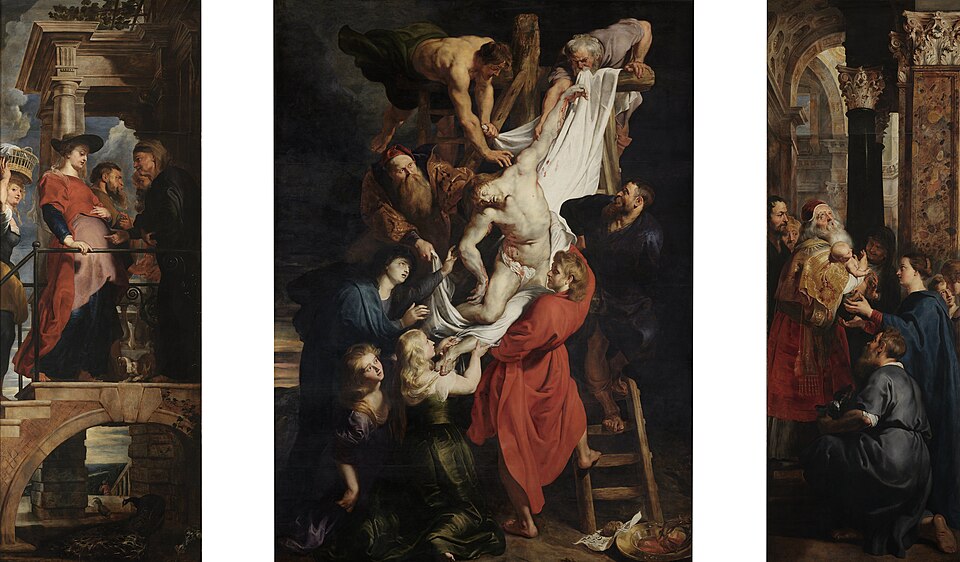
Men lean over the crossbar, one gripping the shroud in his teeth, as Christ's body is lowered into waiting arms. Rubens painted it for an Antwerp guild, and after two wartime removals it still hangs where it was made to hang.
The story behind the painting
On 7 September 1611 the Confraternity of the Arquebusiers in Antwerp, whose patron saint was Saint Christopher, commissioned Rubens to paint a triptych. Wikidata dates the work 1611, the year of the commission, while Wikipedia dates the painting to 1612 to 1614. The Descent from the Cross is its central panel, and it remains in its original place, the Cathedral of Our Lady in Antwerp. It is considered one of Rubens' masterpieces. History did not leave it in peace: in 1794 the occupying French army sent it to the Louvre, it came back in 1815, and in 1914 the Imperial German Army took it to Berlin, returning it only after the armistice of 1918.
What to look for
The figures form an interlocking oval around the lifeless body. Saint John, in a scarlet cloak with one foot on the ladder, takes most of Christ's weight, helped by Joseph of Arimathea. Nicodemus stands higher on the ladder, and two men lean over the crossbar, one holding the winding sheet between his teeth to free his hands. Mary Magdalene and Mary Cleophas kneel at the foot of the cross, while the Virgin stands upright, reaching toward her Son, her anguish in her pale face. On the ground lie the inscription and a copper basin with the crown of thorns and nails. Strong light against a dark background gives the group the effect of a relief, and the evening sky opens on the left.
Meaning and intent
Rubens shows the lowering of Christ as a solemn, almost ritual act, unlike the more dramatic Italian painters who influenced him. In the context of the Counter-Reformation, the image invites believers to feel the weight of Christ's sacrifice and reminds them of his divine nature. Rubens also turns the Virgin from a figure of frailty into one of fortitude, following the Gospel of John; her standing pose matches the Catholic emphasis on Mary's part in redemption, which Protestants limited or denied. On the outer shutters the guild's patron Christopher, the Christ-bearer, carries the Child across a stream, a metaphor for the Eucharist and the real presence of Christ's body at Mass.
Legacy
The inner wings frame the death with scenes from the beginning of Christ's life: on the left the pregnant Virgin visits her cousin Elizabeth on a raised bridge with a classical portico, and on the right the old Simeon receives the Christ child in a carefully built temple interior. The subject stayed with Rubens throughout his career, and beyond the Antwerp altarpiece he painted three or more other versions of the descent. The bold posture of the workmen recalls a composition by Daniele da Volterra, and the work grows out of the Italian Mannerist tradition, but its calm and ritual mood made it its own.
Le saviez-vous ?
- Commissioned on 7 September 1611 by the Antwerp Arquebusiers.
- Central panel of a triptych in the Cathedral of Our Lady, Antwerp.
- Taken to Paris in 1794 and to Berlin in 1914, returned both times.
- One man holds the shroud between his teeth to free his hands.
À propos de l'artiste
Pierre Paul Rubens (1577-1640)
art religieux · homme · Jésus-Christ · Descente de croix
Autres œuvres de Pierre Paul Rubens
.jpg) L'Érection de la croix - Peter Paul Rubens (1609)
L'Érection de la croix - Peter Paul Rubens (1609)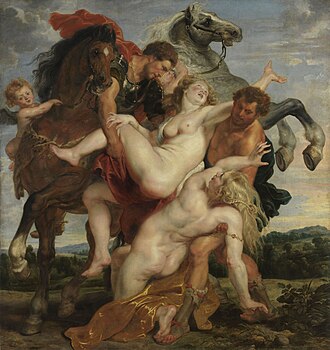 L'Enlèvement des filles de Leucippe - Peter Paul Rubens (1618)
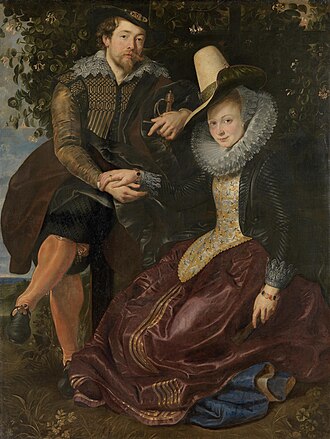 Sous la tonnelle de chèvrefeuille - Peter Paul Rubens (1600s)
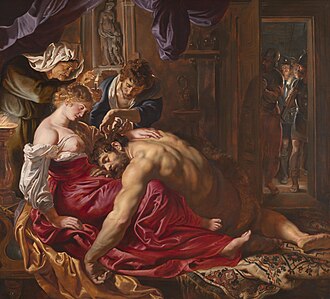 Samson et Dalila - Peter Paul Rubens (1600s)
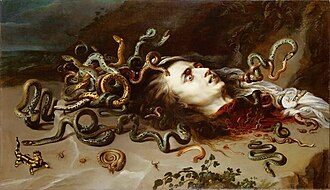 Tête de Méduse - Peter Paul Rubens (1618)
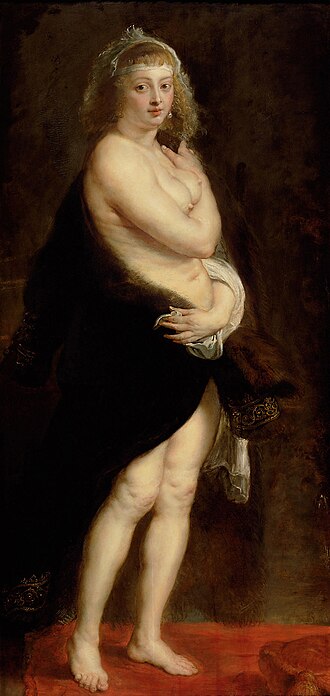 Hélène Fourment sortant du bain - Peter Paul Rubens (1638)
.jpg) Le Jardin d'Amour - Peter Paul Rubens (1632)
Le Jardin d'Amour - Peter Paul Rubens (1632)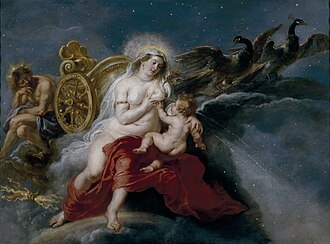 L'Origine de la Voie lactée - Peter Paul Rubens (1630s)
Œuvres d'artistes liés
 La Nuit étoilée - Vincent van Gogh (1889)
.jpg) Terrasse du café le soir - Vincent van Gogh (1888)
Terrasse du café le soir - Vincent van Gogh (1888)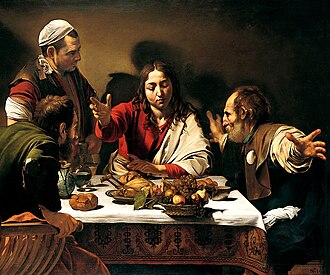 Le Souper à Emmaüs - Caravaggio (1601)
 La Vocation de saint Matthieu - Caravaggio (1609)
 Les Ménines - Diego Velázquez (1656)
 La Reddition de Bréda - Diego Velázquez (1635)
%20-%20Google%20Art%20Project.jpg) Triple portrait de Charles Ier - Anthony van Dyck (1635)
Triple portrait de Charles Ier - Anthony van Dyck (1635)%20with%20M.%20de%20St%20Antoine%20-%20Google%20Art%20Project.jpg) Charles Ier à cheval avec Monsieur de Saint Antoine - Anthony van Dyck (1636)
Charles Ier à cheval avec Monsieur de Saint Antoine - Anthony van Dyck (1636) La Ronde de nuit - Rembrandt van Rijn (1642)
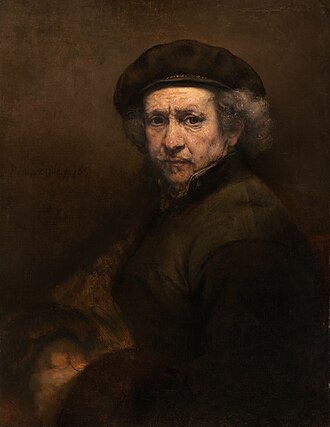 Autoportrait - Rembrandt van Rijn (1659)
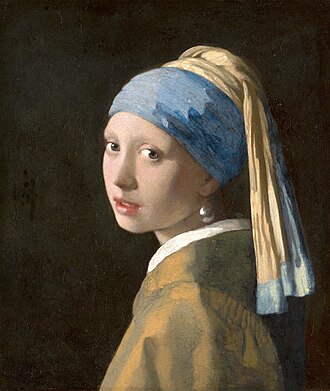 La Jeune Fille à la perle - Johannes Vermeer (1665)
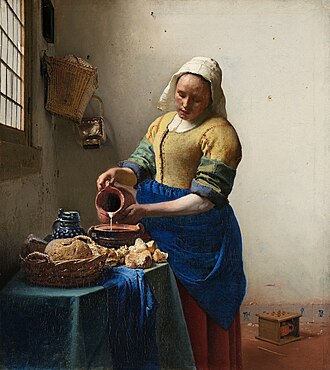 La Laitière - Johannes Vermeer (c. 1658)