Les Grands Boulevards
Pierre-Auguste Renoir · 1875
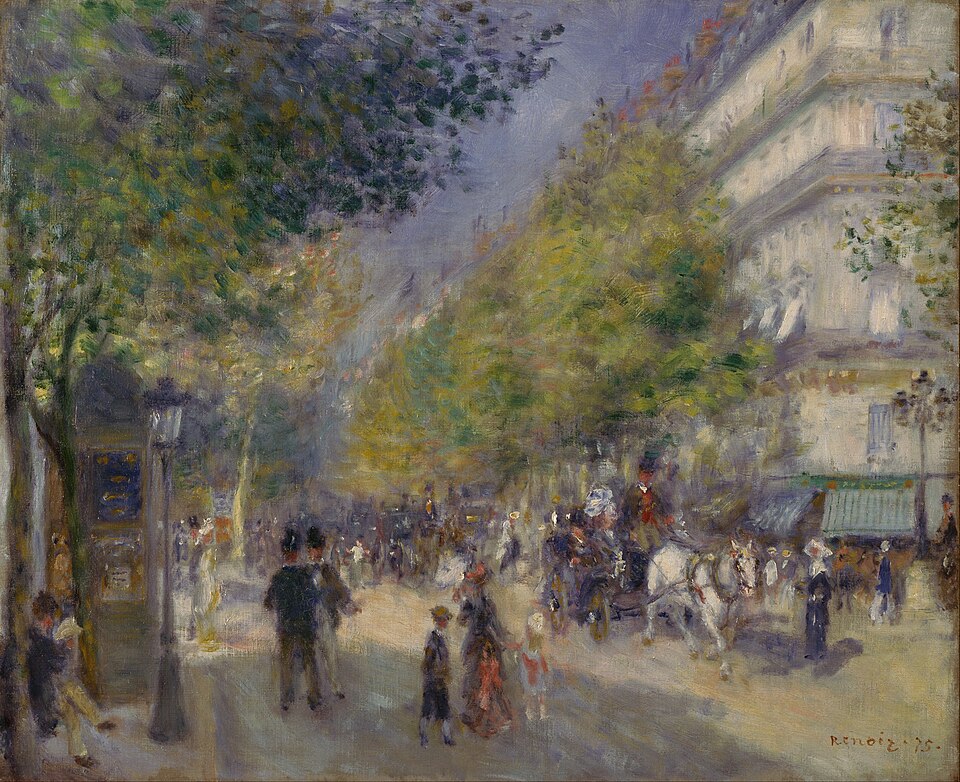
Sunlight through young trees, a carriage passing, people strolling along a brand new avenue. In 1875 Renoir painted the Paris he loved, and this is considered his most famous view of the city.
The story behind the painting
In the 1850s and 1860s Georges-Eugène Haussmann transformed Paris into a modern metropolis. His huge urban renewal gave the city wide boulevards lined with uniform stone buildings, and open parks, a layout still visible today. Many Impressionists were drawn to these lively urban scenes. Renoir had moved to Paris at the age of four, when his family left Limoges, and he spent much of his life there. He loved the city and said that in the streets of Paris he felt at home. In 1875 he painted one of its newest and most fashionable districts, where middle-class Parisians strolled at leisure.
What to look for
Look at the wide paved street and the large building on the right, both signs of Haussmann's renovation. The boulevard is full of life, with people of every class and especially the flâneurs, the idle strollers of the city. Their clothes are painted in enough detail to suggest their social class, yet Renoir shows no details of their faces, so no one becomes an individual. What he really studies is the sun: on the buildings, on the trees, and in the shadows cast by the trees, the passers-by and the horse-drawn carriage. The short brushstrokes and the slightly out of focus view are typical of Impressionism.
Meaning and intent
The painting shows the effects of industrialisation and Haussmannisation on everyday Paris. Renoir moves the emphasis away from the human figure and toward the effect of light on the whole scene. The crowd is not a set of portraits but part of the atmosphere, as much a part of the sunny afternoon as the leaves and the stone. It is a portrait of the modern city as a place to walk, to look and to be seen, painted by someone who called those streets home.
Legacy
The painting is held at the Philadelphia Museum of Art, where it is catalogued as an Impressionist cityscape, about 52 by 63.5 cm. It is considered Renoir's most famous view of Paris. More than a record of new streets, it keeps a moment of the city just after its great transformation, when the boulevards were still new and the trees along them still young, and when a painter could make the passing light the true subject of a busy street.
Le saviez-vous ?
- Painted by Renoir in 1875.
- Shows a Paris boulevard after Haussmann's renovation.
- Considered Renoir's most famous view of Paris.
- Held at the Philadelphia Museum of Art.
À propos de l'artiste
Pierre-Auguste Renoir (1841-1919)
impressionnisme · paysage urbain · Philadelphia Museum of Art
Autres œuvres de Pierre-Auguste Renoir
 Bal du moulin de la Galette - Pierre-Auguste Renoir (1876)
 Le Déjeuner des canotiers - Pierre-Auguste Renoir (1881)
 La Balançoire - Pierre-Auguste Renoir (1876)
 Les Grandes Baigneuses - Pierre-Auguste Renoir (1884)
 Jeunes Filles au piano - Pierre-Auguste Renoir (1892)
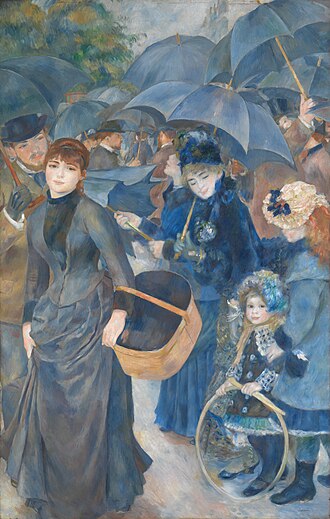 Les Parapluies - Pierre-Auguste Renoir (1880s)
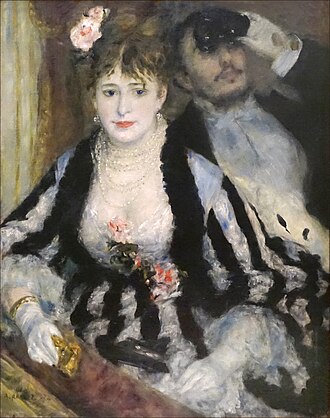 La Loge - Pierre-Auguste Renoir (1874)
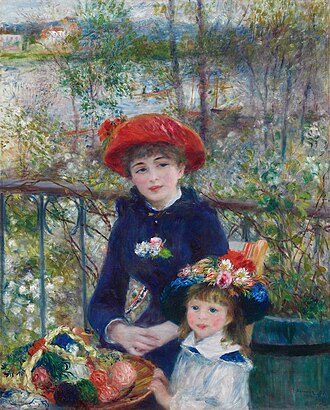 Les Deux Sœurs - Pierre-Auguste Renoir (1881)
Œuvres d'artistes liés
 Impression, soleil levant - Claude Monet (1872)
 Nymphéas - Claude Monet (1906)
 Le Déjeuner sur l'herbe - Édouard Manet (1863)
 Olympia - Édouard Manet (1863)
 Le Berceau - Berthe Morisot (1872)
 Jour d'été - Berthe Morisot (1879)
 L'Absinthe - Edgar Degas (1875)
 La Famille Bellelli - Edgar Degas (1858)
 Le Canal du Loing - Alfred Sisley (1892)
 L'Abreuvoir à Marly-Le-Roi, gelée blanche - Alfred Sisley (1876)
 Rue de Paris, temps de pluie - Gustave Caillebotte (1877)
 Les Raboteurs de parquet - Gustave Caillebotte (1875)