L'Enterrement
Édouard Manet · 1869
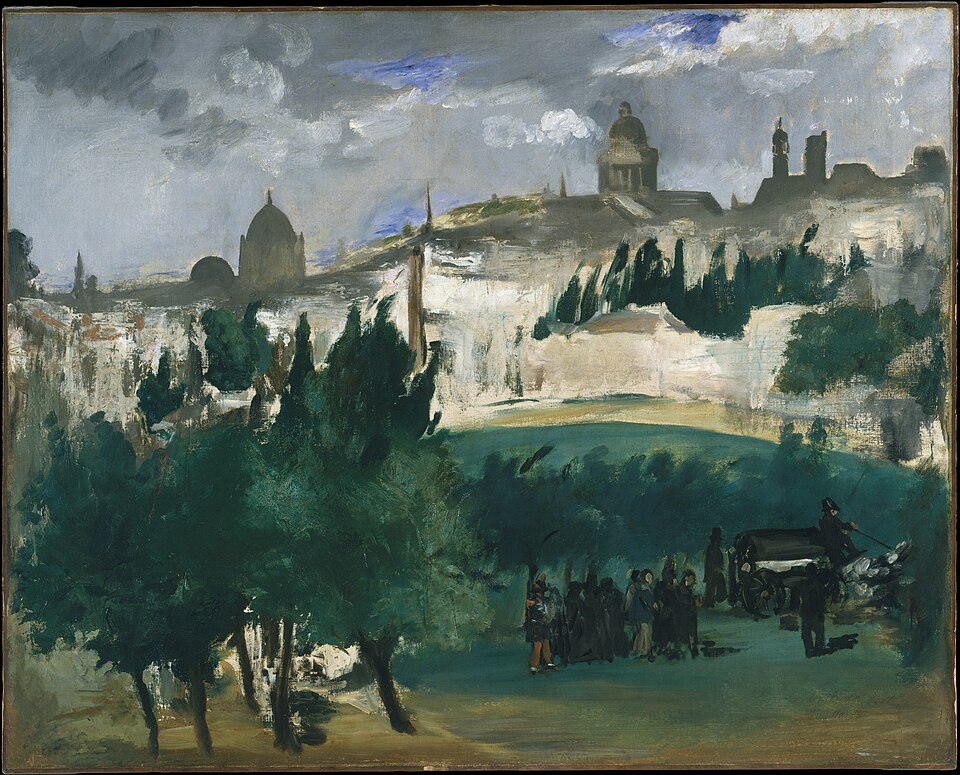
A small hearse crawls across a bare slope under a heavy sky, the domes of Paris rising beyond. Manet never finished this quiet picture, and it was most probably painted in memory of the stormy day he buried his friend Baudelaire.
The story behind the painting
The Funeral was most probably inspired by the burial of Manet's friend, the poet Charles Baudelaire, on 2 September 1867, which Manet attended. The weather was stormy, the sky heavy, and the procession small because, according to Charles Asselineau, many people were away from Paris and could not return in time; about a hundred came to the church and to Montparnasse Cemetery. The dating varies: Wikipedia gives 1867 to 1870, Wikidata 1869. Adolphe Tabarant first dated it 1870, then preferred the earlier date as more probable.
What to look for
A hearse and its attendants move along the bottom of the Mouffetard quarter, heading for Montparnasse Cemetery. In the distance rise the Paris Observatory, the church of Val-de-Grace, the Pantheon, the bell tower of Saint-Etienne-du-Mont and the Clovis tower. Charles Sterling noted that Manet moved the domes of the Observatory and Val-de-Grace closer together to improve the composition. Look also for a horse grenadier of the Imperial Guard at the back of the procession; Henri Loyrette argues that this detail sets the scene before the end of the Second Empire.
Meaning and intent
The canvas is unfinished, and its style is very close to Manet's Effect of Snow on Petit-Montrouge and his view of the Exposition Universelle of 1867. It is also known as Burial at the Glaciere, the title given to it in the inventory of Manet's works by Denis Rouart and Daniel Wildenstein. Tabarant placed the scene in the rue de l'Estrapade. Read as a farewell to Baudelaire, the thin cortege under that heavy sky becomes a picture of how few were there to say goodbye.
Legacy
After Manet's death his widow, Suzanne Manet, sold the painting in August 1894 to the dealer Portier. By 1902 it belonged to Camille Pissarro, who had known Manet well and frequented the Cafe Guerbois with him, so one painter kept another's unfinished farewell to a poet. It was next acquired by Ambroise Vollard, who sold it to the Metropolitan Museum of Art in New York, where it hangs today, a small and unfinished canvas that has passed through the hands of people who knew the painter.
Le saviez-vous ?
- Probably inspired by Baudelaire's funeral on 2 September 1867.
- Dated 1867 to 1870 by Wikipedia, 1869 by Wikidata.
- Left unfinished by Manet.
- Once owned by Camille Pissarro, now in the Metropolitan Museum of Art.
À propos de l'artiste
Édouard Manet (1832-1883)
paysage · Metropolitan Museum of Art · arbre · paysage · obsèques
Autres œuvres de Édouard Manet
 Le Déjeuner sur l'herbe - Édouard Manet (1863)
 Olympia - Édouard Manet (1863)
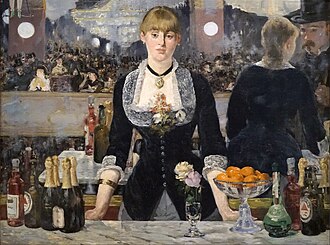 Un bar aux Folies Bergère - Édouard Manet (1882)
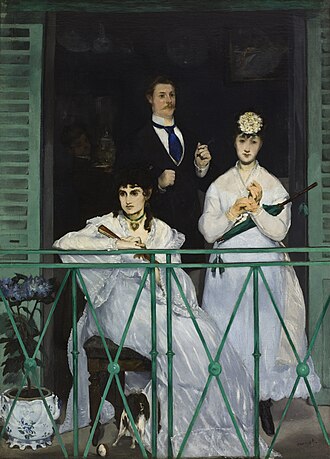 Le Balcon - Édouard Manet (1868)
 La Musique aux Tuileries - Édouard Manet (1862)
 Le Fifre - Édouard Manet (1866)
 Le Chemin de fer - Édouard Manet (1873)
 Nana - Édouard Manet (1877)
Œuvres d'artistes liés
 Impression, soleil levant - Claude Monet (1872)
 Nymphéas - Claude Monet (1906)
 Bal du moulin de la Galette - Pierre-Auguste Renoir (1876)
 Le Déjeuner des canotiers - Pierre-Auguste Renoir (1881)
 Le Berceau - Berthe Morisot (1872)
 Jour d'été - Berthe Morisot (1879)
 L'Absinthe - Edgar Degas (1875)
 La Famille Bellelli - Edgar Degas (1858)
 Le Canal du Loing - Alfred Sisley (1892)
 L'Abreuvoir à Marly-Le-Roi, gelée blanche - Alfred Sisley (1876)
 Rue de Paris, temps de pluie - Gustave Caillebotte (1877)
 Les Raboteurs de parquet - Gustave Caillebotte (1875)