L'Exécution de l'empereur Maximilien
Édouard Manet · 1860s
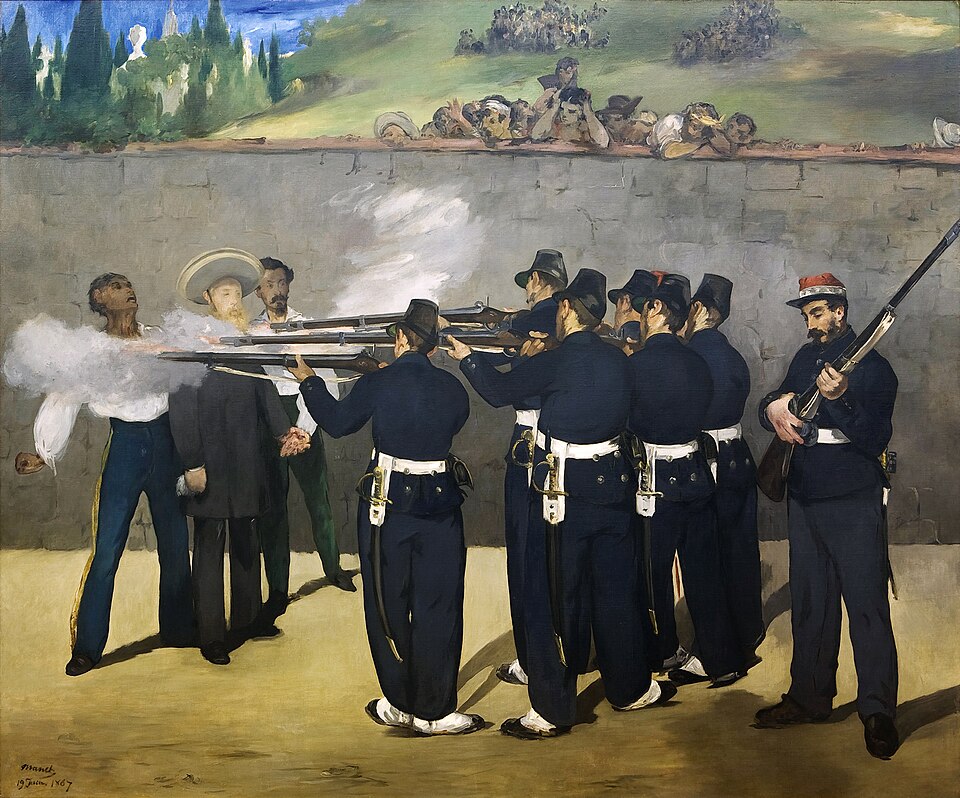
A firing squad shoots an emperor at point-blank range while one soldier calmly reloads and onlookers peer over a wall. In this final, largest version, now in Mannheim, Manet dressed the executioners in uniforms that looked French, and France would not let him show it.
The story behind the painting
Maximilian of Habsburg had ruled Mexico for three years under the protection of Napoleon III's troops. When the French emperor withdrew them and urged him to abdicate, Maximilian refused, saying a Habsburg would not desert the post Providence had given him. He was captured at Querétaro after a 72-day siege, condemned and shot in June 1867 with two loyal generals, Tomás Mejía and Miguel Miramón. The news reached Manet during the Universal Exposition of 1867. A lifelong republican, he was outraged, and worked for more than a year on an oil sketch, a lithograph and three large canvases. This last one, finished in 1868 or 1869, carries the date of the execution.
What to look for
The composition draws heavily on Goya's Third of May, and the Mexican onlookers and General Mejía are painted in a very Goya-like way. Yet the mood is drained of violent emotion: the soldiers fire calmly, one is busy reloading his rifle, and spectators crowd above the wall. The Boston version still had warm tones; the later ones use a cool harmony of greys, greens and blacks, and where Goya chose the moment of aiming, Manet fixes the shot itself. Look at the sombrero, which draws a wide pale halo around Maximilian's face, and the blood on the hands of Maximilian and Miramón as the volley has barely begun, a detail some read as Christ's stigmata.
Meaning and intent
In the first, Boston version the soldiers wear Mexican republican dress and sombreros. In July 1867 the press turned its blame on Napoleon III for abandoning Maximilian, and in the next two versions Manet changed the uniforms; photographs showed him that Mexican uniforms differed little from French ones. Some saw a provocation, as if France itself were killing Maximilian, and his lithograph of the subject was banned by the censor. Manet also left out the dramatic details reported by the press, the waiting coffins, the priest, the weeping faithful, the blindfolds, aiming instead at the tradition of academic history painting, perhaps with the Salon in mind.
Legacy
Manet could neither exhibit nor sell any of these works in France in his lifetime, even after the fall of the Second Empire; he would likely have sent this one to the Salon had he not been warned it would be refused. He showed the Execution in his own pavilion at the Pont de l'Alma. Known in artistic circles, it still found followers, such as Gérôme's Execution of Marshal Ney. Suzanne Manet sold the final version in 1898 to Paul Durand-Ruel, and in 1910 the Kunsthalle Mannheim acquired it, amid controversy, through a gift from nine Germans. The other versions are in Boston, London and Copenhagen.
Le saviez-vous ?
- Manet's last and largest version, finished in 1868 or 1869.
- The soldiers wear uniforms resembling the French army's.
- Manet could not exhibit it in France in his lifetime.
- Acquired by the Kunsthalle Mannheim in 1910.
À propos de l'artiste
Édouard Manet (1832-1883)
Autres œuvres de Édouard Manet
 Le Déjeuner sur l'herbe - Édouard Manet (1863)
 Olympia - Édouard Manet (1863)
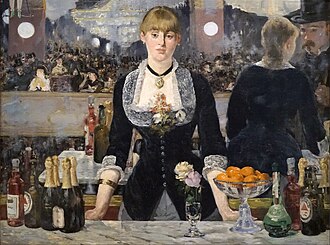 Un bar aux Folies Bergère - Édouard Manet (1882)
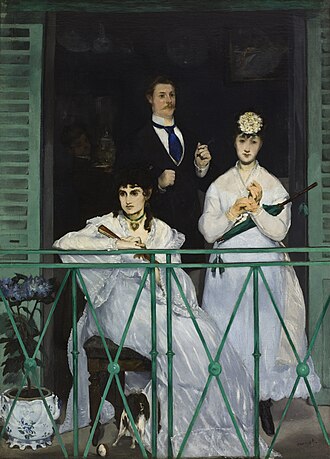 Le Balcon - Édouard Manet (1868)
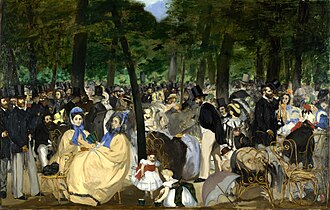 La Musique aux Tuileries - Édouard Manet (1862)
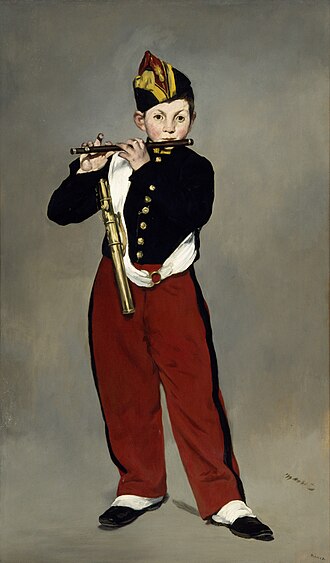 Le Fifre - Édouard Manet (1866)
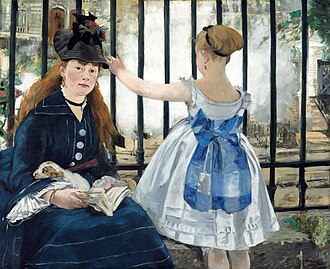 Le Chemin de fer - Édouard Manet (1873)
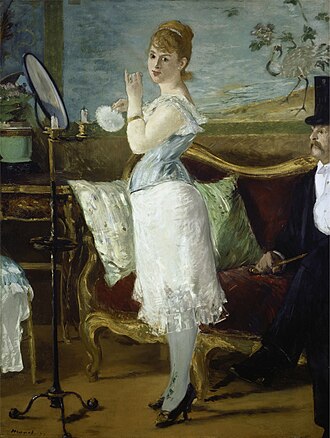 Nana - Édouard Manet (1877)
Œuvres d'artistes liés
 Impression, soleil levant - Claude Monet (1872)
 Nymphéas - Claude Monet (1906)
 Bal du moulin de la Galette - Pierre-Auguste Renoir (1876)
 Le Déjeuner des canotiers - Pierre-Auguste Renoir (1881)
 Le Berceau - Berthe Morisot (1872)
 Jour d'été - Berthe Morisot (1879)
 L'Absinthe - Edgar Degas (1875)
 La Famille Bellelli - Edgar Degas (1858)
 Le Canal du Loing - Alfred Sisley (1892)
 L'Abreuvoir à Marly-Le-Roi, gelée blanche - Alfred Sisley (1876)
 Rue de Paris, temps de pluie - Gustave Caillebotte (1877)
 Les Raboteurs de parquet - Gustave Caillebotte (1875)