Le Chenal de Gravelines, Petit Fort Philippe
Georges Seurat · 1890
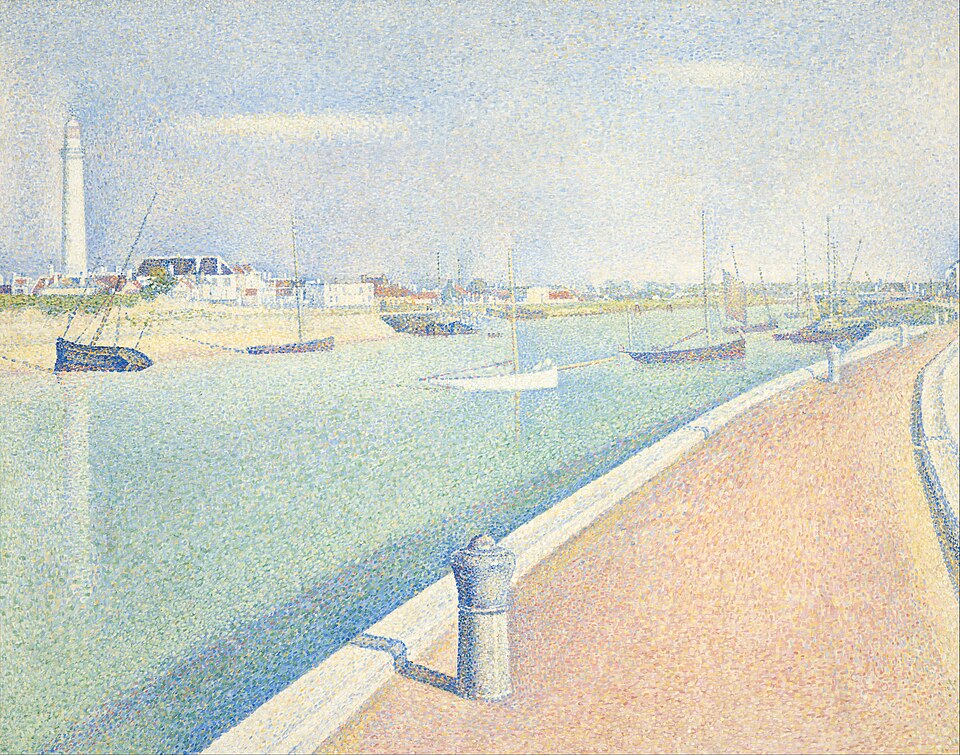
No people, no storm, just a quiet harbour mouth, a curving wharf and a sky made of tiny dots of light. Seurat painted it in the last summer of his life, and it still hums with a luminous stillness.
The story behind the painting
Seurat spent most of the year shocking Paris with his new style, but his summers went to calm seascapes. In 1890, the year before his death, he travelled to Gravelines, a tiny port near the Belgian border, and painted what would be his last four landscapes, two fewer than the summer before. Guidebooks of the day called Gravelines an uninteresting town, and that obscurity may have attracted an artist growing protective of his methods. The straight lines of its canal also suited the strictly organised compositions he preferred. Unlike Monet, he liked plain, everyday ports rather than dramatic sunsets and stormy seas.
What to look for
Look closely at the dots. Seurat chose their colours by laws of chromatic harmony, and varied their shape and density: the solid central bollard is the most densely painted, while on the right of the sky the dots are so sparse that the white ground shows through. A narrow border of darker dots runs around the edge of the canvas to heighten the light, and the frame, a reproduction of his own design, carries an ultramarine base with matching dots. The wharf curves away in an elegant parabola, while a sweeping diagonal cuts the picture in two. The light and shadows suggest midafternoon.
Meaning and intent
The painting is a late demonstration of Neo-Impressionism, the movement Seurat founded, where method serves feeling. He stayed faithful to the real harbour, much of which is still recognisable, yet he arranged the boats so their horizontals and verticals give maximum stability. The parabola of the wharf brings serenity and seems to stretch into infinity, evoking the vastness of the sea, while the diagonal adds counter movement. Comparing studies and canvas shows how hard he worked: the bollard is missing from the panel study, and he adjusted the walkway so sea, sky and ground take roughly equal shares. There are no vacationers or fishermen, only still light.
Legacy
Described as wistful and poetic, the painting is counted among the treasures of the Indianapolis Museum of Art. Caroline Marmon Fesler gave it in 1945 to the Herron School of Art in memory of her parents, Daniel W. and Elizabeth C. Marmon, and it passed to the museum when the two institutions separated. Its accession number is 45.195. As one of Seurat's final paintings, it is often seen as a clear summary of his ideas about colour and light. Wikidata gives its size as 73 by 92.7 cm.
Le saviez-vous ?
- Painted at Gravelines in the summer of 1890.
- One of Seurat's last four landscapes.
- Seurat painted a border of darker dots around the edge.
- Given to Indianapolis in 1945 by Caroline Marmon Fesler.
paysage · Musée d'Art d'Indianapolis
Autres œuvres de Georges Seurat
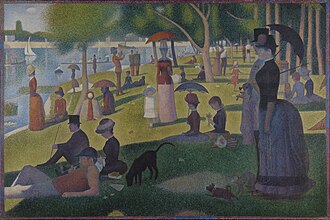 Un dimanche après-midi à l'Île de la Grande Jatte - Georges Seurat (1884-1886)
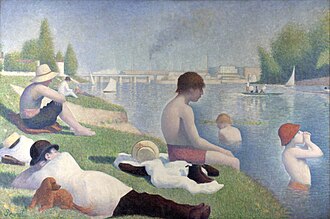 Une baignade à Asnières - Georges Seurat (1884)
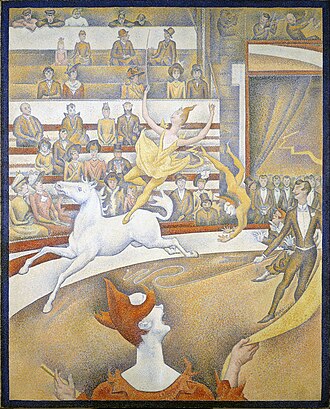 Le Cirque - Georges Seurat (1891)
%20-%20BF811%20-%20Barnes%20Foundation.jpg) Les Poseuses - Georges Seurat (1886)
Les Poseuses - Georges Seurat (1886)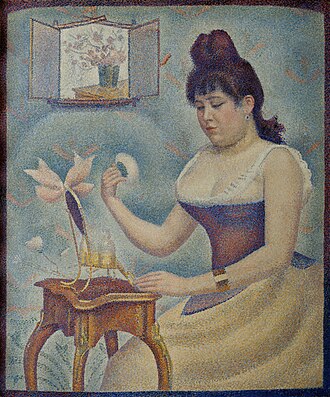 Jeune femme se poudrant - Georges Seurat (1889)
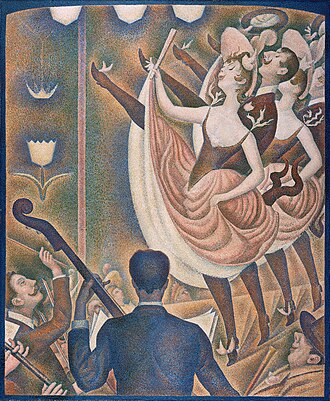 Le Chahut - Georges Seurat (1889)
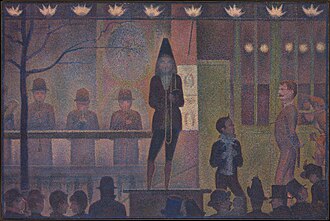 Parade de cirque - Georges Seurat (1888)
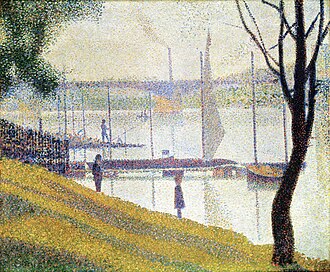 Le Pont de Courbevoie - Georges Seurat (1880)
Œuvres d'artistes liés
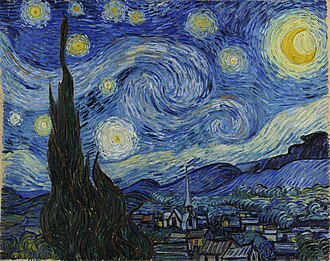 La Nuit étoilée - Vincent van Gogh (1889)
.jpg) Terrasse du café le soir - Vincent van Gogh (1888)
Terrasse du café le soir - Vincent van Gogh (1888)