Une baignade à Asnières
Georges Seurat · 1884
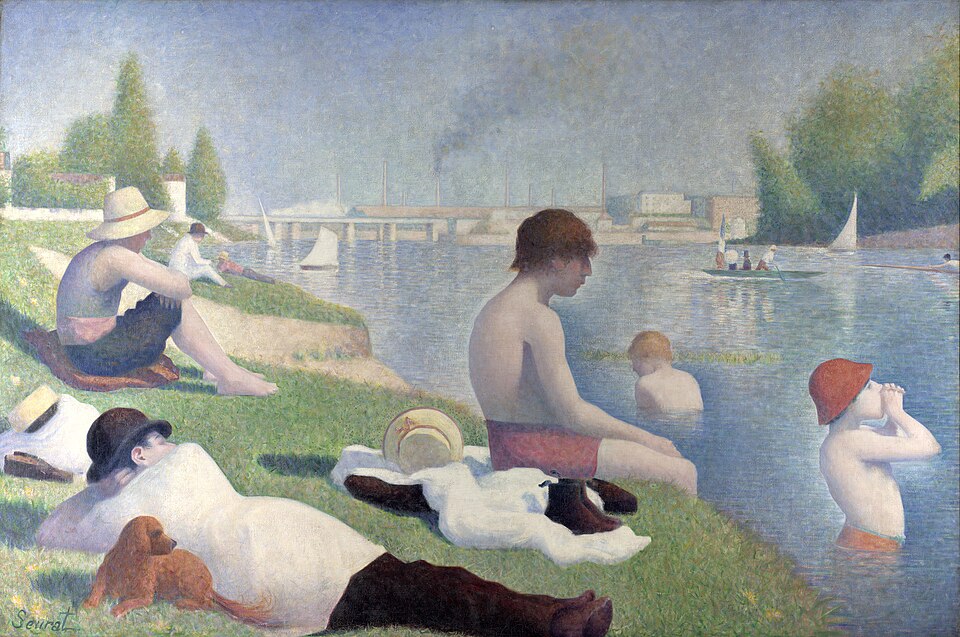
Young men rest and swim in the Seine on a hot summer day, factory chimneys hazy behind them. Rejected by the Salon when Seurat was 24, Bathers at Asnieres is now a highlight of the National Gallery in London.
The story behind the painting
Georges Seurat finished Bathers at Asnieres in 1884, at the age of 24, the first of his two monumental masterpieces. Trained at the Ecole des Beaux-Arts in 1878 and 1879, he prepared it in the academic way: he may have begun the first small oil study as early as 1882, and the catalogue of Cesar de Hauke lists fourteen oil studies, most painted outdoors, which he fondly called croquetons. Nine conte crayon drawings focus on each of the five main figures. He submitted the finished canvas to the Salon of 1884 and was rejected, and the picture puzzled many contemporaries until long after his death at 31.
What to look for
The scene lies just short of four miles from central Paris, and the figures sit not in Asnieres but in neighbouring Courbevoie. Across the water is the tip of the island of La Grande Jatte, stretched beyond its real length, with the Asnieres railway bridge and the factories of Clichy behind. Heat haze softens the trees and pales the sky almost to white. The statuesque figures, clothes piled on the bank, mostly look away, none toward the viewer. Look at the brushwork: in the grass Seurat used his criss-crossing balaye strokes, while the water has thin, nearly horizontal strokes and the skin is smooth.
Meaning and intent
In a fast-growing suburb, where the population of Asnieres nearly doubled in ten years, Seurat chose not to dwell on the hardship of industrial workers. Instead he showed the working class and petite bourgeoisie with dignity, in lazy leisure, on a scale then reserved for grander subjects. Their faces are mostly in profile and their social status is left unclear. The chimneys smoke, yet they seem powerless to disturb the settled scene. The art historian Roger Fry wrote that no one could render this enveloping heat with a more exquisitely tremulous sensibility than Seurat.
Legacy
Charles Blanc, a professor at the Ecole, had copies of Quattrocento frescoes from Arezzo shown in the school chapel, and their stately, regularly spaced figures echo in the Bathers. Seurat's careful use of contemporary colour theory gives the picture its gentle vibrancy, and his later works from the same stretch of the Seine include A Sunday Afternoon on the Island of La Grande Jatte. Appreciation for the Bathers grew through the twentieth century. Today the canvas, about 201 by 301.5 cm, hangs in the National Gallery in London, where it is counted among the highlights of the collection.
Le saviez-vous ?
- Finished in 1884, when Seurat was 24.
- Rejected by the Salon of 1884.
- Prepared with fourteen oil studies and nine conte crayon drawings.
- Now in the National Gallery, London.
scène de genre · National Gallery · baignade
Autres œuvres de Georges Seurat
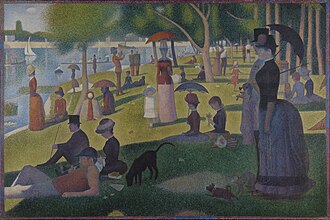 Un dimanche après-midi à l'Île de la Grande Jatte - Georges Seurat (1884-1886)
Œuvres d'artistes liés
 La Nuit étoilée - Vincent van Gogh (1889)
.jpg) Terrasse du café le soir - Vincent van Gogh (1888)
Terrasse du café le soir - Vincent van Gogh (1888)