Thaïs
Joshua Reynolds · 1781
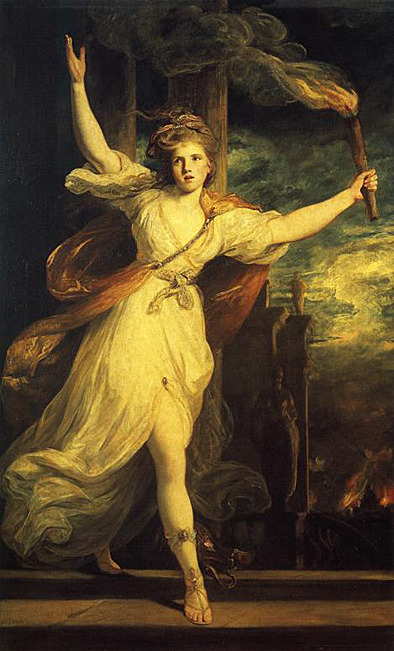
A woman raises a burning torch and urges an army to set a city on fire. Joshua Reynolds painted a London courtesan as the ancient Thaïs, and the Royal Academy crowd of 1781 could not resist a joke about it.
The story behind the painting
Thaïs is a portrait by Sir Joshua Reynolds of the English courtesan Emily Warren in the guise of Thaïs, the hetaera who was mistress of Alexander the Great. Reynolds exhibited it at the Royal Academy in London in 1781. The image comes from John Dryden's poem Alexander's Feast, which tells how, at a victory feast after the capture of the Persian capital Persepolis, Thaïs called for the city to be burned in revenge for the ruin of Greek cities. In Dryden's line, like another Helen, she fired another Troy. Reynolds mixed portrait, history painting and social comment in one canvas.
What to look for
The canvas is large, about 229 by 145 cm in oil. Thaïs holds a burning torch in one hand, and with the other she urges Alexander and his followers on to burn Persepolis. Her gesture is the whole story: she is not a passive beauty but the one who leads the way, as Dryden's poem says, to light him to his prey. A woman painted at full length on this scale, with the attributes of a heroine from ancient history, was a deliberate choice that would have been read at once by the audience of the Royal Academy.
Meaning and intent
The model is the subject of some debate. She was the courtesan Emily, mistress of Charles Francis Greville. Some researchers suggested Amy Lyon, also Greville's mistress and the future Lady Hamilton, posed for it, but it is more likely to be Emily Bertie Pott, who called herself Emily Warren. At the 1781 exhibition one viewer joked that Reynolds, unpaid by Emily, had shown her setting fire to the Temple of Chastity. Some of his friends denied the story, but Phillippa Plock, former curator at Waddesdon Manor, notes that he may well have wanted the link, since the name Thaïs itself meant courtesan.
Legacy
In 1792 the painting was published as a print engraved by Francesco Bartolozzi, which carried the image beyond the walls of the Academy. A likely portrait of the same Emily Warren by George Romney is in the Metropolitan Museum of Art in New York, so she can be seen through the eyes of two great painters of the age. Reynolds's Thaïs is now at Waddesdon Manor, in the care of the National Trust, where it still shows how a society portrait could borrow the drama of history and carry a pointed message.
Le saviez-vous ?
- Shown at the Royal Academy, London, in 1781.
- The model is most likely the courtesan Emily Warren.
- Inspired by John Dryden's poem Alexander's Feast.
- Engraved by Francesco Bartolozzi in 1792; now at Waddesdon Manor.
À propos de l'artiste
Joshua Reynolds (1723-1792)
femme · portrait · National Trust
Autres œuvres de Joshua Reynolds
 The Ladies Waldegrave - Joshua Reynolds (1780)
 Capitaine George K. H. Coussmaker - Joshua Reynolds (1782)
 Lady Cockburn et ses enfants - Joshua Reynolds (1773)
 Lady Elizabeth Delmé et ses enfants - Joshua Reynolds (1770s)
 Elizabeth Kerr, Marchioness of Lothian - Joshua Reynolds (1769)
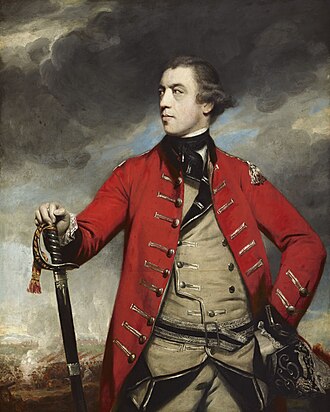 Portrait de John Burgoyne - Joshua Reynolds (1766)
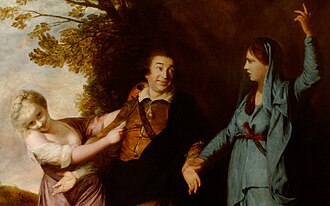 David Garrick Between Tragedy and Comedy - Joshua Reynolds (1761)
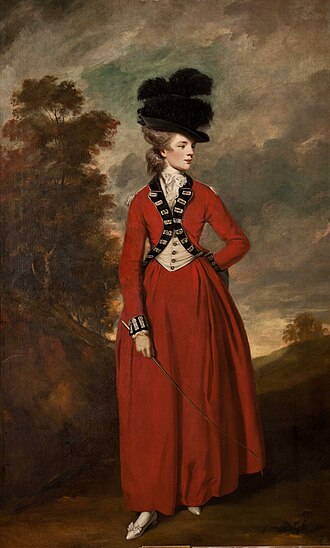 Lady Worsley - Joshua Reynolds (1779)
Œuvres d'artistes liés
 Le Dernier Voyage du Téméraire - J. M. W. Turner (1839)
 Pluie, Vapeur et Vitesse - J. M. W. Turner (1844)
 Pollice verso - Jean-Léon Gérôme (1872)
 Le Marché aux esclaves - Jean-Léon Gérôme (1866)
 Le Déjeuner sur l'herbe - Édouard Manet (1863)
 Olympia - Édouard Manet (1863)
 L'Origine du monde - Gustave Courbet (1866)
 Un enterrement à Ornans - Gustave Courbet (2020)
 Œillet, lys, lys, rose - John Singer Sargent (1885-1886)
 Madame X - John Singer Sargent (1884)
 La Liberté guidant le peuple - Eugène Delacroix (1830)
 La Mort de Sardanapale - Eugène Delacroix (1827)