Synagogue
John Singer Sargent · 1919
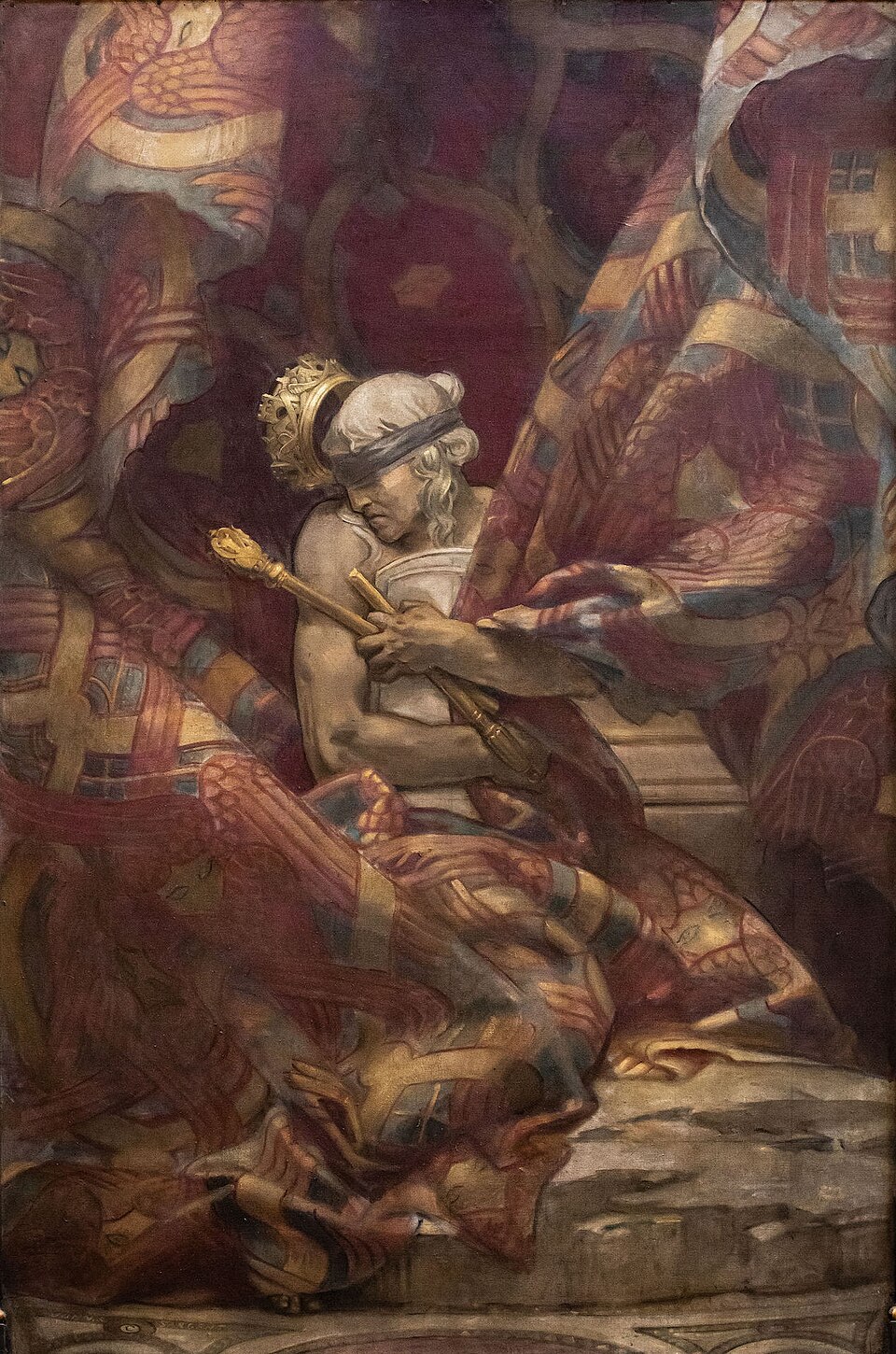
A blindfolded, huddled woman in a public library in Boston. Sargent unveiled Synagogue in 1919, and it was attacked at once as antisemitic. A law ordered it removed, the law fell, and the mural is still on the wall.
The story behind the painting
Synagogue is an allegorical mural in the Boston Central Library at Copley Square, part of John Singer Sargent's cycle the Triumph of Religion. Sargent described the commission as a mural decoration illustrating certain stages of Jewish and Christian religious history. Designed and painted in London, the cycle is divided into 17 works sent to Boston in instalments; Sargent began sketching in 1891, and it was still unfinished when he died in 1925. Synagogue and its counterpart Church sit on the East wall, either side of a space reserved for Jesus giving the Sermon on the Mount, which was never installed. Even before the unveiling, the critic Frederick William Coburn hoped Sargent had avoided the old bigotry of the Middle Ages.
What to look for
The Synagogue is personified as a cowering, feeble woman wearing a blindfold, and the contrast with Sargent's glorified Church, shown as a pietà, is what critics saw first. The scholar Sally M. Promey notes the visual likeness between Synagogue and Michelangelo's Cumaean Sibyl in the Sistine Chapel, and Sargent may also have been influenced by the writings of Ernest Renan. Promey reads three themes in the whole cycle: individualism and subjectivity overcoming law and doctrine, a reaction to the First World War, and concealment and revelation. Seen beside its partner across the empty central space, the figure carries the cycle's argument and its trouble together.
Meaning and intent
Many viewers saw a triumph of Christianity rather than of religion. Leo Franklin, president of the Central Conference of American Rabbis, wrote that it presented Judaism as a broken faith without a future, unfit for a public library. State Representative Coleman Silbert called it against the spirit of Americanism; the artist Rose Kohler answered with a medallion, Spirit of the Synagogue, showing the figure upright and triumphant. Rabbi Henry Raphael Gold found it unfair to Jewish students. Sargent said little in public; privately in 1919 he wrote that he was in hot water and could only point to the cathedrals of Reims, Notre Dame and Strasbourg. In 1922 a friend let it be known that no reflection on the Jewish race was intended.
Legacy
A petition for removal failed in 1919, and many groups wrote to the library, which said its contract with Sargent and the donors stopped it acting. In June 1922 the Massachusetts legislature passed Silbert's bill to take the painting by eminent domain, but it was struck down as unconstitutional and repealed in 1924; that year someone smeared an ink-like fluid on it. The Sermon on the Mount was never installed, and Promey notes Sargent never collected his final payment. Harvard's Straus Center restored the murals in 2003 to 2004, with explanatory signs added. The Boston Globe found the controversy largely forgotten and no active calls for removal.
Le saviez-vous ?
- An allegorical mural in Sargent's Triumph of Religion cycle, Boston Central Library.
- Unveiled in 1919 and criticised at once as antisemitic.
- A 1922 removal law was struck down and repealed in 1924.
- Restored in 2003-2004, with explanatory signs added.
À propos de l'artiste
John Singer Sargent (1856-1925)
Autres œuvres de John Singer Sargent
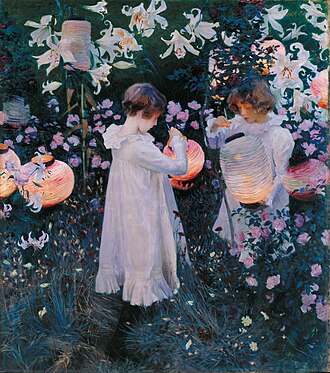 Œillet, lys, lys, rose - John Singer Sargent (1885-1886)
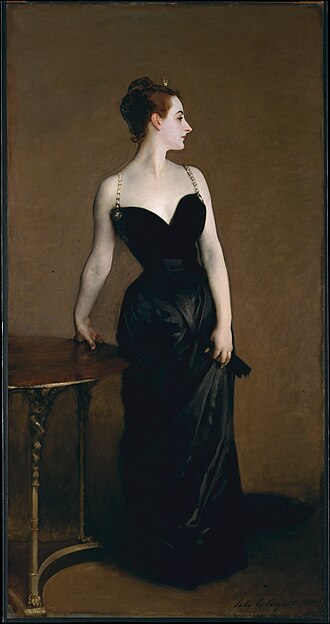 Madame X - John Singer Sargent (1884)
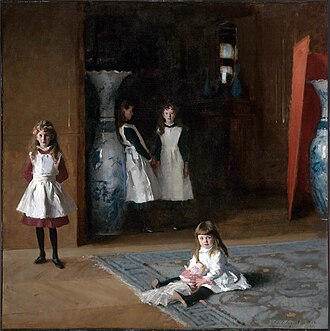 Les Filles d'Edward Darley Boit - John Singer Sargent (1882)
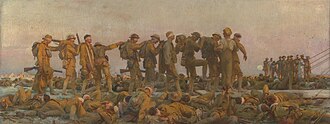 Gazés - John Singer Sargent (1919)
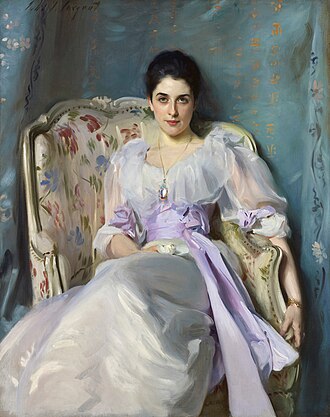 Portrait de Lady Agnew of Lochnaw - John Singer Sargent (1892)
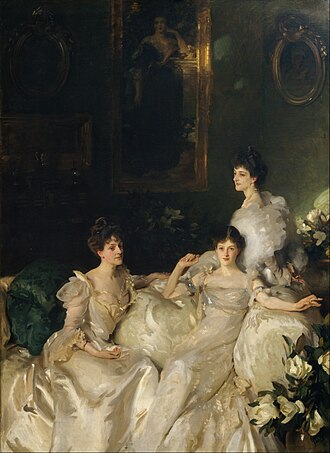 Les Sœurs Wyndham - John Singer Sargent (1899)
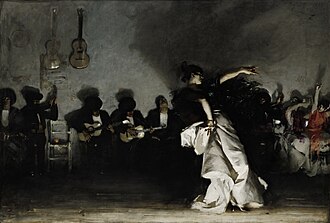 El Jaleo - John Singer Sargent (1882)
 Rue à Venise - John Singer Sargent (1882)
Œuvres d'artistes liés
 Pollice verso - Jean-Léon Gérôme (1872)
 Le Marché aux esclaves - Jean-Léon Gérôme (1866)
 Le Déjeuner sur l'herbe - Édouard Manet (1863)
 Olympia - Édouard Manet (1863)
 L'Origine du monde - Gustave Courbet (1866)
 Un enterrement à Ornans - Gustave Courbet (2020)
 La Liberté guidant le peuple - Eugène Delacroix (1830)
 La Mort de Sardanapale - Eugène Delacroix (1827)
 La Mort de Socrate - Jacques-Louis David (1787)
 Le Serment des Horaces - Jacques-Louis David (1784)
 The Ladies Waldegrave - Joshua Reynolds (1780)
 Capitaine George K. H. Coussmaker - Joshua Reynolds (1782)