La Chanteuse de rue
Édouard Manet · 1862
%20-%20Edouard%20Manet%20(Museum%20of%20Fine%20Arts%2C%20Boston).jpg)
A young singer steps out of a cabaret at night, clutching a guitar and lifting cherries to her lips. The woman Manet first saw refused to pose and walked off laughing, so his favourite model, Victorine Meurent, took her place.
The story behind the painting
One day in the early 1860s, Manet was walking to his studio with the journalist Antonin Proust when they saw a woman with a guitar leaving a café. Manet was struck by her look and decided at once to paint her. He asked her to pose, but she went off laughing and refused. So he turned to Victorine Meurent, then about 18, who would become his favourite model and was an artist in her own right. Street Singer, painted around 1862, is either the first or the second of the large paintings for which she posed. Manet later painted her in Le Bain and Olympia as well.
What to look for
The singer, in fashionable contemporary dress, leaves a cabaret by night, holding a guitar tightly and eating cherries. Her hat sits low, hiding her forehead. Deep shadows on either side of her nose form a kind of parenthesis. Her right hand covers her chin and cheek, and two small ruby cherries almost hide her upper lip. According to Stéphane Guégan, the cherries were an afterthought. The palette is limited, much in the manner of Velázquez. George Mauner noted her confrontational stare and the awkward way she holds the cherries and the guitar, which seems almost too bulky for her. The canvas stands about 171 by 106 cm, life-size.
Meaning and intent
Street Singer belongs to a series of single figures from the 1860s in which Manet painted contemporary types at life size. That broke a convention: humble genre subjects were meant to be painted small. Here an ordinary singer from the streets of Paris receives the scale once given to kings and saints. The style shows the influence of Frans Hals and Spanish masters such as Velázquez. The self-conscious effect Mauner described, unexpected in a genre scene, makes her feel less like a type and more like a real person caught in a moment, aware of being looked at.
Legacy
Critics split sharply. Paul Mantz complained that all form was lost, that the eyebrows slid down the nose like two commas of shadow, and that the effect was pallid, hard and sinister. Émile Zola, Manet's friend, admired the painting as a keen search for truth. The two men stood for two camps: Mantz for the academy's traditions, Zola for a more modern style. It is interesting to compare the singer with Mademoiselle V. in the Costume of an Espada of 1862, where the same Victorine looks quite different, rounder and dressed as a male Spanish matador. Street Singer was donated to the Museum of Fine Arts, Boston, in 1966.
Le saviez-vous ?
- Painted around 1862, with Victorine Meurent as the model.
- The real street singer Manet met refused to pose.
- One of Manet's life-size single figures of contemporary types.
- Donated to the Museum of Fine Arts, Boston, in 1966.
À propos de l'artiste
Édouard Manet (1832-1883)
scène de genre · portrait · musée des Beaux-Arts de Boston · Victorine Meurent · guitare · chanteur ou chanteuse
Autres œuvres de Édouard Manet
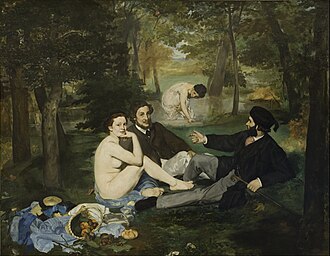 Le Déjeuner sur l'herbe - Édouard Manet (1863)
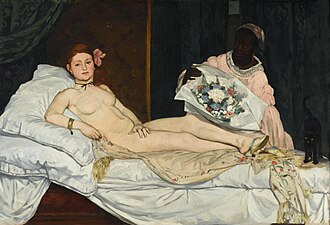 Olympia - Édouard Manet (1863)
%20(33539037428).jpg) Un bar aux Folies Bergère - Édouard Manet (1882)
Un bar aux Folies Bergère - Édouard Manet (1882)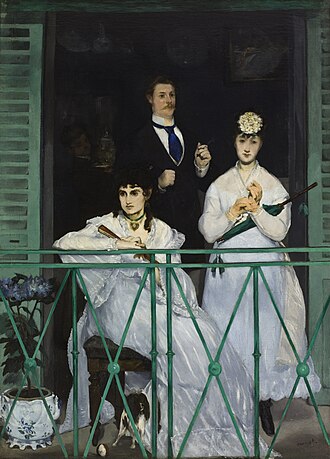 Le Balcon - Édouard Manet (1868)
.jpg) La Musique aux Tuileries - Édouard Manet (1862)
La Musique aux Tuileries - Édouard Manet (1862).jpg) Le Fifre - Édouard Manet (1866)
Le Fifre - Édouard Manet (1866)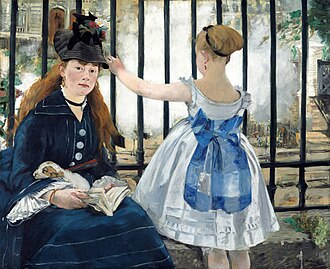 Le Chemin de fer - Édouard Manet (1873)
 Berthe Morisot au bouquet de violettes - Édouard Manet (1872)
Œuvres d'artistes liés
 Impression, soleil levant - Claude Monet (1872)
 Nymphéas - Claude Monet (1906)
 Bal du moulin de la Galette - Pierre-Auguste Renoir (1876)
 Le Déjeuner des canotiers - Pierre-Auguste Renoir (1881)
 Le Dernier Voyage du Téméraire - J. M. W. Turner (1839)
 Pluie, Vapeur et Vitesse - J. M. W. Turner (1844)
 La Nuit étoilée - Vincent van Gogh (1889)
.jpg) Terrasse du café le soir - Vincent van Gogh (1888)
Terrasse du café le soir - Vincent van Gogh (1888)