Nuit étoilée
Jean-François Millet · 1850s
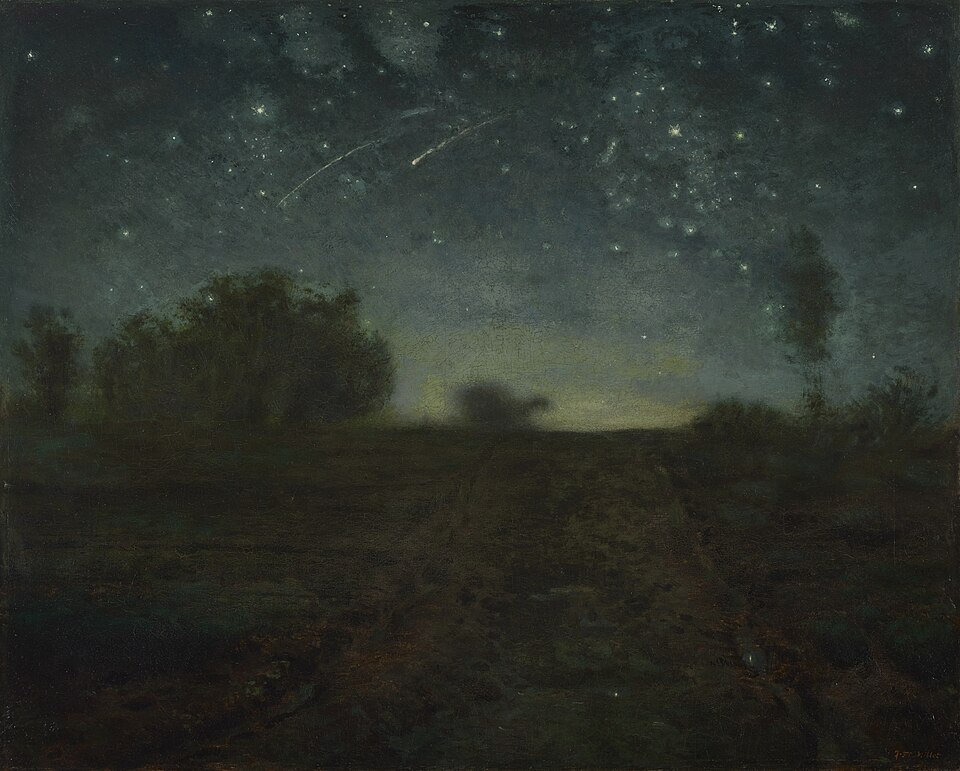
A dark path, a cart on the horizon, and a sky full of real stars and shooting meteors. Long before van Gogh, Millet painted his own Starry Night from the nights he loved in Barbizon.
The story behind the painting
In 1849 Jean-François Millet left Paris, where he had lived for almost a decade, and moved to Barbizon, a village on the edge of the Fontainebleau forest, fleeing a cholera outbreak and the unrest that followed the Revolutions of 1848. There he loved to look up at the stars. In a letter to his brother he wrote that the calm and grandeur of the night were so awesome he felt overwhelmed. Wikipedia says the painting was completed in 1850 and retouched in 1865, while Wikidata dates it only to the 1850s. It is one of Millet's few pure landscapes.
What to look for
The foreground is a dark, almost black stretch of grass and earth along a darkened path. Dark green trees and shrubs fill the middle ground. Near the centre a horizon of light green blends into deeper blue, and against it stands the silhouette of a cart. Above, the sky is showered with stars in hues of green and blue. Look for real constellations: the sword of Orion and Canis Major. The shooting stars may be the Orionid meteor shower of October, which would make the green glow a sunrise, not a sunset. One faint star at the edge of Orion's belt is painted unusually bright, perhaps pointing to where the meteors seem to come from.
Meaning and intent
Millet told his student Edward Wheelwright that every landscape, however small, should feel as if it could extend indefinitely on either side, every glimpse of the horizon a segment of the great circle that bounds our vision. Starry Night carries that idea into the night. Unlike many painters of his time, who invented bright dot-like stars in made-up patterns, Millet painted a mostly accurate sky from memory and observation. The astronomer Martin Beech has said the season of the scene can possibly be dated with some accuracy.
Legacy
The painting first appeared at the Hôtel Drouot in Paris on 10 and 11 May 1875, after Millet's death, then at Galerie Goupil. From 1878 it belonged to the Scottish writer George Lillie Craik and his descendants, before the Yale University Art Gallery in New Haven acquired it. In 2008 it was shown at the National Gallery of Art in an exhibition on the Fontainebleau forest. Van Gogh admired Millet deeply, but there is no evidence he saw this painting before making his own Starry Night.
Le saviez-vous ?
- Completed in 1850 and retouched in 1865, per Wikipedia.
- One of Millet's few pure landscapes.
- Includes real constellations such as Orion's sword.
- Now at the Yale University Art Gallery.
Autres œuvres de Jean-François Millet
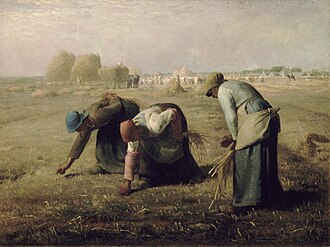 Des glaneuses - Jean-François Millet (1857)
.jpg) L'Angélus - Jean-François Millet (1858)
L'Angélus - Jean-François Millet (1858)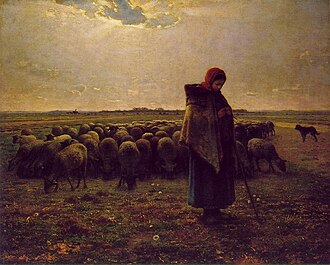 Bergère avec son troupeau - Jean-François Millet (1863)
.jpg) Un vanneur - Jean-François Millet (1848)
Un vanneur - Jean-François Millet (1848)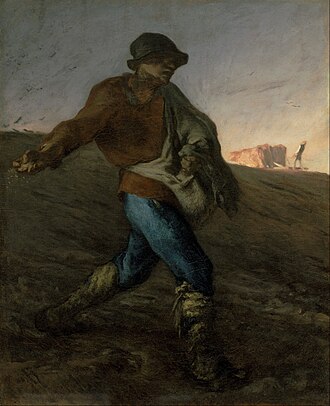 le Semeur - Jean-François Millet (1850)
.jpg) L'Homme à la houe - Jean-François Millet (1860s)
L'Homme à la houe - Jean-François Millet (1860s)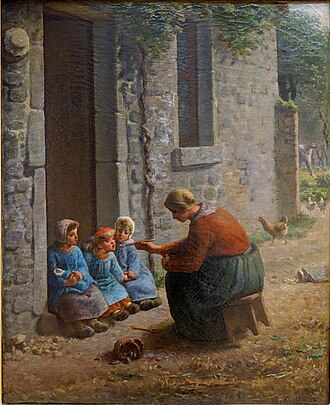 La Becquée - Jean-François Millet (1860)
Œuvres d'artistes liés
 La Nuit étoilée - Vincent van Gogh (1889)
.jpg) Terrasse du café le soir - Vincent van Gogh (1888)
Terrasse du café le soir - Vincent van Gogh (1888)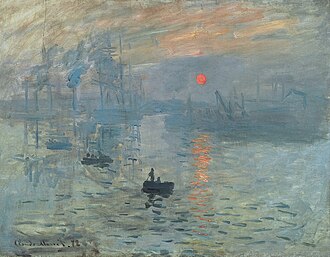 Impression, soleil levant - Claude Monet (1872)
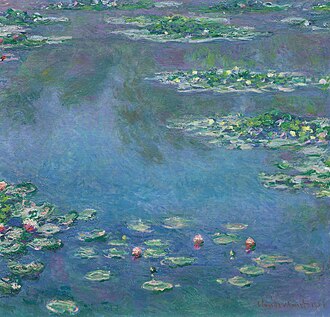 Nymphéas - Claude Monet (1906)