L'Homme à la houe
Jean-François Millet · 1860s
.jpg)
A farm worker leans on his hoe in a field of stones and thistles, too tired to straighten up. Millet called this the cry of the earth. A Paris critic asked if the man had just come from working, or from murdering.
The story behind the painting
Jean-François Millet painted Man with a Hoe, also called The Labourer, between 1860 and 1862; Wikidata simply says the 1860s. It was first shown at the Paris Salon in 1863. It was the last painting of Millet's so called radical period, which began with The Sower in 1850. He set out to make it deliberately rough, sweeping away anything that might please. In his own words, it was the sheer cry of the earth in all its savage reality.
What to look for
A weary worker with blunt features and rustic clothes pauses for a moment while clearing stones and stubborn weeds from a field. He leans on his hoe, mouth open, too tired to stand straight. In the left foreground grow thistles and thorns, said to suggest barrenness, toil, pain and the Passion of Christ. The land around him gives little back. The canvas, about 80 by 99 cm, puts the man and the hard ground on almost equal terms.
Meaning and intent
The first reaction was fury. The critic Paul Saint-Victor wrote that there was no gleam of human intelligence in this animal, and asked whether he came from working or from murdering, probably comparing him to a serial killer of the day. Others saw dignity. In 1867 the American critic Ednah Dow Cheney wrote that it stirs the soul with every great problem of life and thought. In 1908 Gutzon Borglum and Walter Winans called it a man, handicapped, battling with nature for food.
Legacy
After a quiet period, the painting returned in the 1880s, including at the 1889 World's Fair in Paris. In 1891 Ethel Sperry Crocker bought it and took it to the United States, and the Crockers' butler, Mr. Head, saved it from the 1906 San Francisco earthquake and fire that destroyed their home. The Getty Museum bought it from the heirs in 1985. It inspired Edwin Markham's 1898 poem The Man With the Hoe, and Robert Hughes counted Millet's peasants among the most popular images of the age of mass production.
Le saviez-vous ?
- Painted 1860-1862, shown at the Salon of 1863.
- The last painting of Millet's radical period.
- Saved from the 1906 San Francisco fire by a butler.
- In the J. Paul Getty Museum since 1985.
Autres œuvres de Jean-François Millet
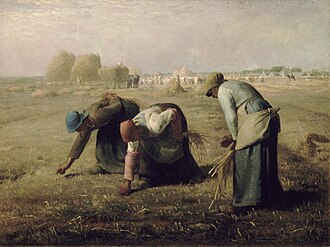 Des glaneuses - Jean-François Millet (1857)
.jpg) L'Angélus - Jean-François Millet (1858)
L'Angélus - Jean-François Millet (1858)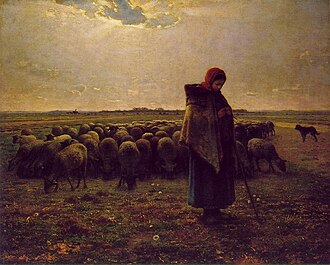 Bergère avec son troupeau - Jean-François Millet (1863)
.jpg) Un vanneur - Jean-François Millet (1848)
Un vanneur - Jean-François Millet (1848)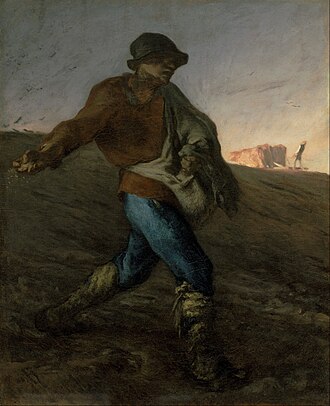 le Semeur - Jean-François Millet (1850)
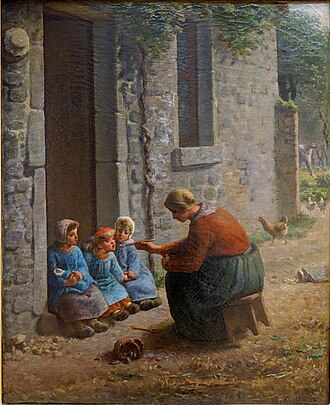 La Becquée - Jean-François Millet (1860)
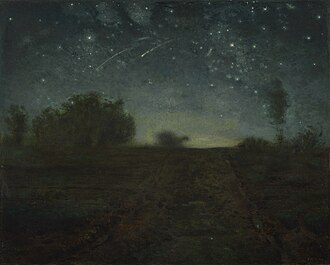 Nuit étoilée - Jean-François Millet (1850s)
Œuvres d'artistes liés
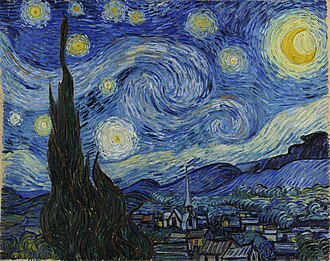 La Nuit étoilée - Vincent van Gogh (1889)
.jpg) Terrasse du café le soir - Vincent van Gogh (1888)
Terrasse du café le soir - Vincent van Gogh (1888)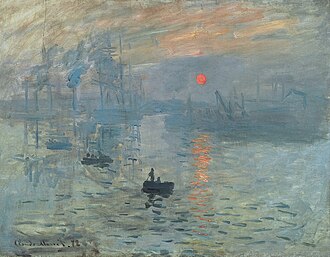 Impression, soleil levant - Claude Monet (1872)
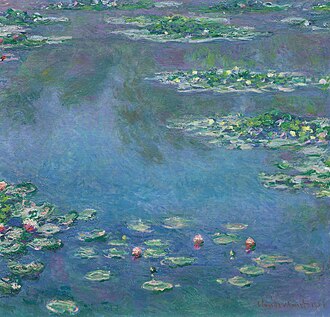 Nymphéas - Claude Monet (1906)