Sainte Rufine
Diego Velázquez · 1620s
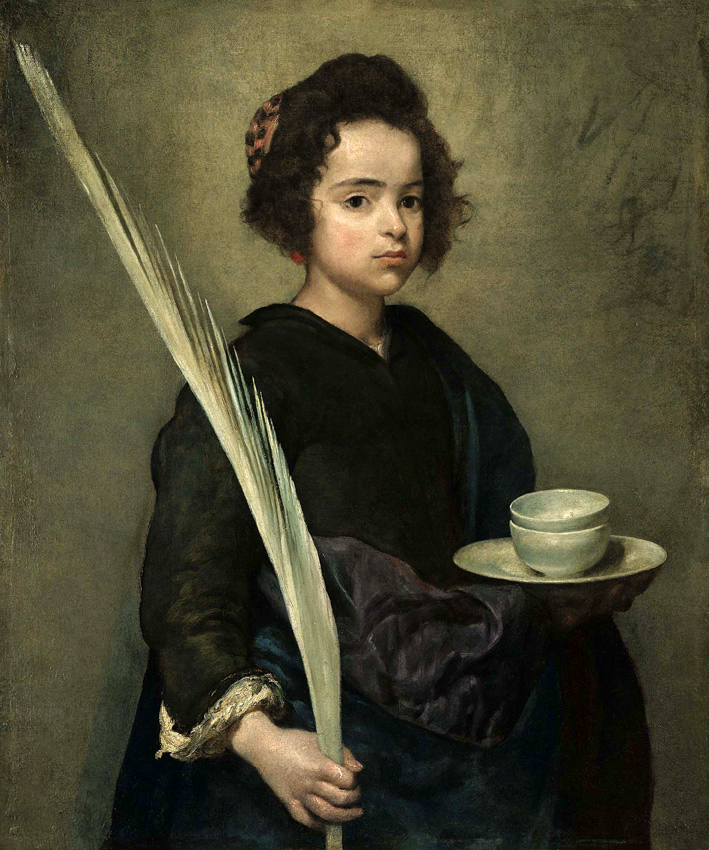
A young girl holds a palm branch in one hand and two small cups on a saucer in the other. She is Saint Rufina, patron of Seville, and after passing through centuries under other names and other painters, she is now shown again as a Velázquez.
The story behind the painting
Rufina and her sister Justa are the patron saints of Seville. Velázquez probably used one of his own daughters, Francisca or Ignacia, then aged 12 or 14, as the model. The date is debated. Pérez-Sánchez first placed it around 1629, comparing it to a portrait of Queen Mariana of Austria, then after a full cleaning moved it to 1623, close to The Imposition of the Chasuble on Saint Ildefonso. The Velázquez Center in Seville sees a technique from his transition between Seville and his first contact with the royal collections in Madrid, before his first trip to Italy, so before 1630. Wikidata simply says the 1620s.
What to look for
The half-length saint holds a large palm branch, described in an old inventory as a feather, in her right hand, and two cups resting on a saucer in her left. The canvas measures 79 by 64 cm. The precise preparatory drawing and the dense paint on the palm recall the still lifes Velázquez painted in Seville, as Jonathan Brown has noted, and the child model links the picture to the Ildefonso canvas made in 1622 to 1623. During cleaning, marks where the painter wiped his brushes were found along the right edge, a habit of his, since he knew he would cover those zones later. The paint is very thin here, which made this visible.
Meaning and intent
The attribution has been argued over. Peter Cherry has defended it since the canvas was auctioned at Christie's in 1999, and Pérez-Sánchez agreed. Jonathan Brown, however, judged it a mediocre work that cannot be given to Velázquez, perhaps instead to Mazo. Scientific analysis at the Prado by Peter Cherry and Carmen Garrido then fully supported Velázquez as the author. The saint's identity also drifted: across its history the same girl was recorded as Saint Justa and even as Saint Clare, a reminder of how easily the meaning of a painting slips once its story is forgotten.
Legacy
In 1802 the picture appeared in a Carpio inventory, during the succession of the Duke of Alba, as an original Velázquez showing Saint Rufina with a feather and cups. It later belonged to Sebastián Martínez, a friend of Goya, as Saint Justa, passed to Fernando Casado de Torres and in 1844 to Celestino García Fernández, then to the Marquis of Salamanca, who sold it in Paris in 1867 as Saint Clare. Its owner Cooke kept it as a Murillo, and it travelled through New York, Buenos Aires and Brazil before resurfacing in 1999. Sold again in 2007, it now belongs to the Focus-Abengoa Foundation, bought with support from the city of Seville, and is shown in Seville.
Le saviez-vous ?
- Shows Saint Rufina, a patron saint of Seville, holding a palm branch and cups.
- Dated between about 1623 and 1629, in any case before 1630.
- Long recorded as Saint Justa, Saint Clare, and a Murillo.
- Now in the Focus-Abengoa Foundation collection in Seville.
À propos de l'artiste
Diego Velázquez (1599-1660)
Autres œuvres de Diego Velázquez
 Les Ménines - Diego Velázquez (1656)
 La Reddition de Bréda - Diego Velázquez (1635)
 Vénus à son miroir - Diego Velázquez (1644)
 Les Fileuses - Diego Velázquez
 Innocent X - Diego Velázquez
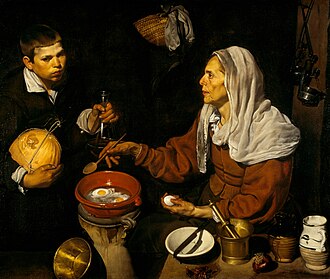 Vieille faisant frire des œufs - Diego Velázquez (1618)
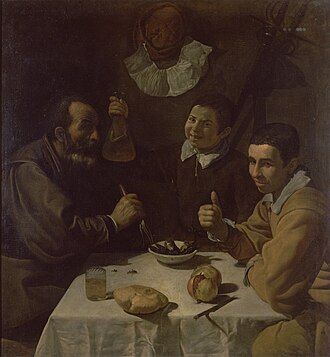 Trois hommes à table, le déjeuner - Diego Velázquez (1617)
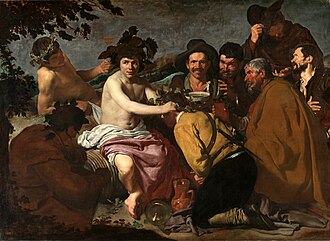 Le Triomphe de Bacchus - Diego Velázquez (1628)
Œuvres d'artistes liés
 Le Souper à Emmaüs - Caravaggio (1601)
 La Vocation de saint Matthieu - Caravaggio (1609)
 Saint Francis in Meditation - Francisco de Zurbarán (1639)
 The Immaculate Conception - Francisco de Zurbarán (1661)
 Triple portrait de Charles Ier - Anthony van Dyck (1635)
 Charles Ier à cheval avec Monsieur de Saint Antoine - Anthony van Dyck (1636)
 L'Érection de la croix - Peter Paul Rubens (1609)
 L'Enlèvement des filles de Leucippe - Peter Paul Rubens (1618)
 La Ronde de nuit - Rembrandt van Rijn (1642)
 Autoportrait - Rembrandt van Rijn (1659)
 Le Joyeux Buveur - Frans Hals (1620s)
 Le Cavalier riant - Frans Hals (1624)