Saint-Maurice
Lucas Cranach l'Ancien · 1520s
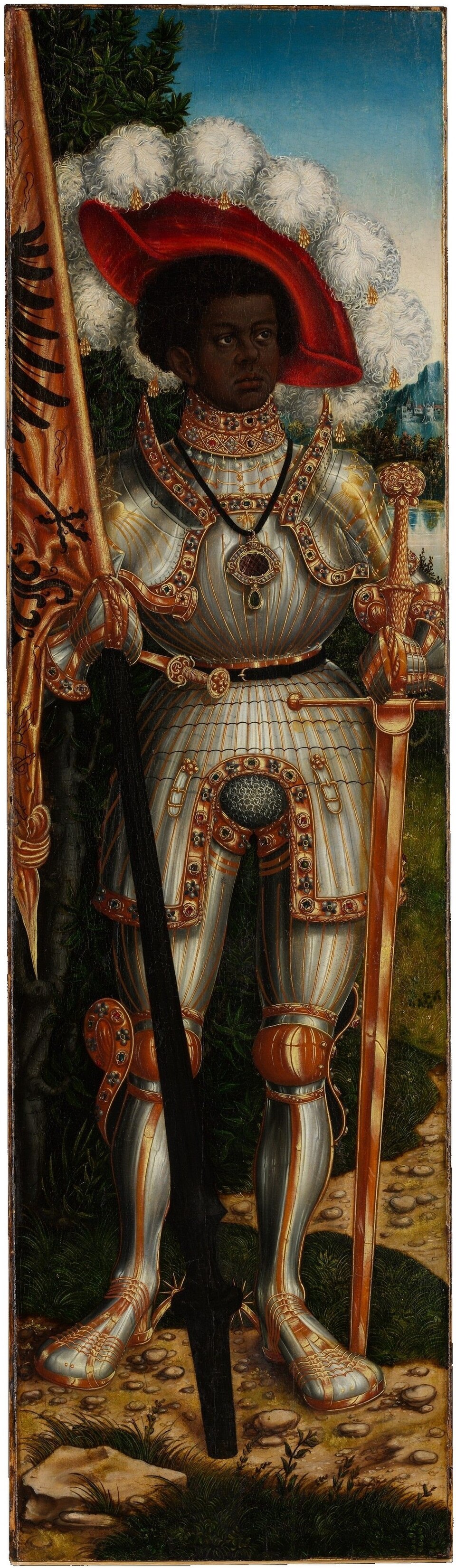
A Black knight in gem-studded armour stands with a golden sword and a red ostrich-feather cap. Cranach and his workshop painted this Saint Maurice for a church in Halle, modelling the armour on a reliquary that has since vanished.
The story behind the painting
Cardinal Albrecht of Brandenburg commissioned the painting as the inner left wing of a larger altarpiece for the Marktkirche in Halle, part of a group of altarpieces for that church. Saint Maurice was its patron saint. It is not known whether the panel was ready for the church's dedication in 1523, but church inventory records show it installed by October 1525. In the full altarpiece it stood to the left of a Madonna and a donor portrait of Albrecht himself. Wikidata dates it to the 1520s and lists both Ambras Castle and the Metropolitan Museum of Art.
What to look for
Maurice wears a full suit of highly adorned plate armour, gold laced into the metal and set with jewels, with a golden sword, a dagger and a banner bearing an eagle. A red ostrich-feather cap crowns his head and a pendant hangs on his chest. Gilt badges on the breastplate and shoulders carry the Order of the Golden Fleece, the insignia of Charles V. Behind him are a forest, a castle and sky. The armour copies a reliquary in the church: a wax figure in armour holding a relic of the saint. One theory holds that it was a suit Charles V wore at his coronation.
Meaning and intent
Maurice commanded the Theban Legion, an Egyptian unit of Roman soldiers, and was martyred with his men in the late third century, in what is now Switzerland, for refusing to persecute other Christians. Showing him with dark skin began in the mid-13th century, first in Magdeburg, and Cranach continued the tradition. The source suggests reasons: his name resembled the word moor, a local belief linked dark complexion with Egypt, and above all dark-skinned figures stood for universal sovereignty in Hohenstaufen imperial imagery. Halle claimed his relics, and Albrecht led a surge of new images of him.
Legacy
The Metropolitan Museum received and restored the painting in 2005. Grime and discoloured varnish had hidden the damage. George Bisacca and Michael Alan Miller treated the linden panel, and Michael Gallagher did the cleaning. Infrared reflectography showed that Cranach drew the underdrawing himself, including freely drawn ostrich feathers, while the armour was painted by his workshop. The Golden Fleece badges, most jewels and the sword grip were added during painting, beyond the plan, which is uncommon for the period. Neither the relic nor the reliquary survive, so the painting preserves their memory.
Le saviez-vous ?
- Made for the Marktkirche in Halle; installed by October 1525.
- Commissioned by Cardinal Albrecht of Brandenburg.
- Underdrawing by Cranach, armour painted by his workshop.
- Restored at the Metropolitan Museum of Art in 2005.
À propos de l'artiste
Lucas Cranach l'Ancien (1472-1553)
art religieux · homme · Metropolitan Museum of Art · épée · saint ou sainte · blindage
Autres œuvres de Lucas Cranach l'Ancien
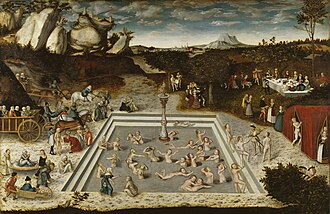 Fontaine de jouvence - Lucas Cranach the Elder (1546)
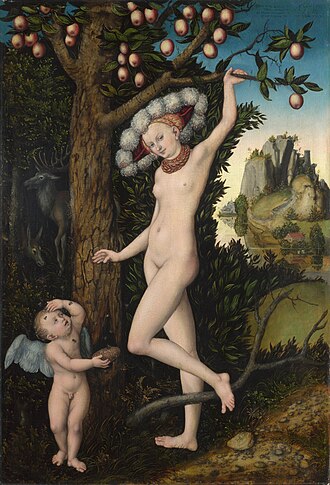 Vénus avec Cupidon le voleur de miel - Lucas Cranach the Elder (1520s)
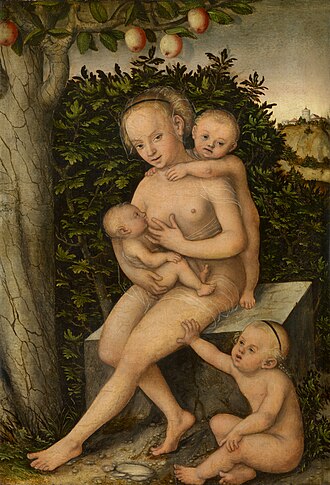 Charité - Lucas Cranach the Elder (1540)
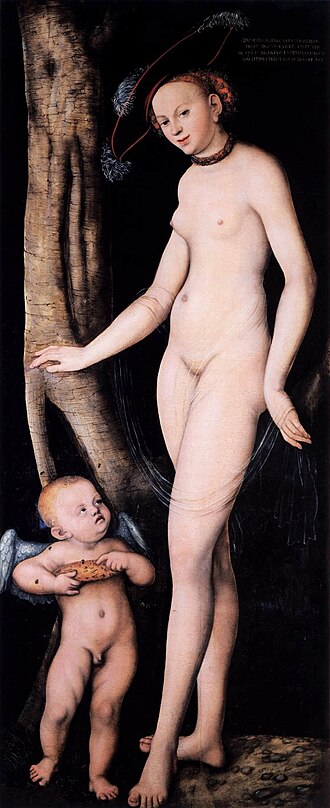 Vénus avec Cupidon voleur de miel - Lucas Cranach the Elder (1531)
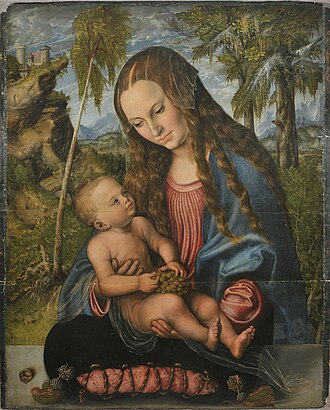 Madonna sous le sapin. - Lucas Cranach the Elder
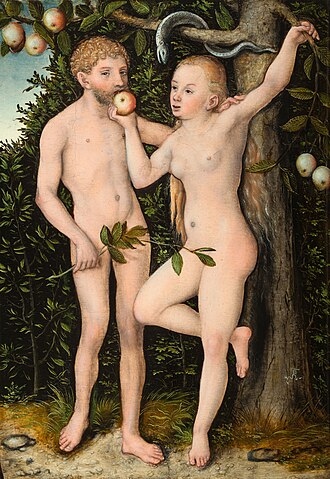 Adam et Eve - Lucas Cranach the Elder (1538)
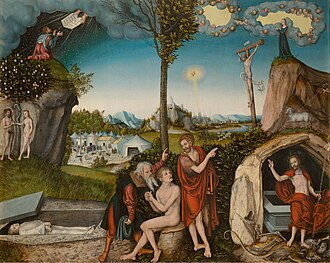 Loi et Évangile - Lucas Cranach the Elder (1529)
 Jean V d'Anhalt-Dessau - Lucas Cranach the Elder (1520)
Œuvres d'artistes liés
 Autoportrait - Albrecht Dürer (1500)
 Adoration des mages - Albrecht Dürer (1504)