Lucas Cranach l'Ancien
1472-1553
Lucas Cranach the Elder served the Electors of Saxony for nearly half a century, painted Martin Luther again and again, and filled narrow panels with slender Venuses and Eves. Thanks largely to him we know what the men of the Reformation looked like.
Origins
Cranach was born at Kronach in Upper Franconia, probably in 1472; his exact birth date is unknown. He learned drawing from his father, Hans Maler, whose surname simply meant 'painter' and described his trade. His mother, born Hübner, died in 1491. Following a custom of the time, Lucas later took a form of his town's name as his own surname. Where he trained is not known, though it was probably with local south German masters, as with his contemporary Matthias Grünewald. There are suggestions that he spent some time in Vienna around 1500. According to Gunderam, later the tutor of his children, Cranach had already shown his gifts as a painter before the end of the 15th century, and his work caught the attention of Frederick the Wise, Elector of Saxony.
Life and turning points
In 1504 Frederick attached Cranach to his court at Wittenberg as the duke's painter, and he served the Electors and their successors for the rest of his life. He painted altarpieces for the Castle Church in competition with Albrecht Dürer and others, decorated palaces, designed coins and produced woodcuts and engravings. In 1509 he travelled to the Netherlands and painted the Emperor Maximilian and the boy who became Charles V. He married Barbara Brengbier of Gotha; they had two sons, both painters, and three daughters. He grew prosperous, holding the monopoly on medicines in Wittenberg and a printing privilege for Bibles, and twice served as burgomaster. In 1547 Elector John Frederick was captured at Mühlberg; Cranach later joined him in captivity at Augsburg and returned home with him in 1552. He died at Weimar on 16 October 1553, aged about 81.
Style and technique
Portraits make up the largest share of Cranach's work: German princes, Reformers and leading Catholics alike. He ran a large workshop, and once was paid in a single day for sixty pairs of portraits of the Elector and his brother, so quality varies. Wikipedia suggests that his constant attention to contour as an engraver shaped his painting, and that he often outlined shapes in black rather than modelling with light and shade. His religious pictures follow the Reformation, from early Madonnas to images showing salvation by faith, Lutheran altarpieces in which the apostles are portraits of Reformers, and cruder anti-papal prints. His mythological scenes nearly always feature a slim nude woman, bare but for a transparent veil or a large hat. Early ones show Italian influence; later ones revive a Late Gothic look, with small heads, narrow shoulders and high waists, in tall narrow formats.
Stories and anecdotes
Early in his service Cranach startled courtiers with painted game and antlers so real on palace walls that the duke took him hunting to sketch the chase. In 1508 the Elector gave him a winged snake as his emblem, which replaced his initials as his signature. He was a close friend of Martin Luther, who in a letter of 1521 called him his 'gossip'; Cranach witnessed Luther's betrothal to Katharina von Bora and was godfather to their first child. When Wittenberg was besieged in 1547, Charles V remembered Cranach from childhood and summoned him, and the painter knelt to beg mercy for his captive prince. A lost canvas of 1545 was said to show hares catching and roasting hunters. His final altarpiece at Weimar, finished by his son, shows the blood of Christ falling on Cranach's own head.
Legacy
Cranach is often considered the most successful German artist of his time, and eleven of his portraits of Luther survive. His son Lucas Cranach the Younger and the workshop went on making versions of his compositions for decades after his death, and he and his workshop painted more than sixty versions of the Roman heroine Lucretia alone. Through his daughter Barbara he was an ancestor of Johann Wolfgang von Goethe. The Lutheran Church remembers him on 6 April, together with Dürer. His paintings were prized and looted under the Nazis, and several have since been the subject of long restitution cases. His Wittenberg apothecary stayed open for centuries until a fire in 1871. In his crisp lines and pale, elegant figures, the age of the Reformation still looks back at us.
Le saviez-vous ?
- Cranach's oldest surviving picture is the Rest on the Flight into Egypt of 1504.
- He was court painter to the Electors of Saxony from 1505 to 1550.
- He provided woodcut illustrations for Luther's German translation of the Bible.
- The house where he lived in Weimar still stands on the marketplace.
Artistes liés
Œuvres de Lucas Cranach l'Ancien
.jpg) Fontaine de jouvence - Lucas Cranach the Elder (1546)
Fontaine de jouvence - Lucas Cranach the Elder (1546)%20-%20Venus%20and%20Cupid%20(National%20Gallery%2C%20London).jpg) Vénus avec Cupidon le voleur de miel - Lucas Cranach the Elder (1520s)
Vénus avec Cupidon le voleur de miel - Lucas Cranach the Elder (1520s).jpg) Charité - Lucas Cranach the Elder (1540)
Charité - Lucas Cranach the Elder (1540)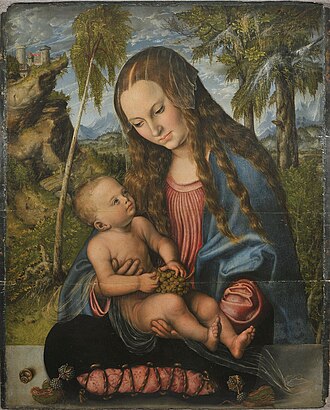 Madonna sous le sapin. - Lucas Cranach the Elder
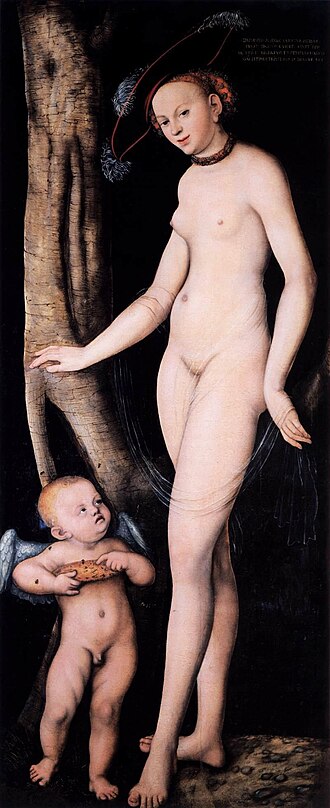 Vénus avec Cupidon voleur de miel - Lucas Cranach the Elder (1531)
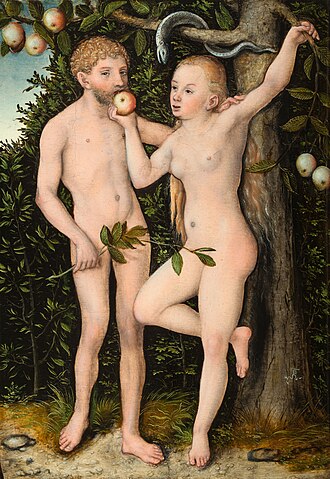 Adam et Eve - Lucas Cranach the Elder (1538)
.jpg) Loi et Évangile - Lucas Cranach the Elder (1529)
Loi et Évangile - Lucas Cranach the Elder (1529)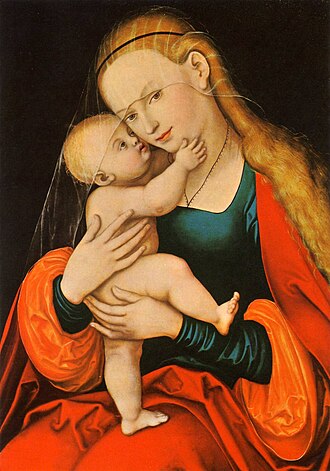 Vierge du Bon-Secours - Lucas Cranach the Elder (1517)
.jpg) Jean V d'Anhalt-Dessau - Lucas Cranach the Elder (1520)
Jean V d'Anhalt-Dessau - Lucas Cranach the Elder (1520).jpg) The Procuress - Lucas Cranach the Elder (1548)
The Procuress - Lucas Cranach the Elder (1548)