Saint Antoine Abbé et saint Paul, premier ermite
Diego Velázquez · 1634
.jpg)
Two old hermits sit in a wild landscape as a raven flies down with a whole loaf of bread. Around them, Velázquez quietly tells the rest of their story, from the first search to the last farewell, all in one canvas.
The story behind the painting
Diego Velázquez painted this oil on canvas in 1634. It was commissioned to decorate the hermitage of Saint Paul in the gardens of the Buen Retiro in Madrid, and it is one of the few religious works by the painter from Seville. The subject comes from the Golden Legend of Jacobus de Voragine, who drew on an account by Jerome. According to the legend, Anthony, living as a hermit in the desert, learned in a dream that another man had chosen this life before him, and was commanded to go and find him.
What to look for
The canvas does not show one instant but gathers several moments of the legend in the same landscape, regardless of their order in time. In the left background are the centaur and the faun who guided Anthony on his search. On the right, in the middle ground, Paul at first refuses to open his door to Anthony. At the centre, the two hermits talk after giving thanks to God as a raven arrives with a whole loaf, twice what it usually brought Paul each day. On the left, Anthony prays beside Paul's body while two lions dig the grave.
Meaning and intent
Reading the picture is like following a path: the eye moves from the guides, to the closed door, to the shared meal, and finally to death and burial. The legend tells that after the meal Anthony set off home, but saw angels carrying Paul's soul, turned back, and found him dead, still kneeling in prayer. Having nothing to dig with, he was helped by two lions. The doubled bread at the centre makes the meeting of two solitary men the heart of the picture, the moment the legend marks with a double gift.
Legacy
The painting has been in the Museo del Prado in Madrid since the museum opened in 1819. It measures 261 by 192.5 cm according to Wikidata, a large size for such a quiet subject. Within Velázquez's work, which includes relatively few religious pictures, it stands out for its wide landscape and its storytelling, with several episodes of the legend set across one scene. The French Wikipedia article draws on the Prado's 1990 Velázquez exhibition catalogue and the museum's guide, and lists the work among the paintings of the Prado.
Le saviez-vous ?
- Painted in 1634 for a hermitage in the Buen Retiro gardens.
- Combines several episodes of the legend in one landscape.
- Based on the Golden Legend, after an account by Jerome.
- In the Prado since the museum opened in 1819.
À propos de l'artiste
Diego Velázquez (1599-1660)
art religieux · musée du Prado · Antoine le Grand
Autres œuvres de Diego Velázquez
 Les Ménines - Diego Velázquez (1656)
 La Reddition de Bréda - Diego Velázquez (1635)
 Vénus à son miroir - Diego Velázquez (1644)
 Les Fileuses - Diego Velázquez
.jpg) Innocent X - Diego Velázquez
Innocent X - Diego Velázquez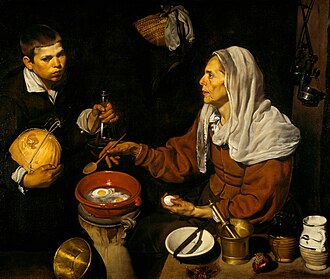 Vieille faisant frire des œufs - Diego Velázquez (1618)
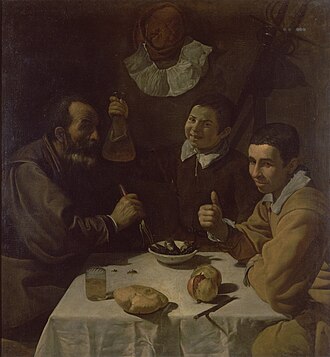 Trois hommes à table, le déjeuner - Diego Velázquez (1617)
.jpg) Le Triomphe de Bacchus - Diego Velázquez (1628)
Le Triomphe de Bacchus - Diego Velázquez (1628)
Œuvres d'artistes liés
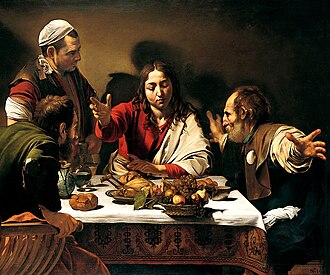 Le Souper à Emmaüs - Caravaggio (1601)
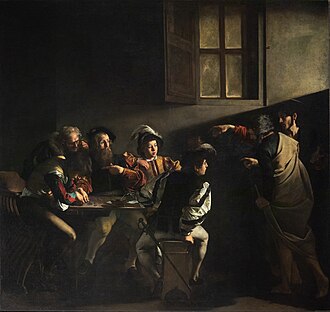 La Vocation de saint Matthieu - Caravaggio (1609)
.jpg) L'Érection de la croix - Peter Paul Rubens (1609)
L'Érection de la croix - Peter Paul Rubens (1609) L'Enlèvement des filles de Leucippe - Peter Paul Rubens (1618)
%20-%20Google%20Art%20Project.jpg) Triple portrait de Charles Ier - Anthony van Dyck (1635)
Triple portrait de Charles Ier - Anthony van Dyck (1635)%20with%20M.%20de%20St%20Antoine%20-%20Google%20Art%20Project.jpg) Charles Ier à cheval avec Monsieur de Saint Antoine - Anthony van Dyck (1636)
Charles Ier à cheval avec Monsieur de Saint Antoine - Anthony van Dyck (1636) La Ronde de nuit - Rembrandt van Rijn (1642)
 Autoportrait - Rembrandt van Rijn (1659)
 La Jeune Fille à la perle - Johannes Vermeer (1665)
 La Laitière - Johannes Vermeer (c. 1658)