Bergère nue couchée
Berthe Morisot · 1891
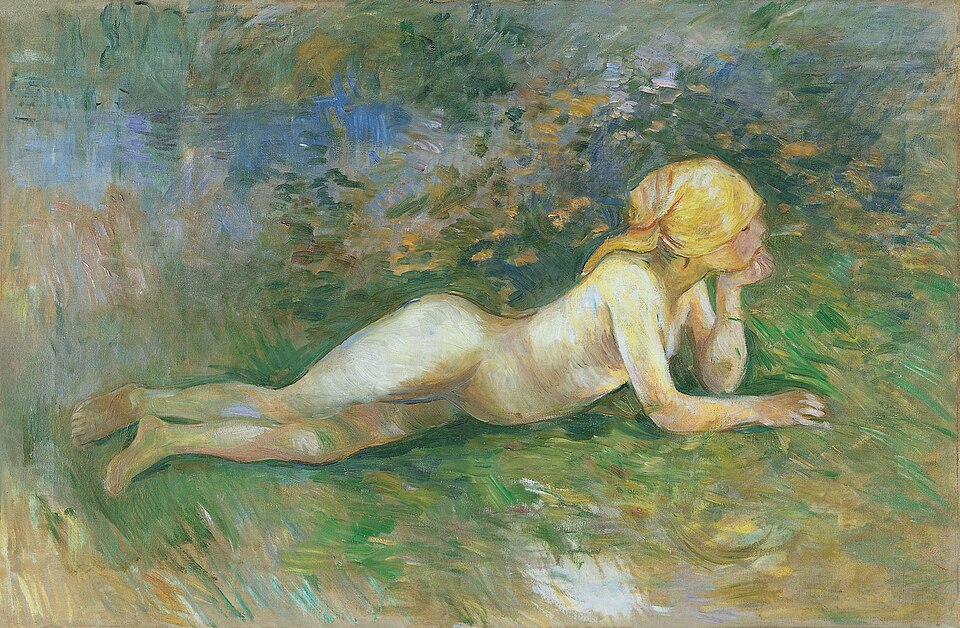
A young woman from a Seine village lies in the grass by the water, eyes closed, her hair hidden under a yellow scarf. It is one of the rare nudes by Berthe Morisot, painted in her happiest working summer.
The story behind the painting
In the warm months of 1890 and 1891 Morisot lived with her family in a summer house at Mézy-sur-Seine, with an orchard and a terrace overlooking the Seine valley. She had to look after the education of her daughter Julie and care for her sick husband, Eugène Manet, brother of Édouard Manet, yet this became the best period of her artistic development. For the first time in her life she had a studio of her own. She drew several village children, and painted a young female body lying in the grass with a goat beside it.
What to look for
The model, a young girl named Gabrièlle Dufous, agreed to pose for several works but asked to hide her hair in this nude, hence the yellow silk scarf. Her face is in profile: small nose, full cheeks, red lips, and closed eyes. Look at the lashes: apart from a few touches on the far bank, they are the only places where Morisot used pure black. The grass flattened by the body is painted in long strokes of green, ochre and brown, almost white in a patch of sun, while flowers and leaves along her back and head are short, contrasting dabs.
Meaning and intent
Unlike her male colleagues, Morisot rarely painted the nude, and when she did it was without voyeurism and without reducing the woman to an object, in line with Baudelaire's view that nudes should be shown realistically. Here the girl loses the specific role of shepherdess or goatherd; the subject is simply the human body, naked in nature, relaxed, chin on her left hand, which recalls her teacher Corot. Strong contour drawing suggests she was thinking of Renoir's nudes. Renoir visited her at Mézy in 1890 and 1891, yet in these years she found her own style.
Legacy
Several drawings of Gabrièlle Dufous survive, some in red chalk. Two show her in the same reclining pose: one clothed, as a shepherdess with a grazing goat, and one as a direct study for this nude. The oil on canvas, 57.5 by 86.4 cm, stayed in the artist's family until 1997, when it was auctioned at the Hôtel Drouot in Paris from the estate of Thérèse Rouart, widow of Morisot's last grandson, and acquired by the Carmen Thyssen-Bornemisza collection. It was exhibited in Washington, Fort Worth and South Hadley in 1987 and 1988, and is now on loan to the Museo Thyssen-Bornemisza in Madrid.
Le saviez-vous ?
- Painted in 1891 at Mézy-sur-Seine.
- The model was Gabrièlle Dufous, who asked to cover her hair.
- The eyelashes are almost the only pure black in the picture.
- On loan from the Carmen Thyssen collection to the Museo Thyssen-Bornemisza.
À propos de l'artiste
Berthe Morisot (1841-1895)
Autres œuvres de Berthe Morisot
 Le Berceau - Berthe Morisot (1872)
 Jour d'été - Berthe Morisot (1879)
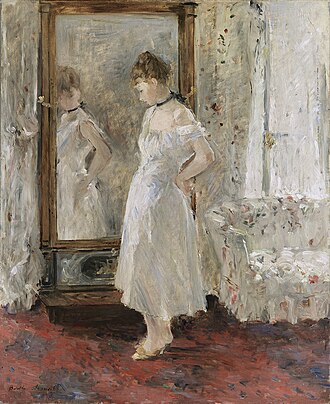 La Psyché - Berthe Morisot (1876)
 Vue du petit port de Lorient - Berthe Morisot (1869)
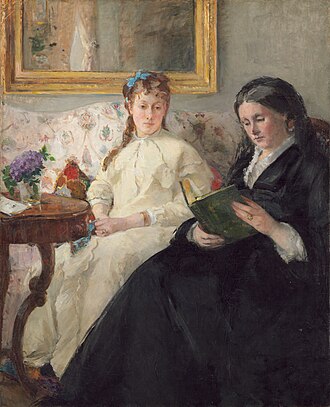 La Mère et la Sœur de l'artiste - Berthe Morisot
 Eugène Manet à l'île de Wight - Berthe Morisot (1875)
 Jeune Fille dans un parc - Berthe Morisot (1893)
 Dans la salle à manger - Berthe Morisot (1886)
Œuvres d'artistes liés
 Impression, soleil levant - Claude Monet (1872)
 Nymphéas - Claude Monet (1906)
 Le Déjeuner sur l'herbe - Édouard Manet (1863)
 Olympia - Édouard Manet (1863)
 Bal du moulin de la Galette - Pierre-Auguste Renoir (1876)
 Le Déjeuner des canotiers - Pierre-Auguste Renoir (1881)
 L'Absinthe - Edgar Degas (1875)
 La Famille Bellelli - Edgar Degas (1858)
 Le Canal du Loing - Alfred Sisley (1892)
 L'Abreuvoir à Marly-Le-Roi, gelée blanche - Alfred Sisley (1876)
 Rue de Paris, temps de pluie - Gustave Caillebotte (1877)
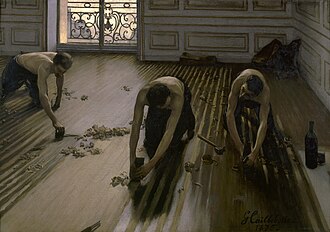 Les Raboteurs de parquet - Gustave Caillebotte (1875)