El bufón el Primo
Diego Velázquez · 1644
.jpg)
A small man sits on the ground and looks straight at us, fists closed, unmoving. Velazquez painted a court jester with the same seriousness he gave a king, and the gaze still feels like a question.
The story behind the painting
Little is documented about Sebastian de Morra. King Philip IV acquired him in 1643 from his younger brother, the Cardinal-Infante Fernando, and gave him to Prince Baltasar Carlos, whom he was to entertain with humour until the prince died in 1646. De Morra died in October 1649 after six years at court. The Thread Count Automation Project found that his portrait and Philip IV's portrait in Fraga were painted on canvas cut from the same piece of cloth, which places this painting in Fraga too, around 1644, during the royal campaign there.
What to look for
De Morra faces us straight on, against a plain dark background with no objects. The right side of his face is in shadow because of the tilt of his head and the light from the left, and that light grounds him, so he does not seem to float in the dark. White lace collar and cuffs draw our eyes to his face and hands; a red and gold trimmed cape leads up to his face, and recalls the military coat Philip IV wears. His hands rest at his sides, painted without visible fingers. Marks on the canvas show it was first meant to be oval.
Meaning and intent
Spanish court painters before Velazquez had shown dwarfs coldly, as property, often with a master's hand on their head or holding animals. Velazquez painted them with warmth and naturalism, with a humanity that sometimes surpasses other courtiers. Because De Morra stares at the viewer without moving or gesturing, one critic reads the painting as a denunciation of how the court treated him and other dwarfs. The source is careful, though: the painter's own opinions are never stated in any document, and his sympathy is inferred from the pictures.
Legacy
The portrait survived the 1734 fire that destroyed the Real Alcazar in Madrid, which may explain the irregularly cut canvas and the scorched look of the wall. It is now in the Prado, among at least ten dwarf portraits by Velazquez. Its identity is disputed: a palace bill names a dwarf painted at Fraga El Primo, and inventories of the Marquess of Carpio from 1689 and 1692 call this very painting El Primo, while since 1872 that nickname had been attached to Diego de Acedo, a palace official rather than a jester. The question remains open.
Le saviez-vous ?
- Painted around 1644, probably in Fraga.
- Sebastian de Morra served at Philip IV's court from 1643 until 1649.
- Survived the 1734 fire at the Royal Alcazar of Madrid.
- Whether he or Diego de Acedo was called El Primo is disputed.
À propos de l'artiste
Diego Velázquez (1599-1660)
portrait · musée du Prado · bouffon
Autres œuvres de Diego Velázquez
 Les Ménines - Diego Velázquez (1656)
 La Reddition de Bréda - Diego Velázquez (1635)
 Vénus à son miroir - Diego Velázquez (1644)
 Les Fileuses - Diego Velázquez
.jpg) Innocent X - Diego Velázquez
Innocent X - Diego Velázquez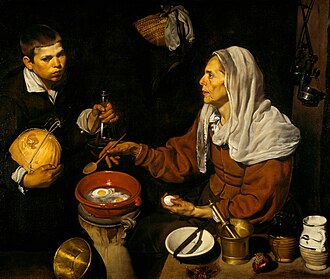 Vieille faisant frire des œufs - Diego Velázquez (1618)
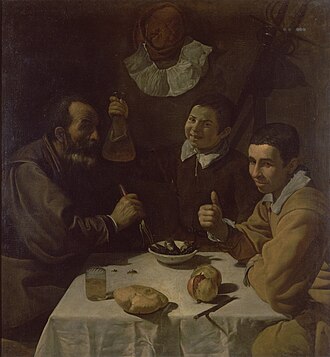 Trois hommes à table, le déjeuner - Diego Velázquez (1617)
.jpg) Le Triomphe de Bacchus - Diego Velázquez (1628)
Le Triomphe de Bacchus - Diego Velázquez (1628)
Œuvres d'artistes liés
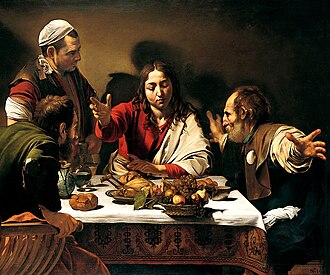 Le Souper à Emmaüs - Caravaggio (1601)
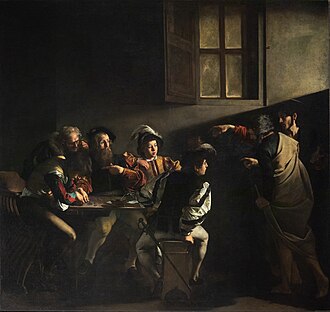 La Vocation de saint Matthieu - Caravaggio (1609)
.jpg) L'Érection de la croix - Peter Paul Rubens (1609)
L'Érection de la croix - Peter Paul Rubens (1609) L'Enlèvement des filles de Leucippe - Peter Paul Rubens (1618)
%20-%20Google%20Art%20Project.jpg) Triple portrait de Charles Ier - Anthony van Dyck (1635)
Triple portrait de Charles Ier - Anthony van Dyck (1635)%20with%20M.%20de%20St%20Antoine%20-%20Google%20Art%20Project.jpg) Charles Ier à cheval avec Monsieur de Saint Antoine - Anthony van Dyck (1636)
Charles Ier à cheval avec Monsieur de Saint Antoine - Anthony van Dyck (1636) La Ronde de nuit - Rembrandt van Rijn (1642)
 Autoportrait - Rembrandt van Rijn (1659)
 La Jeune Fille à la perle - Johannes Vermeer (1665)
 La Laitière - Johannes Vermeer (c. 1658)
 Le Joyeux Buveur - Frans Hals (1620s)
 Le Cavalier riant - Frans Hals (1624)