Pablo de Valladolid
Diego Velázquez · 1632
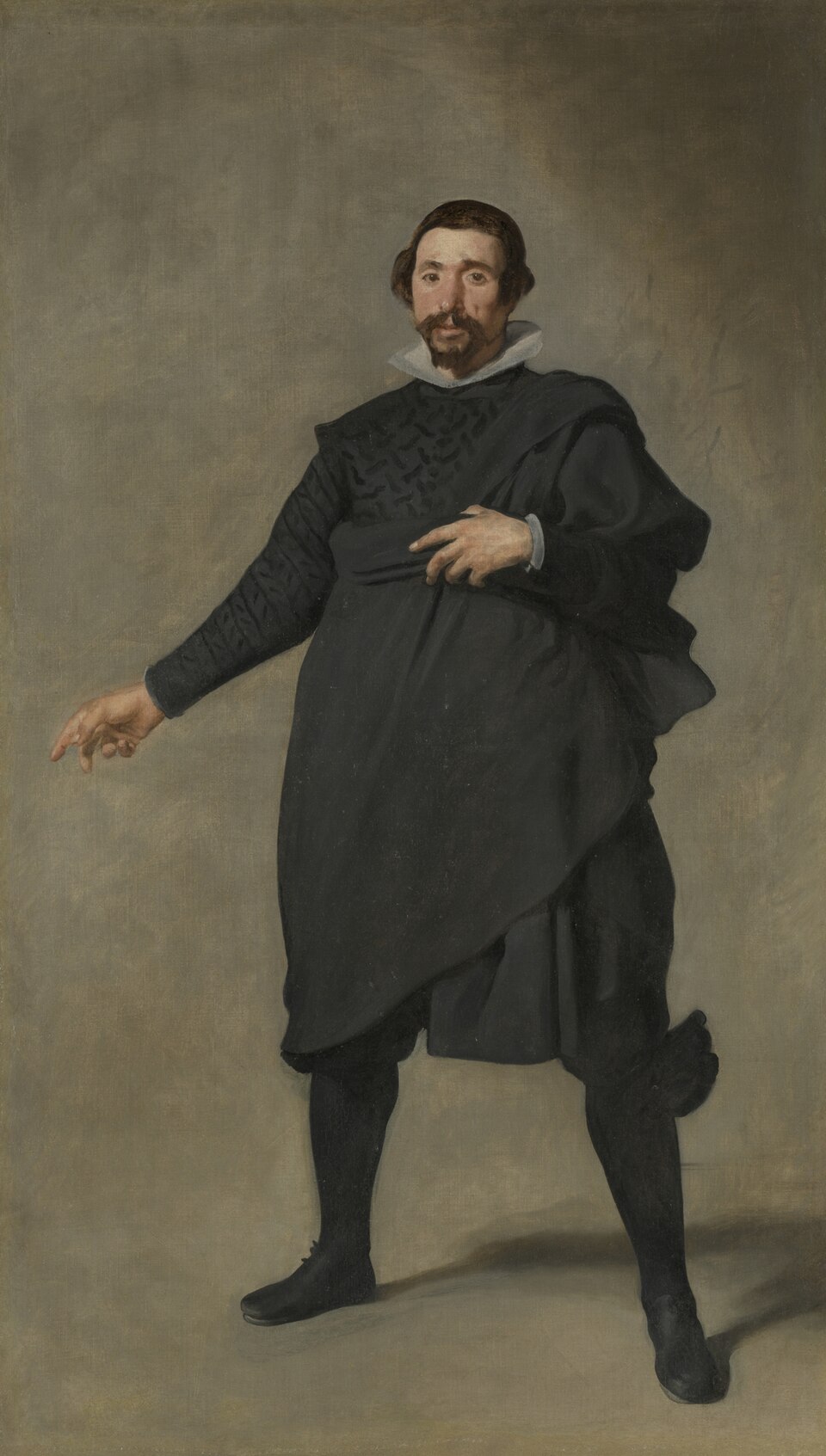
A man in black stands on nothing at all. There is no floor, no wall, only air and a shadow at his feet. Manet called it perhaps the most astonishing piece of painting ever made.
The story behind the painting
Pablo, or Pablillos, de Valladolid (1587 to 1648) was a jester and actor at the court of Philip IV from 1632 until his death. Velazquez painted a group of portraits of jesters and court entertainers to decorate secondary rooms and passageways of the royal palaces. In those less formal places he could try new means of expression more freely than in official portraits of the royal family, which had to show their sitters in the best light. Wikipedia dates this portrait around 1635, while Wikidata gives 1632, the year Pablo entered court service.
What to look for
Pablo stands full-length, legs spread wide, dressed entirely in black. With his left hand he gathers his cape against his chest, and his right arm stretches out in a declamatory gesture, as if on stage. The silhouette is sharply drawn against a neutral background, and nothing marks where his feet stand except the shadow he casts; Velazquez even left out the faint line between floor and wall that he used in the portrait of the infante Don Carlos. Look at the outline: his corrections are visible to the naked eye, above all in the left leg, which was first painted longer.
Meaning and intent
Painting a figure with no setting is the feature most often praised in this work. Julian Gallego called it revolutionary, because it shows a jester with means more typical of a heavenly vision, like a saint floating on a gold ground. The background colour is debated. Lopez-Rey wrote that it was once a luminous grey turned to an abominable ochre by varnish and neglect, while a technical study signed by Carmen Garrido found that brown is the original colour, made from black iron oxides, white lead, calcite, vermilion and much binder, though varnish and dirt have distorted the surface.
Legacy
Inventories trace the painting through the Buen Retiro Palace in 1701, where it was named as a jester with ruff called Pablillo, and the Royal Palace of Madrid in 1772 and 1794, when his name had dropped away. In 1816 it went to the Academia de San Fernando as Portrait of a mayor, and in 1827 to the Prado, catalogued in 1828 as Unknown Portrait. In 1865 Edouard Manet saw it in Spain and wrote to Fantin-Latour that the background disappears and the man, all in black and full of life, is surrounded by air.
Le saviez-vous ?
- Pablo de Valladolid was a jester and actor at Philip IV's court from 1632.
- There is no painted setting: only a shadow anchors the figure.
- In the Prado since 1827.
- Manet praised it in an 1865 letter to Fantin-Latour.
À propos de l'artiste
Diego Velázquez (1599-1660)
portrait · homme · musée du Prado
Autres œuvres de Diego Velázquez
 Les Ménines - Diego Velázquez (1656)
 La Reddition de Bréda - Diego Velázquez (1635)
 Vénus à son miroir - Diego Velázquez (1644)
 Les Fileuses - Diego Velázquez
 Innocent X - Diego Velázquez
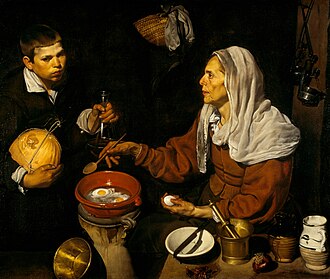 Vieille faisant frire des œufs - Diego Velázquez (1618)
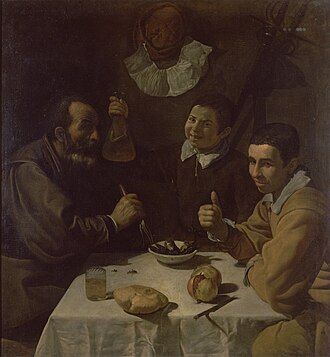 Trois hommes à table, le déjeuner - Diego Velázquez (1617)
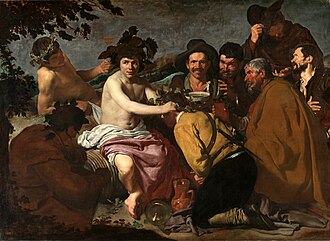 Le Triomphe de Bacchus - Diego Velázquez (1628)
Œuvres d'artistes liés
 Le Souper à Emmaüs - Caravaggio (1601)
 La Vocation de saint Matthieu - Caravaggio (1609)
 Saint Francis in Meditation - Francisco de Zurbarán (1639)
 The Immaculate Conception - Francisco de Zurbarán (1661)
 Triple portrait de Charles Ier - Anthony van Dyck (1635)
 Charles Ier à cheval avec Monsieur de Saint Antoine - Anthony van Dyck (1636)
 L'Érection de la croix - Peter Paul Rubens (1609)
 L'Enlèvement des filles de Leucippe - Peter Paul Rubens (1618)
 La Ronde de nuit - Rembrandt van Rijn (1642)
 Autoportrait - Rembrandt van Rijn (1659)
 Le Joyeux Buveur - Frans Hals (1620s)
 Le Cavalier riant - Frans Hals (1624)