La Reine Marianne d'Autriche
Diego Velázquez · 1650s
.jpg)
A 19-year-old queen stands stiff in a vast black dress, her face rouged almost like a doll's, a red and white plume framing her head. Velazquez painted Mariana of Austria, a girl remembered as fun-loving, with an unhappy pout.
The story behind the painting
Mariana was born on 21 December 1634 in Wiener Neustadt, daughter of Emperor Ferdinand III and Maria Anna of Spain. At 13 she was betrothed to her cousin, Prince Baltasar Carlos, who died of smallpox in 1646. To preserve the Habsburg line, his father Philip IV, her uncle, married her in 1649. He was over 40, she was 19. When Ferdinand asked for a portrait of his daughter, Philip called Velazquez back from Italy. The Prado dates the painting 1652 to 1653, and Josep Gudiol to 1652.
What to look for
The picture is built from harmonious whites, blacks and reds. A scarlet velvet curtain gives a theatrical air, matching the long table behind her, on which stands a gilt clock shaped like a tower. Her pose is unusually rigid; her body seems almost to suffocate inside a black dress held wide by a stiff farthingale, lined with silver braid and red ribbon. Her pale face is heavily rouged, painted in thick opaque layers that thin to quick dabs at the edges. One hand rests on a chair; the other holds a folded white handkerchief called worthy of El Greco.
Meaning and intent
As an official court portrait it follows convention and tries to convey majesty: the chair and table signal royal status, and the clock points to her duties as queen and to the virtue of prudence. Yet Velazquez seems to look closely at her character. Art historian Rose-Marie Hagen described her as a ruddy-cheeked girl who loved a good laugh, whom boredom, loneliness, homesickness and constant pregnancies turned wilful. A modern view sees a rather plain woman in an unhappy marriage, perhaps with less elegance than the painter gave her. Her pout returns in later portraits.
Legacy
Three full-length versions survive, plus half-length variants; the Prado canvas, in the Spanish royal collection since it was finished, is the original. The sources disagree on dating details: the article's opening says a matching canvas was sent to Ferdinand on 15 December 1651, while a later section says the Louvre replica was sent on 15 December 1652. Mariana became regent for her son Charles II after Philip died in 1665 and dominated Spanish politics until her death in 1696. She appears again in Velazquez's Las Meninas of 1656.
Le saviez-vous ?
- Painted by Velazquez around 1652 to 1653; Mariana was 19.
- She married her uncle Philip IV in 1649.
- Three full-length versions survive; the Prado canvas is the original.
- Mariana later ruled Spain as regent for Charles II.
À propos de l'artiste
Diego Velázquez (1599-1660)
portrait · musée du Prado · rideau · gemme
Autres œuvres de Diego Velázquez
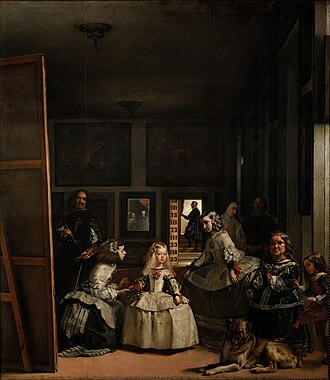 Les Ménines - Diego Velázquez (1656)
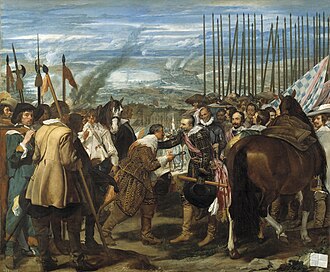 La Reddition de Bréda - Diego Velázquez (1635)
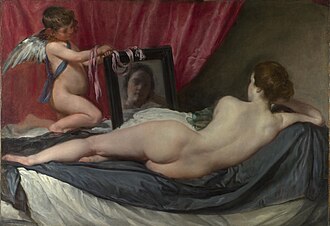 Vénus à son miroir - Diego Velázquez (1644)
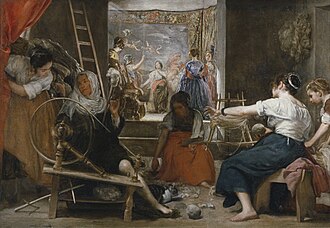 Les Fileuses - Diego Velázquez
.jpg) Innocent X - Diego Velázquez
Innocent X - Diego Velázquez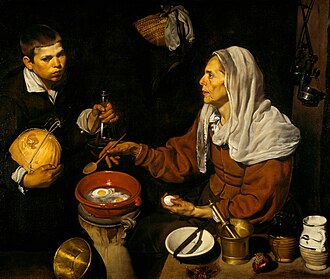 Vieille faisant frire des œufs - Diego Velázquez (1618)
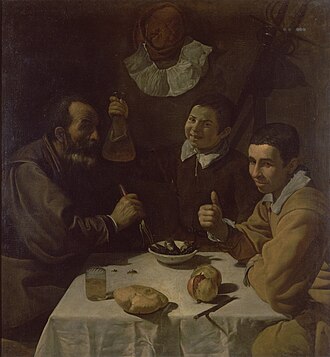 Trois hommes à table, le déjeuner - Diego Velázquez (1617)
.jpg) Le Triomphe de Bacchus - Diego Velázquez (1628)
Le Triomphe de Bacchus - Diego Velázquez (1628)
Œuvres d'artistes liés
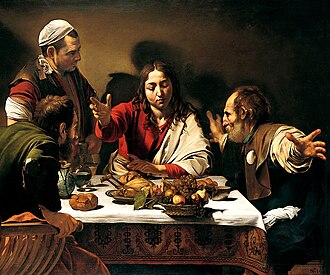 Le Souper à Emmaüs - Caravaggio (1601)
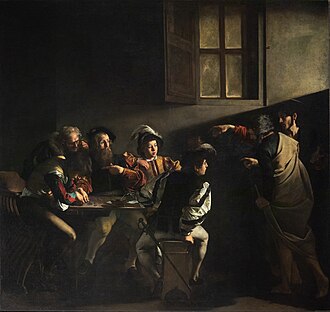 La Vocation de saint Matthieu - Caravaggio (1609)
.jpg) L'Érection de la croix - Peter Paul Rubens (1609)
L'Érection de la croix - Peter Paul Rubens (1609)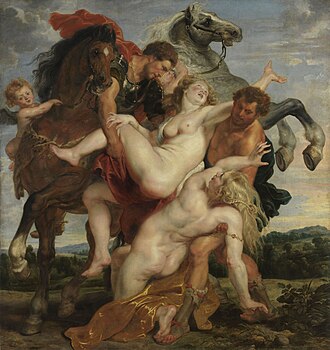 L'Enlèvement des filles de Leucippe - Peter Paul Rubens (1618)
%20-%20Google%20Art%20Project.jpg) Triple portrait de Charles Ier - Anthony van Dyck (1635)
Triple portrait de Charles Ier - Anthony van Dyck (1635)%20with%20M.%20de%20St%20Antoine%20-%20Google%20Art%20Project.jpg) Charles Ier à cheval avec Monsieur de Saint Antoine - Anthony van Dyck (1636)
Charles Ier à cheval avec Monsieur de Saint Antoine - Anthony van Dyck (1636)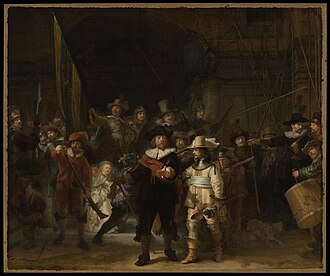 La Ronde de nuit - Rembrandt van Rijn (1642)
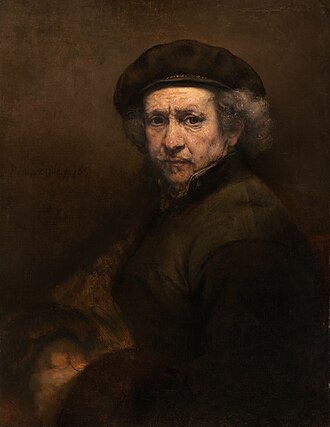 Autoportrait - Rembrandt van Rijn (1659)
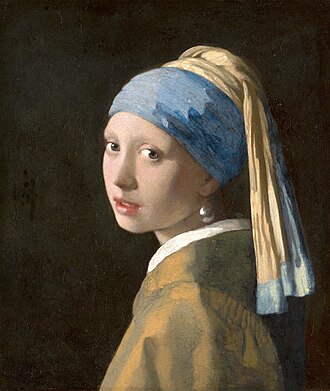 La Jeune Fille à la perle - Johannes Vermeer (1665)
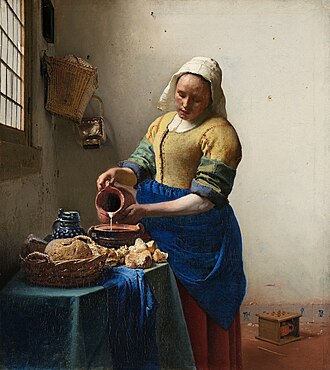 La Laitière - Johannes Vermeer (c. 1658)