Portrait of Johann von Schwarzwaldt
Hans Holbein the Younger · 1543
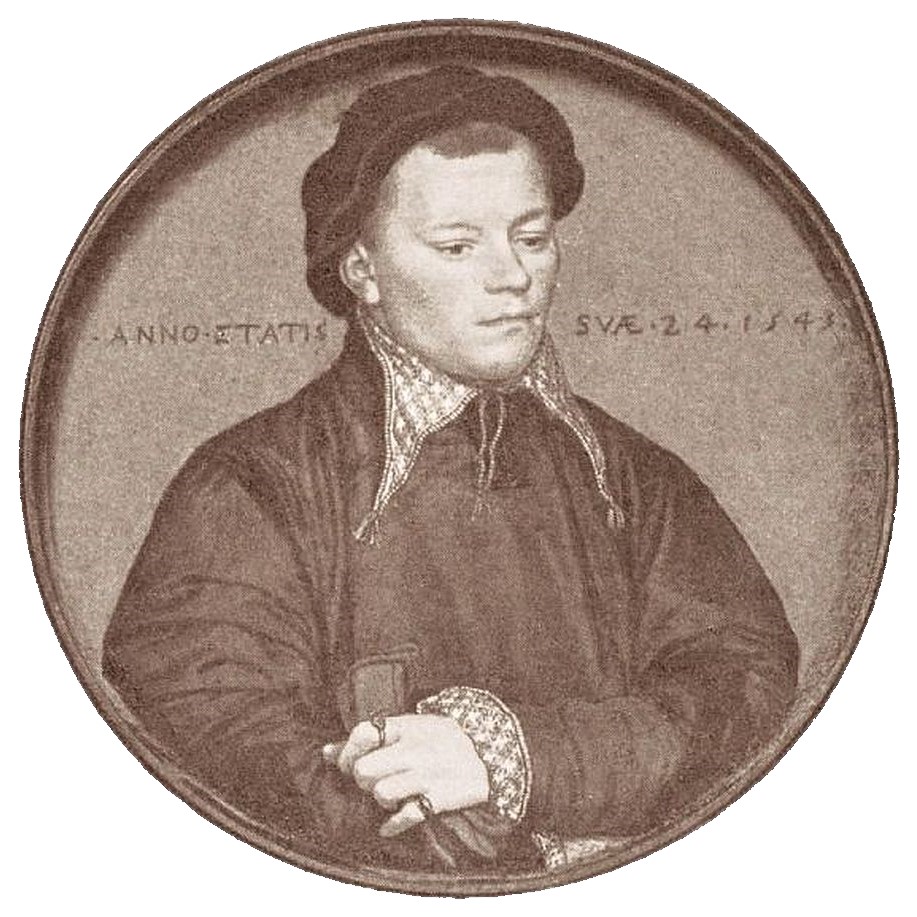
A young man in black, eyes half-lowered, arms folded, painted on parchment in 1543, perhaps the last work of Hans Holbein the Younger. Who he was is still argued over: a Danzig merchant, or the son of Henry VIII's chief minister.
The story behind the painting
This tempera on parchment miniature carries the inscription ANNO ETATIS SVAE 24 1543, meaning the sitter was twenty-four in 1543 and so born around 1519. In 1913 the German art historian Georg Habich found it in the Danzig Stadtmuseum, where it was first recorded in 1902. A Danzig tradition held that the sitter belonged to the Schwarzwald family, whose legacy of 1708, with a library and coin collection, went to the church of Saints Peter and Paul. Holbein died in London that same year, between 7 October and 29 November, during an outbreak of plague, so this may be his last work.
What to look for
Against a blue background the young man turns three-quarters to the viewer's right. He wears a deep black velvet cap and a black silk gown a shade lighter, with a finely embroidered white shirt showing at neck and wrist. His eyes are lowered, half covered by the lids, and his arms are folded. He holds leather gloves and wears two rings on his left hand. Look for the signet ring, marked with what scholars describe as a Z or a very widely placed N. The tasselled pointed collar is distinctly English in fashion.
Meaning and intent
The sitter's name is a puzzle. Habich proposed Heinrich von Schwarzwald, born 1517, but his age and the ring do not match. Danzig tradition and a 2003 study named his half-brother Hans II, born 1513, who would have been thirty, not twenty-four, and Berend, the youngest, is thought unlikely. Roy Strong noted that a second miniature of a very similar face, identified in 1903 among miniatures owned by the Queen of the Netherlands, suggests a sitter of real importance. In 2016 Teri Fitzgerald and Diarmaid MacCulloch suggested Gregory Cromwell, son of Thomas Cromwell and brother-in-law of Henry VIII, of the right age, with the family's upturned nose and a zig-zag in his arms that could explain the ring.
Legacy
The miniature's later history is harsh. It probably passed through the Schwarzwald family to the Danzig church in 1708 and then to the Danzig Stadtmuseum. German occupation forces looted it from the museum in 1943, and in 1945 the Soviet Red Army took it to Moscow as spoils of war. It is now in the Pushkin State Museum of Fine Arts, one of a number of works whose return the Polish government has requested. A small face from the last months of Holbein's life still carries an unsettled name and an unsettled home.
Le saviez-vous ?
- Tempera on parchment, dated 1543.
- The inscription gives the sitter's age as 24.
- Proposed sitters include Schwarzwald merchants and Gregory Cromwell.
- Looted in 1943, now in the Pushkin Museum, Moscow.
À propos de l'artiste
Hans Holbein the Younger (1497-1543)
musée des Beaux-Arts Pouchkine · miniature
Autres œuvres de Hans Holbein the Younger
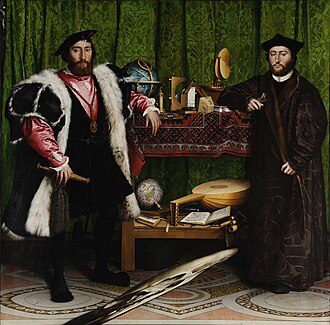 Les Ambassadeurs - Hans Holbein the Younger (1533)
 Le Christ mort - Hans Holbein the Younger (1520s)
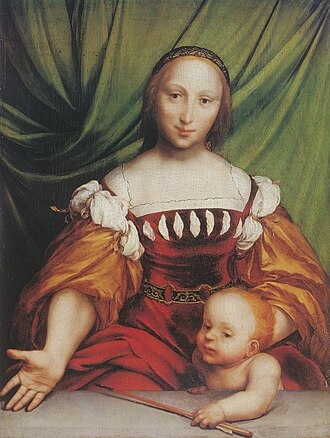 Vénus et Amour - Hans Holbein the Younger (1526)
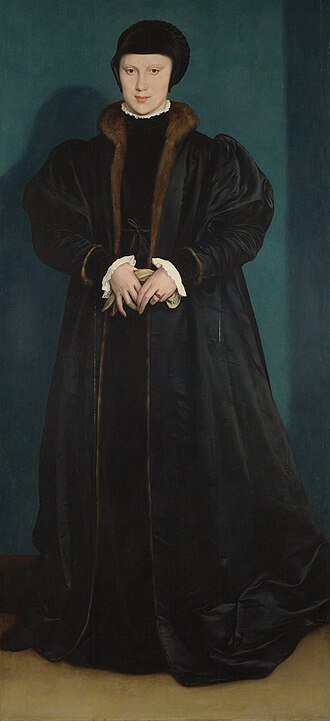 Portrait de Christine de Danemark - Hans Holbein the Younger (1538)
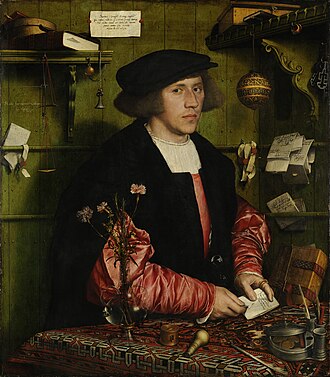 Le Marchand Georg Gisze - Hans Holbein the Younger (1532)
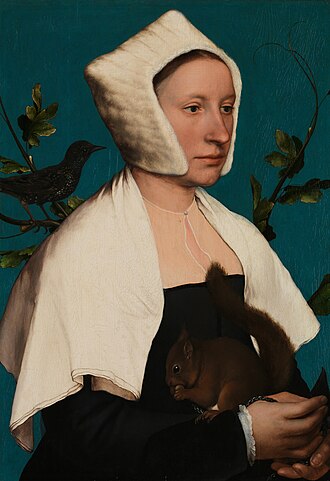 A Lady with a Squirrel and a Starling - Hans Holbein the Younger (1520s)
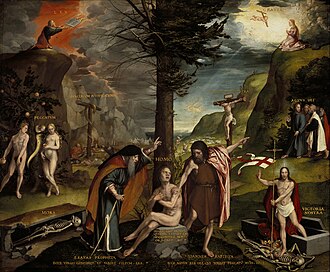 An Allegory of the Old and New Testaments - Hans Holbein the Younger (1530)
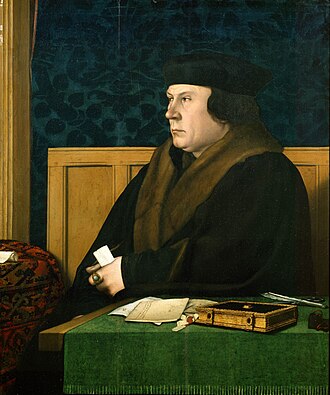 Portrait de Thomas Cromwell - Hans Holbein the Younger (1530s)
Œuvres d'artistes liés
 Les Chasseurs dans la neige - Pieter Bruegel the Elder (1565)
 Les Proverbes flamands - Pieter Bruegel the Elder (1551)
 Le Jardin des délices - Hieronymus Bosch
 La Nef des fous - Hieronymus Bosch (1500s)
 Les Époux Arnolfini - Jan van Eyck (1434)
 L'Agneau mystique - Jan van Eyck (1432)