Portrait de Jan de Leeuw
Jan van Eyck · 1436
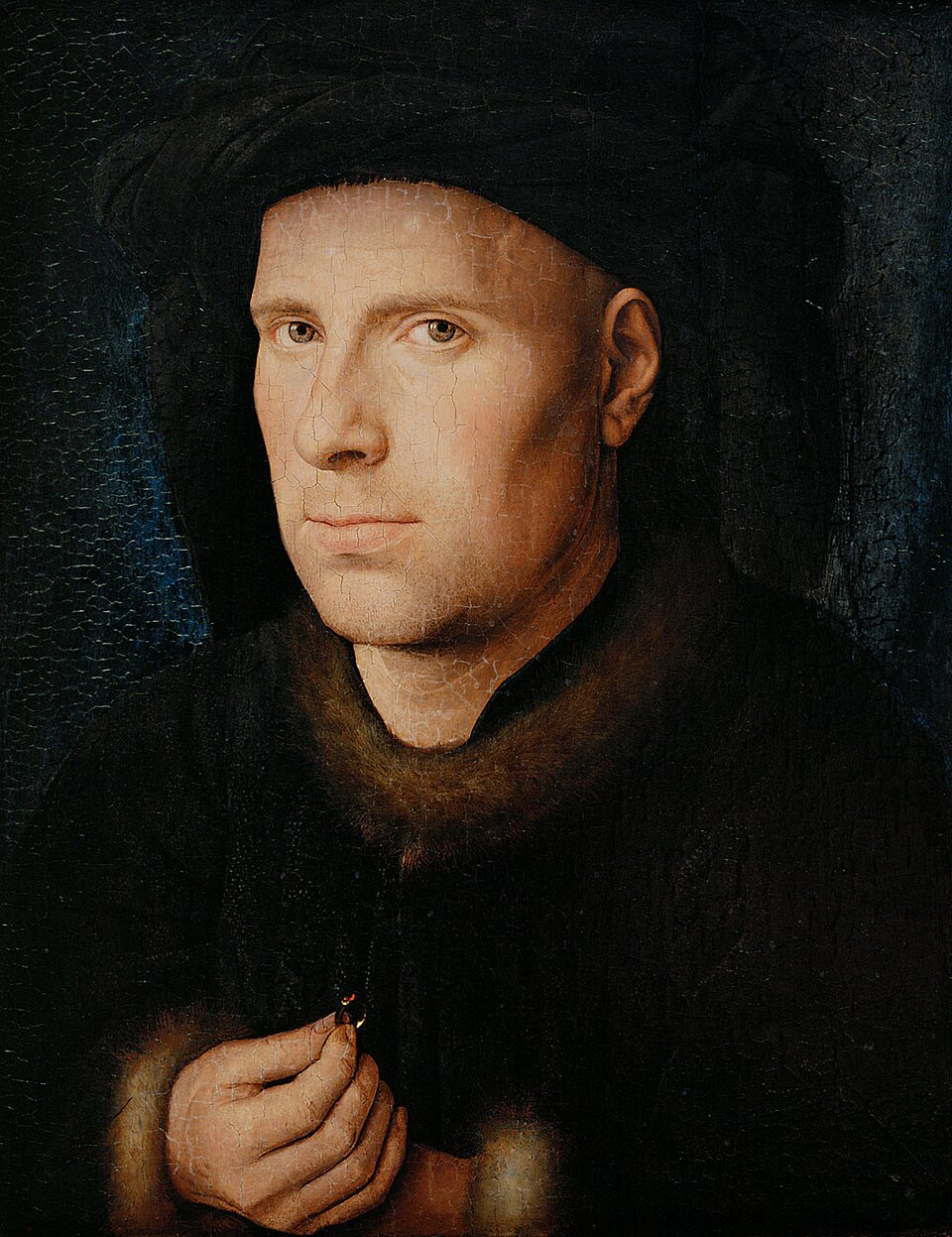
A young goldsmith looks straight at you, holding up a ring, and the frame around him speaks in his voice: now Jan van Eyck has painted me. This small panel from 1436 is a portrait that talks.
The story behind the painting
Jan de Leeuw was a goldsmith living in Bruges. Most art historians accept, given how familiar the portrait feels, that he and Jan van Eyck knew each other and were on good terms. Van Eyck painted him in 1436 on a small wooden panel, only about 24.5 by 19 cm, which is now in the Kunsthistorisches Museum in Vienna. The work is still in its original frame, painted over to look like bronze, very like the frames of van Eyck's London self-portrait and the Dresden Triptych, probably made by the same craftsman.
What to look for
Like the London self-portrait, the picture is dominated by black and dark brown with red overtones. De Leeuw appears as a serious young man with an intense gaze, in a black chaperon and a black fur lined jacket. He turns to look at us while holding a gold ring with a red jewel. As in the London panel, the head is oversized in relation to the body. Then read the frame: its letters are painted in black in Flemish, some carved into the border, some raised in relief, and in place of his surname there is a small golden lion.
Meaning and intent
The ring is a sign of his trade, though some have suggested a recent engagement, or even that the portrait was meant for his intended. The inscription addresses the viewer in the first person: Jan de Leeuw, who first opened his eyes on the feast of Saint Ursula, 1401, now Jan van Eyck has painted me, you can see when he began it, 1436. Leeuw means lion in Dutch, hence the pictogram. Till-Holger Borchert noted that the portrait seems to speak, continuing in words the dialogue begun by the challenging gaze.
Legacy
Scholars have also found word puzzles hidden in the text. Guy Bauman saw three chronograms, where Roman numeral letters add up to the year of completion, the year of birth and the sitter's age, while Max Friedländer and Erwin Panofsky accepted only the first two. Bauman wrote in 1986 that van Eyck, in a God-like way, seems not only to have given the sitter sight and a kind of rebirth, but also to have given the portrait a voice. Nearly six centuries on, it still speaks to whoever stands before it.
Le saviez-vous ?
- Painted in 1436, oil on a small wooden panel.
- The sitter was a goldsmith from Bruges, born in 1401.
- The inscription speaks in the sitter's first person.
- Still in its original frame, now in Vienna.
À propos de l'artiste
Jan van Eyck (1390-1441)
portrait · Primitifs flamands · musée d'Histoire de l'art de Vienne
Autres œuvres de Jan van Eyck
 Les Époux Arnolfini - Jan van Eyck (1434)
 L'Agneau mystique - Jan van Eyck (1432)
 La Vierge du chancelier Rolin - Jan van Eyck
 La Vierge dans une église - Jan van Eyck (1440)
 La Vierge au chanoine Van der Paele - Jan van Eyck (1436)
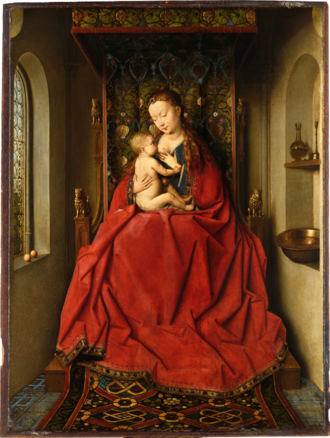 Vierge de Lucques - Jan van Eyck (1437)
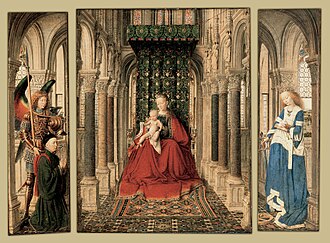 Triptyque de Dresde - Jan van Eyck (1437)
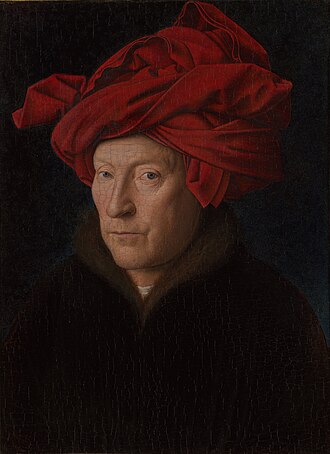 Portrait d'un homme - Jan van Eyck (1433)
Œuvres d'artistes liés
 La Descente de Croix - Rogier van der Weyden (1440s)
 Portrait d'une dame - Rogier van der Weyden (1460)
 L'Annonciation - Hans Memling (1480s)
 Scènes de la Passion du Christ - Hans Memling (1470)
 Le Jardin des délices - Hieronymus Bosch
 La Nef des fous - Hieronymus Bosch (1500s)
 Les Chasseurs dans la neige - Pieter Bruegel the Elder (1565)
 Les Proverbes flamands - Pieter Bruegel the Elder (1551)