Portrait de Henri VIII d'Angleterre
Hans Holbein the Younger · 1540
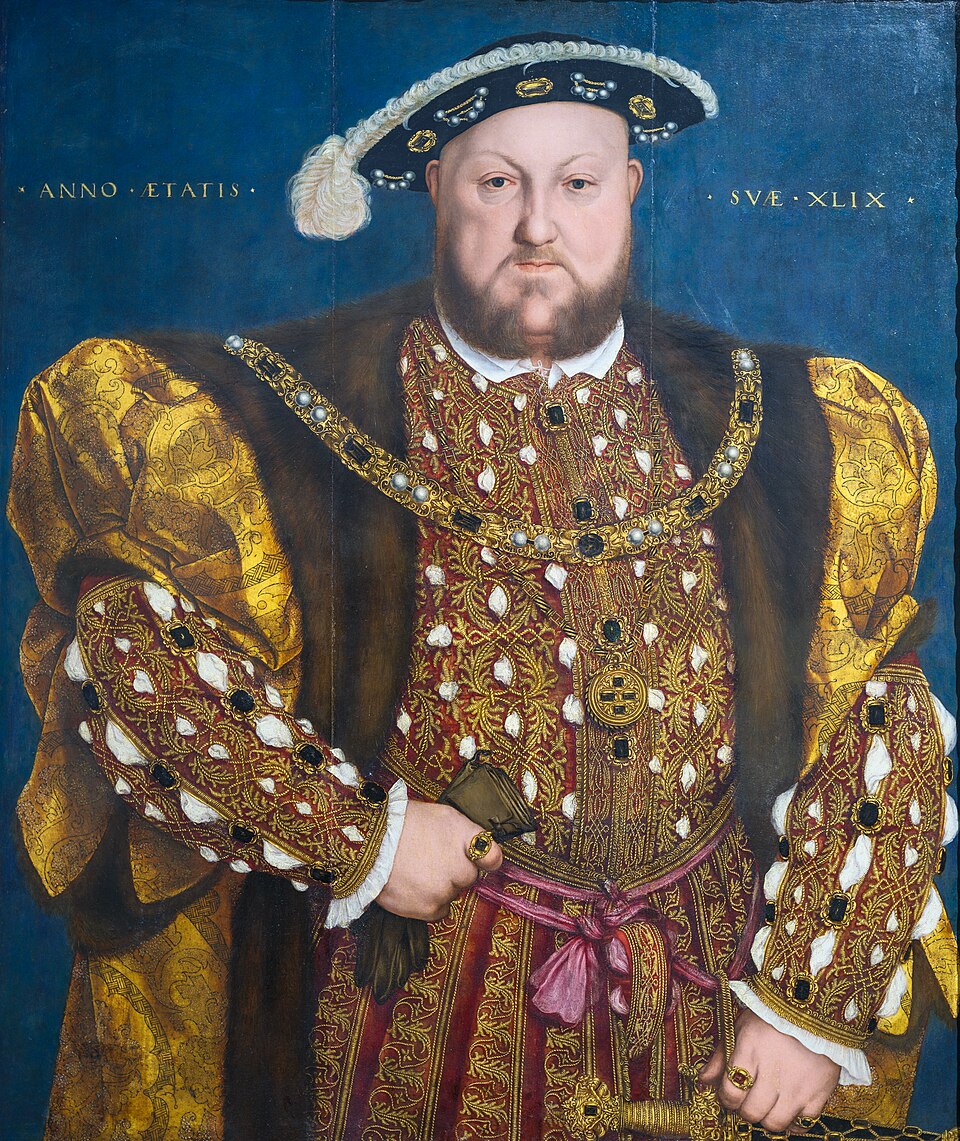
No crown, no sceptre, just a glove, a sword hilt and a body that fills the frame. Holbein painted Henry VIII in 1540, the year of his marriage to Anne of Cleves, and the king's sheer size does the talking.
The story behind the painting
Hans Holbein the Younger served Henry VIII as court painter for years, from 1532 until his death in 1543, having left Basel amid the turmoil of the Reformation and its iconoclasm. His reputation grew from earlier commissions such as the Portrait of Sir Thomas More of 1527, and work for Anne Boleyn's procession in 1533 helped earn him his place at court. Henry married his fourth wife, Anne of Cleves, in January 1540, and this official portrait was commissioned at that time to carry the message of the king's authority.
What to look for
Instead of a crown or sceptre, Holbein shows Henry holding a glove in one hand while the other rests on his sword hilt. The emphasis falls on his clothing and jewels, and a smaller canvas, about 88.5 by 74.5 cm, lets his body cover more of the surface, so that his imposing size dominates. Look for the inscription ANNO AETATIS SVAE XLIX, in the year of his age 49, which dates the painting to 1540.
Meaning and intent
Holbein's many portraits of Henry served as propaganda, helping to restore and raise the king's image amid scandals and the founding of the Church of England. The court poet Nicholas Bourbon called Holbein the King's Painter. Many commissions marked events in Henry's life, including his marriages, often coordinated with Thomas Cromwell. Here authority is shown not through regalia but through presence: the body, the fabric, the jewels and the calm hand on the sword.
Legacy
The painting came three years after Holbein's famous Whitehall Mural of 1537, which celebrated the birth of Edward VI and was destroyed by fire in 1698. This portrait survives in Rome, in the Galleria Nazionale d'Arte Antica at Palazzo Barberini. In 2025 it travelled on loan to the Wadsworth Atheneum in Hartford, Connecticut, in an exchange that brought Caravaggio's Saint Francis of Assisi in Ecstasy to Rome for a special retrospective exhibition there.
Le saviez-vous ?
- Painted by Hans Holbein the Younger in 1540, about 88.5 by 74.5 cm.
- Inscribed ANNO AETATIS SVAE XLIX: Henry was 49.
- Made around his marriage to Anne of Cleves.
- In the Galleria Nazionale d'Arte Antica, Palazzo Barberini, Rome.
À propos de l'artiste
Hans Holbein the Younger (1497-1543)
portrait · Galerie nationale d'art ancien
Autres œuvres de Hans Holbein the Younger
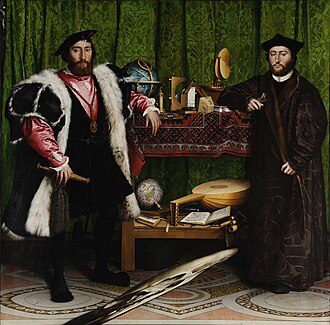 Les Ambassadeurs - Hans Holbein the Younger (1533)
 Le Christ mort - Hans Holbein the Younger (1520s)
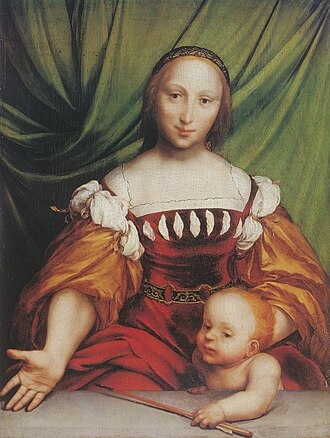 Vénus et Amour - Hans Holbein the Younger (1526)
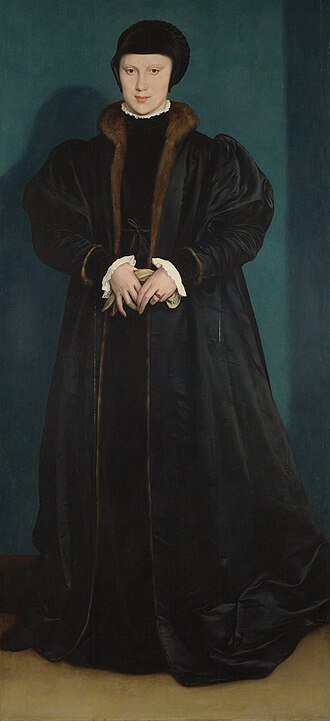 Portrait de Christine de Danemark - Hans Holbein the Younger (1538)
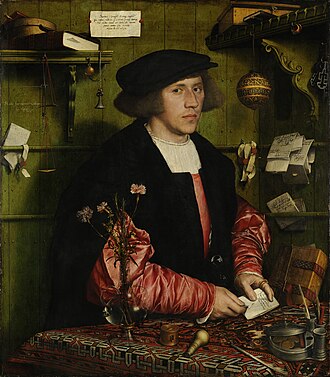 Le Marchand Georg Gisze - Hans Holbein the Younger (1532)
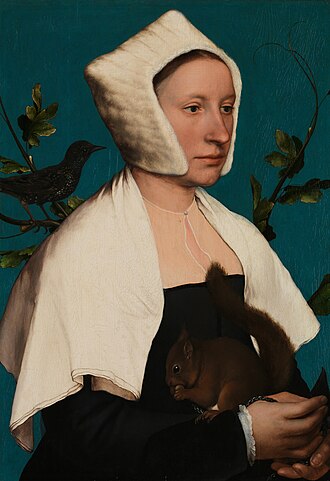 A Lady with a Squirrel and a Starling - Hans Holbein the Younger (1520s)
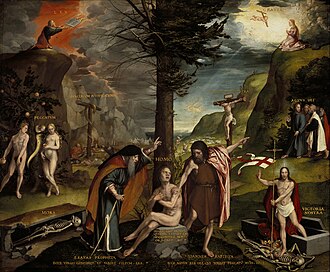 An Allegory of the Old and New Testaments - Hans Holbein the Younger (1530)
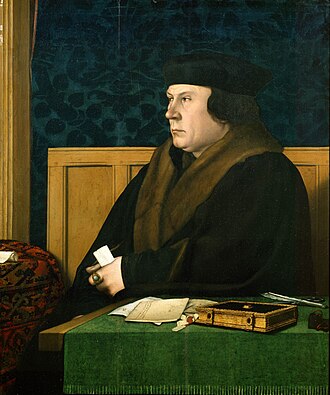 Portrait de Thomas Cromwell - Hans Holbein the Younger (1530s)
Œuvres d'artistes liés
 Les Chasseurs dans la neige - Pieter Bruegel the Elder (1565)
 Les Proverbes flamands - Pieter Bruegel the Elder (1551)
 Le Jardin des délices - Hieronymus Bosch
 La Nef des fous - Hieronymus Bosch (1500s)
 Les Époux Arnolfini - Jan van Eyck (1434)
 L'Agneau mystique - Jan van Eyck (1432)