Portrait of Charles V
Titien · 1549
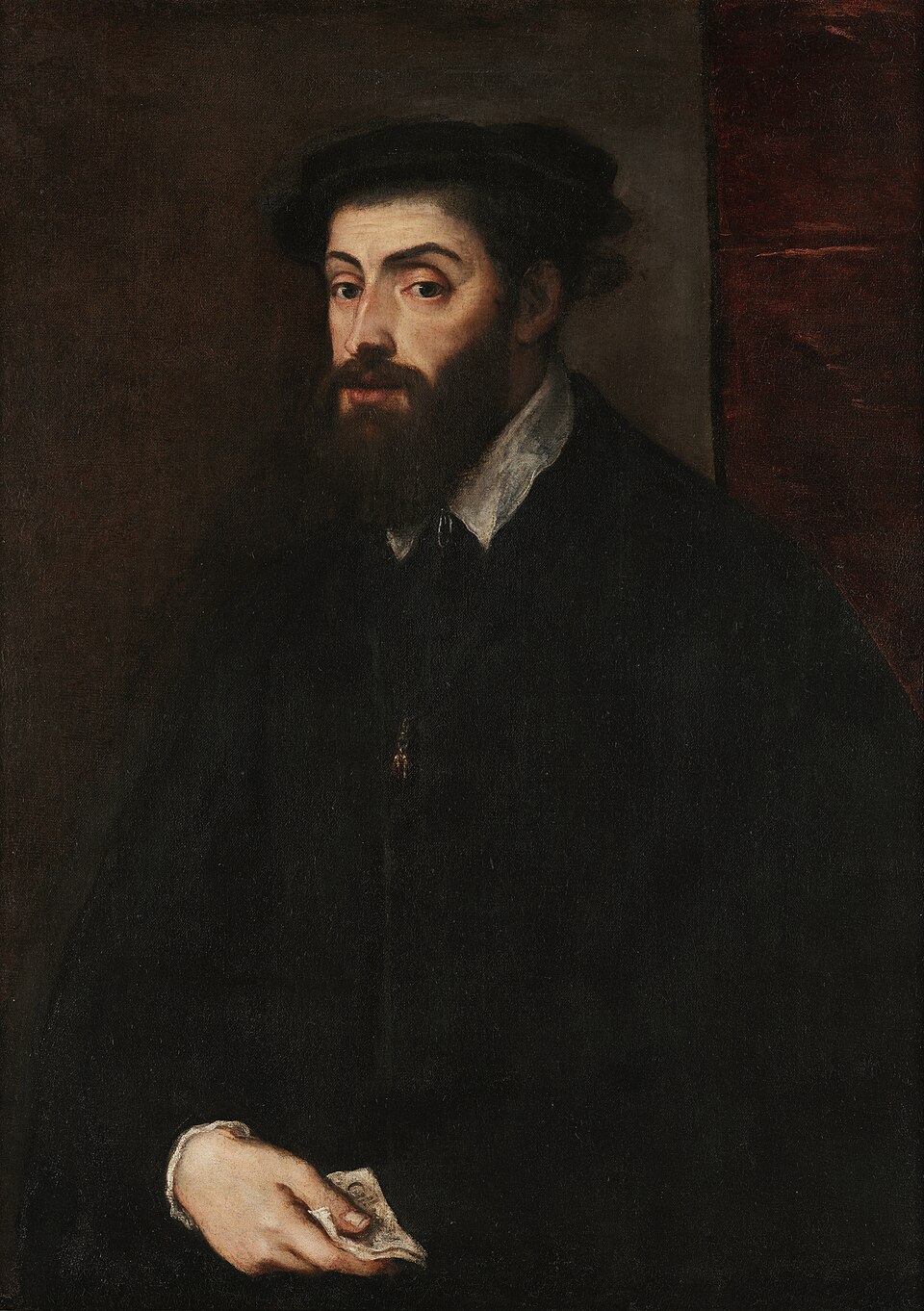
An emperor in black, lips parted, the Golden Fleece at his neck. For a long time nobody even knew who he was: in Parma he became a philosopher, a man in black, or the emperor's brother, until restorers gave Charles V his face back.
The story behind the painting
Titian painted Charles V, Holy Roman Emperor, many times. According to Vasari his first portrait of Charles, in armour with a commander's baton, was made in 1530, as a letter of 18 March 1530 confirms, but it is now lost. Letters of 1534, 1542 and 1563 mention other portraits of Charles sent to or requested by the Farnese, and this picture may be one of them. Another theory, now not widely supported, says Titian sent it to Ferrante Gonzaga in 1549. No source dates it firmly: Wikipedia gives about 1549, but the comparison with a portrait of 1533 points earlier.
What to look for
The canvas is about 98 by 71 cm. The emperor is shown at half length in a dark suit and headdress, details found again in later portraits such as the one in Munich. His face is coloured red, as if lit by a setting sun. In his hand he holds a sheet of paper, on which, it was believed, the name of Charles V might have been written. Around his neck hangs the chain of the Golden Fleece. His lips are parted because of the well-known Habsburg jaw, the physical trait of his family.
Meaning and intent
This is a ruler shown without armour or throne, in sober black, with only the Golden Fleece to mark his rank. Titian does not hide the parted lips of the Habsburg jaw, yet the warm light on the face lends him a calm dignity. The likeness to the full-length Portrait of Charles V with a Dog in the Prado, dated 1533, is close enough that the source uses it to date the Naples picture to the same period, which conflicts with the 1549 date it carries elsewhere.
Legacy
By the mid 17th century the painting had moved from Rome to Parma and its subject had been forgotten. It was called a Portrait of a Philosopher, a Man in Black or Ferdinand I, Charles's younger brother, and was given to Girolamo Mazzola. In 1734 it came to Naples with the Farnese Collection, inherited by Charles III of Spain, and Titian's name was restored. A long restoration in the 20th century identified Charles again. It hangs today in the Museo di Capodimonte, sometimes called Portrait of a Man Wearing the Order of the Golden Fleece.
Le saviez-vous ?
- One of many portraits of Charles V by Titian.
- Dated about 1549, though compared to a portrait of 1533.
- Once titled a philosopher or Ferdinand I, and given to Mazzola.
- Held in the Museo di Capodimonte, Naples.
À propos de l'artiste
Titien (1488-1576)
portrait · musée de Capodimonte
Autres œuvres de Titien
 Vénus d'Urbin - Titian (1538)
 L'Assomption de la Vierge - Titian (1510s)
 Amour sacré et Amour profane - Titian (1510s)
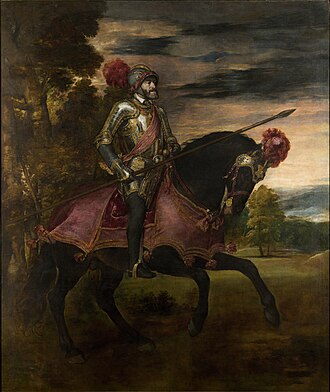 Charles Quint à cheval à Mühlberg - Titian (1548)
 Flore - Titian (1517)
 Allégorie du Temps gouverné par la Prudence - Titian (1550)
 Diane et Actéon - Titian (1550s)
 Bacchus et Ariane - Titian (1520s)
Œuvres d'artistes liés
 La Cène - Jacopo Tintoretto (1563)
 Miracle de l'esclave - Jacopo Tintoretto (1540s)
 Les Noces de Cana - Paolo Veronese (1560s)
 Le Repas chez Levi - Paolo Veronese (1573)