Portrait d'Anne, comtesse de Chesterfield
Thomas Gainsborough · 1770s
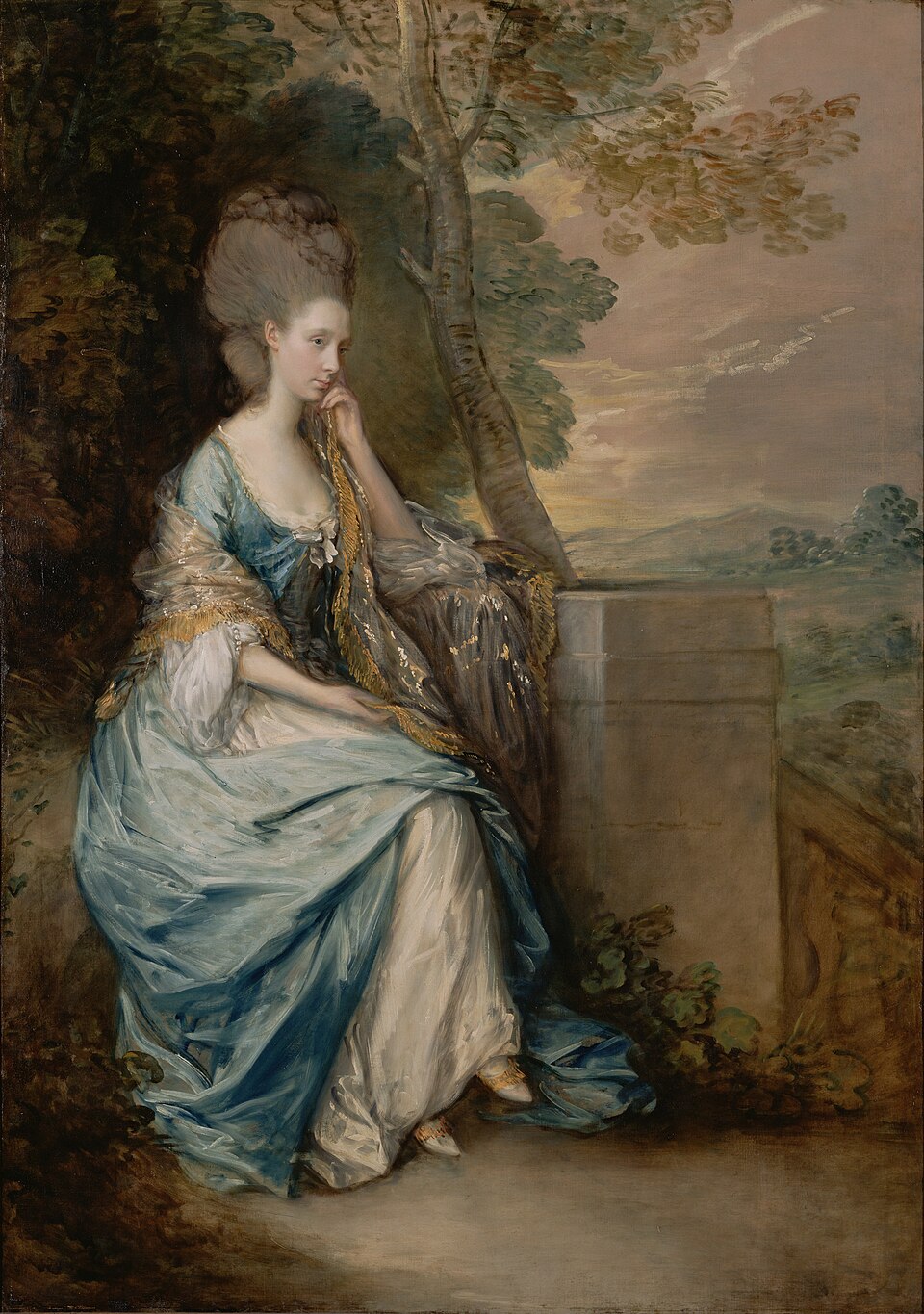
A young countess sits on a garden terrace, lost in thought, her blue and white silk seeming to shimmer and rustle. Gainsborough began her portrait the year she married.
The story behind the painting
Anne Thistlethwaite was the daughter of the Reverend Robert Thistlethwaite of Southwick Park in Hampshire, from the local gentry. In 1777 she married into the Stanhope family as wife of Philip Stanhope, 5th Earl of Chesterfield; the article also names her husband as George at one point, an inconsistency in the source. Thomas Gainsborough began the portrait that same year and finished it in 1777 to 1778, and it was shown at the Royal Academy in London in 1778. During the sittings he also made two small bust-length painted studies of her.
What to look for
Anne is shown full-length, about 221 by 156 cm, sitting outdoors with her legs crossed, facing to her left and leaning on the stone balustrade of a terrace, while a stairway behind her leads down into the garden. Her hair is swept upward in the fashion of the day. She wears a low-cut, off-the-shoulder blue and white silk gown, a translucent beige shawl with gold fringe and white slippers. The picture divides in two: dense foliage behind her, and to one side an open view of her husband's estate under a cloudy sky.
Meaning and intent
According to the Getty, the large sweeping brushstrokes give a sense of immediacy. Short curved strokes build the tree trunk, longer strokes of blue and white create the illusion of shimmering, rustling fabric, and small dabs of white and gold make the shawl glimmer. The portrait was painted together with one of her husband, who faces right, leaning on a tree in a scarlet coat and riding boots with his brown and white dog. Facing each other, the couple were meant to be seen as a pair, she quiet and dreamy, he out on his land.
Legacy
The portrait stayed with the Stanhope family by inheritance until 1923, when the 6th Earl of Carnarvon acquired it. In 1925 it went at Christie's to Sir John Leigh, together with Philip's portrait, and the two remained companions until Leigh's death in 1959, when Anne's portrait passed through Thomas Agnew and Sons to Jean Paul Getty. It was shown again at the Royal Academy in 1887, and James Scott made a mezzotint of it in 1870, now in the National Portrait Gallery. It is in good condition, though the varnish is discoloured in places.
Le saviez-vous ?
- Painted by Thomas Gainsborough in 1777 to 1778.
- Exhibited at the Royal Academy in 1778.
- Separated from her husband's companion portrait in 1959.
- Now in the J. Paul Getty Museum.
À propos de l'artiste
Thomas Gainsborough (1727-1788)
portrait · musée J. Paul Getty
Autres œuvres de Thomas Gainsborough
.jpg) L'Enfant bleu - Thomas Gainsborough (1770)
L'Enfant bleu - Thomas Gainsborough (1770).jpg) Les Époux Andrews - Thomas Gainsborough (1748)
Les Époux Andrews - Thomas Gainsborough (1748)%20-%20WGA8418.jpg) Mr and Mrs William Hallett - Thomas Gainsborough (1785)
Mr and Mrs William Hallett - Thomas Gainsborough (1785) Portrait de Georgiana, duchesse de Devonshire - Thomas Gainsborough (1780s)
%20-%20Google%20Art%20Project.jpg) Portrait de Madame Mary Graham - Thomas Gainsborough (1775)
Portrait de Madame Mary Graham - Thomas Gainsborough (1775) Madame Richard Brinsley Sheridan - Thomas Gainsborough (1785)
 Mrs Siddons - Thomas Gainsborough (1785)
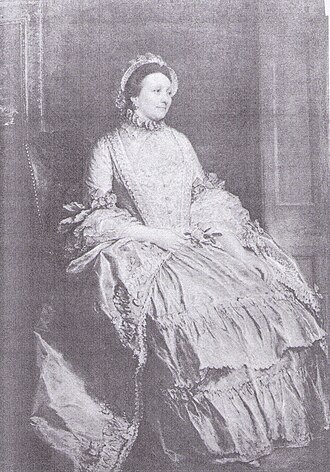 Rebecca St Quintin - Thomas Gainsborough (1767)
Œuvres d'artistes liés
 Tres de Mayo - Francisco Goya (1814)
.jpg) La Maja nue - Francisco Goya (1800)
La Maja nue - Francisco Goya (1800) Le Voyageur contemplant une mer de nuages - Caspar David Friedrich (c. 1818)
 L'Abbaye dans une forêt de chênes - Caspar David Friedrich (1800s)
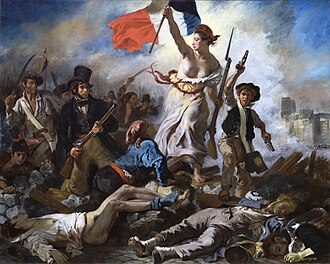 La Liberté guidant le peuple - Eugène Delacroix (1830)
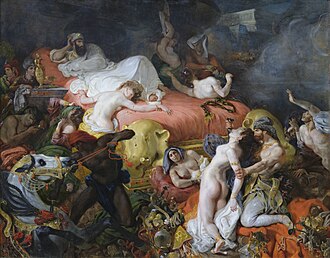 La Mort de Sardanapale - Eugène Delacroix (1827)
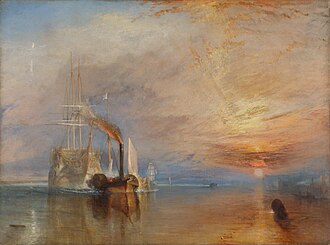 Le Dernier Voyage du Téméraire - J. M. W. Turner (1839)
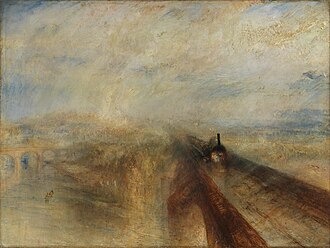 Pluie, Vapeur et Vitesse - J. M. W. Turner (1844)