Mr and Mrs William Hallett
Thomas Gainsborough · 1785
%20-%20WGA8418.jpg)
Two twenty-one-year-olds walk arm in arm through a wood, a white dog at their side, weeks before their wedding. Gainsborough's late, feathery brush turns a summer stroll into a picture of youth itself.
The story behind the painting
Gainsborough painted the work in the summer of 1785, also known as The Morning Walk. William Hallett and Elizabeth Stephen were both 21, and they married shortly afterwards, on 30 July 1785, at the church of St Lawrence in Little Stanmore. Hallett, grandson of a successful cabinetmaker of the same name, commissioned the portrait. He had inherited the estate of Canons Park, and Elizabeth was an heiress whose father, a surgeon, had died before the marriage. The couple never lived at Canons Park and spent almost 20 years at Faringdon House in Oxfordshire.
What to look for
The canvas is large, 236 by 179 cm, and the couple walk along a woodland path. The brushwork is the typical feathery touch of Gainsborough's late career. Elizabeth wears billowing ivory silk with lace cuffs, black silk at the waist, a green ribbon at the breast echoed by a big green bow on her wide black hat with ostrich plumes. William wears a black velvet frock coat with large gold buttons, a green and yellow waistcoat, black breeches, white stockings and buckled shoes, holding a plain black hat. The dog is a Pomeranian sheepdog, then called a fox dog, much larger than the modern Pomeranian.
Meaning and intent
The source suggests the couple may be wearing their wedding clothes, which would make the walk a portrait of a beginning. The marriage that followed was not easy in money: Hallett was a gambler, lost funds in business, and had worked through his fortune by 1830. Yet the marriage was reportedly a happy one, lasting almost 48 years, with two sons and four daughters. After Elizabeth died in 1833 he remarried, but when he died in 1842 he was buried beside her, at the church where they had married.
Legacy
The painting passed to their daughter Lettice Elizabeth and then to her son. Shown at the British Institution in 1859, it was praised in The Times as a perfect realisation of youthful elegance and high breeding. It later belonged to Lord Rothschild and entered the National Gallery in London in 1954 with help from the Art Fund. On 18 March 2017 a man attacked it with a sharp object, leaving two long scratches across Mrs Hallett, but the canvas was not pierced and it returned after 10 days of restoration. It inspired George Romney's The Evening Walk.
Le saviez-vous ?
- Painted in summer 1785, before the couple's wedding on 30 July.
- Also known as The Morning Walk.
- Scratched in an attack in 2017 and restored in 10 days.
- In the National Gallery, London, since 1954.
À propos de l'artiste
Thomas Gainsborough (1727-1788)
Autres œuvres de Thomas Gainsborough
.jpg) L'Enfant bleu - Thomas Gainsborough (1770)
L'Enfant bleu - Thomas Gainsborough (1770).jpg) Les Époux Andrews - Thomas Gainsborough (1748)
Les Époux Andrews - Thomas Gainsborough (1748)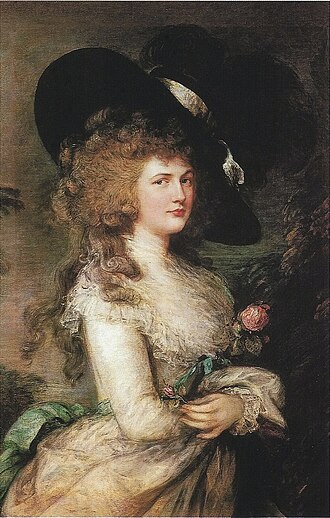 Portrait de Georgiana, duchesse de Devonshire - Thomas Gainsborough (1780s)
%20-%20Google%20Art%20Project.jpg) Portrait de Madame Mary Graham - Thomas Gainsborough (1775)
Portrait de Madame Mary Graham - Thomas Gainsborough (1775)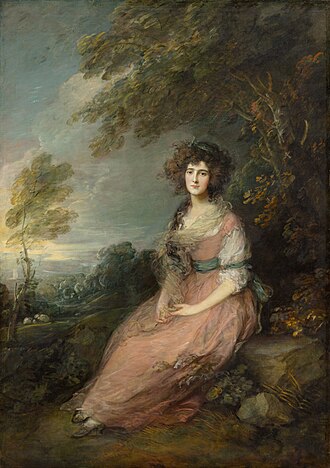 Madame Richard Brinsley Sheridan - Thomas Gainsborough (1785)
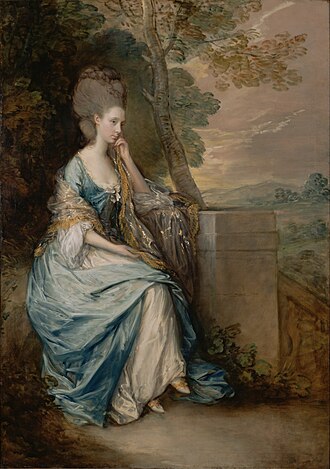 Portrait d'Anne, comtesse de Chesterfield - Thomas Gainsborough (1770s)
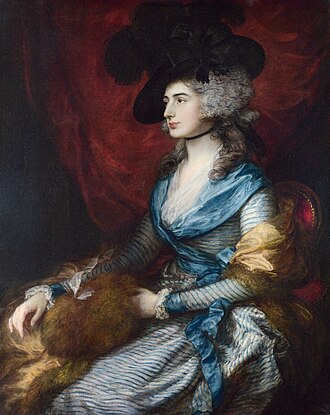 Mrs Siddons - Thomas Gainsborough (1785)
 Rebecca St Quintin - Thomas Gainsborough (1767)
Œuvres d'artistes liés
 Tres de Mayo - Francisco Goya (1814)
.jpg) La Maja nue - Francisco Goya (1800)
La Maja nue - Francisco Goya (1800) Le Voyageur contemplant une mer de nuages - Caspar David Friedrich (c. 1818)
 L'Abbaye dans une forêt de chênes - Caspar David Friedrich (1800s)
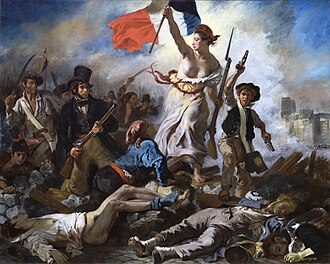 La Liberté guidant le peuple - Eugène Delacroix (1830)
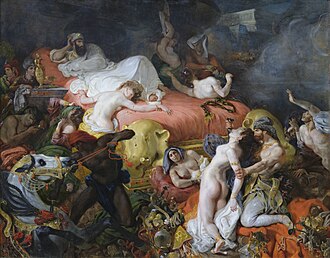 La Mort de Sardanapale - Eugène Delacroix (1827)
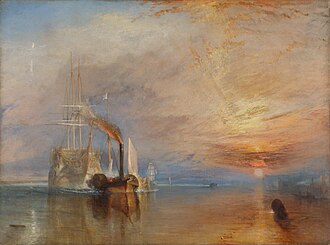 Le Dernier Voyage du Téméraire - J. M. W. Turner (1839)
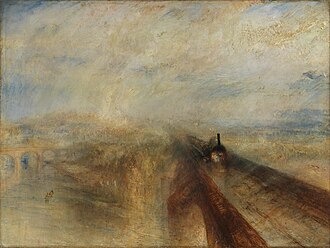 Pluie, Vapeur et Vitesse - J. M. W. Turner (1844)