Portrait d'Ahmed III al-Hafsi
Pierre Paul Rubens · 1613
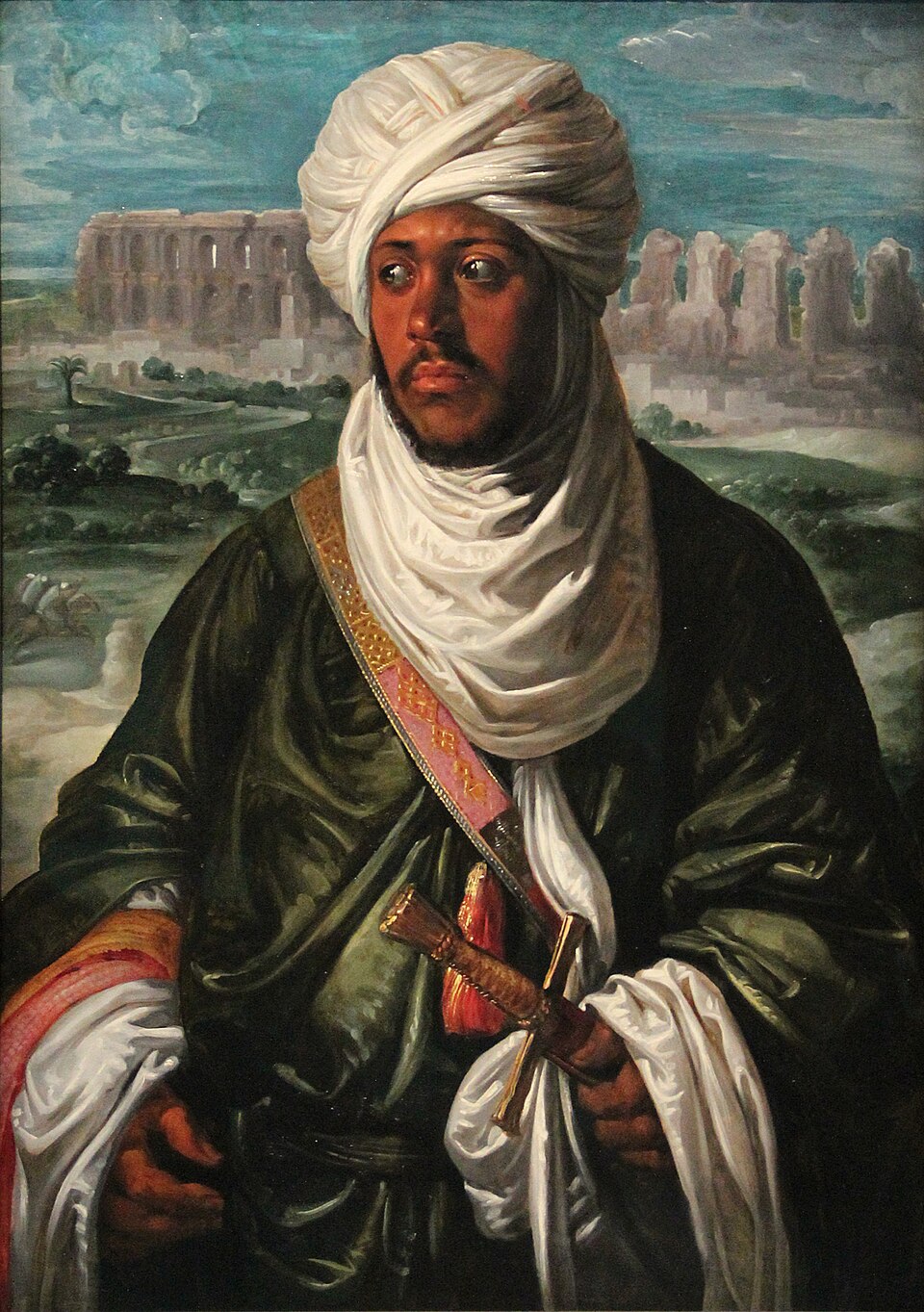
A young North African prince in a green robe, a dreamlike landscape behind him and a Roman amphitheatre on the horizon. Rubens never met him: he copied a lost portrait made almost eighty years earlier, when the prince was long dead.
The story behind the painting
In 1533 to 1534 the painter Jan Cornelisz Vermeyen joined Emperor Charles V in Spain and followed him to Tunis. There he portrayed the future sultan of Tunis, Abu al-Abbas Ahmed III al-Hafsi, noble in an elegant green silk robe, sword in his right hand, signs of war behind him and a coat of arms with an Arabic inscription in the upper right corner. That portrait is lost, and only an engraving of it remains. Rubens certainly saw the original and copied it. Wikidata dates his version to 1613.
What to look for
Look at how Rubens changed his model. He softened the young prince's features and removed the battle scenes, keeping only a small group of soldiers galloping with drawn sabres. He left out the coat of arms and turned the background into a dreamlike landscape. Yet he kept the great building in the distance. The panel, about 99.7 by 71.5 cm, is held in the Museum Boijmans Van Beuningen in Rotterdam. The green silk, with white silk at the sleeves and collar, comes from Vermeyen's description of the original.
Meaning and intent
The building is not a fantasy. It is the amphitheatre of El Jem in Tunisia, built around the first third of the third century. We do not know whether Rubens knew this. The prince had probably wanted it behind him as a sign that his power and his dynasty continued the Roman empire. Ahmed succeeded his father as Hafsid sultan of Tunis in 1543 and died in captivity in 1575 at Termini Imerese in Sicily, so he had been dead for decades when Rubens painted this face.
Legacy
Rubens did not use this image only once. He reused the same face for the African king in his Adoration of the Magi in the Church of Saint John in Mechelen, engraved by Lucas Vorsterman in 1620, and for another Adoration of the Magi of 1633 to 1634, an altarpiece painted for a convent in Leuven and now seen in King's College Chapel, Cambridge. The portrait itself was shown in the exhibition The Europe of Rubens at the Louvre-Lens, from 22 May to 23 September 2013.
Le saviez-vous ?
- A copy by Rubens of a lost portrait by Jan Cornelisz Vermeyen.
- The building in the background is the Roman amphitheatre of El Jem, Tunisia.
- The sitter died in captivity in Sicily in 1575.
- Held in the Museum Boijmans Van Beuningen, Rotterdam.
À propos de l'artiste
Pierre Paul Rubens (1577-1640)
portrait · baroque · paysage · musée Boijmans Van Beuningen
Autres œuvres de Pierre Paul Rubens
 L'Érection de la croix - Peter Paul Rubens (1609)
 L'Enlèvement des filles de Leucippe - Peter Paul Rubens (1618)
 Sous la tonnelle de chèvrefeuille - Peter Paul Rubens (1600s)
 Samson et Dalila - Peter Paul Rubens (1600s)
 La Descente de Croix - Peter Paul Rubens (1611)
 Tête de Méduse - Peter Paul Rubens (1618)
 Hélène Fourment sortant du bain - Peter Paul Rubens (1638)
 Le Jardin d'Amour - Peter Paul Rubens (1632)
Œuvres d'artistes liés
 La Nuit étoilée - Vincent van Gogh (1889)
 Terrasse du café le soir - Vincent van Gogh (1888)
 Le Souper à Emmaüs - Caravaggio (1601)
 La Vocation de saint Matthieu - Caravaggio (1609)
 Les Ménines - Diego Velázquez (1656)
 La Reddition de Bréda - Diego Velázquez (1635)
 Saint Francis in Meditation - Francisco de Zurbarán (1639)
 The Immaculate Conception - Francisco de Zurbarán (1661)
 Triple portrait de Charles Ier - Anthony van Dyck (1635)
 Charles Ier à cheval avec Monsieur de Saint Antoine - Anthony van Dyck (1636)
 La Ronde de nuit - Rembrandt van Rijn (1642)
 Autoportrait - Rembrandt van Rijn (1659)