Le Pont de la Clef à Bruges, Belgique
Camille Pissarro · 1894
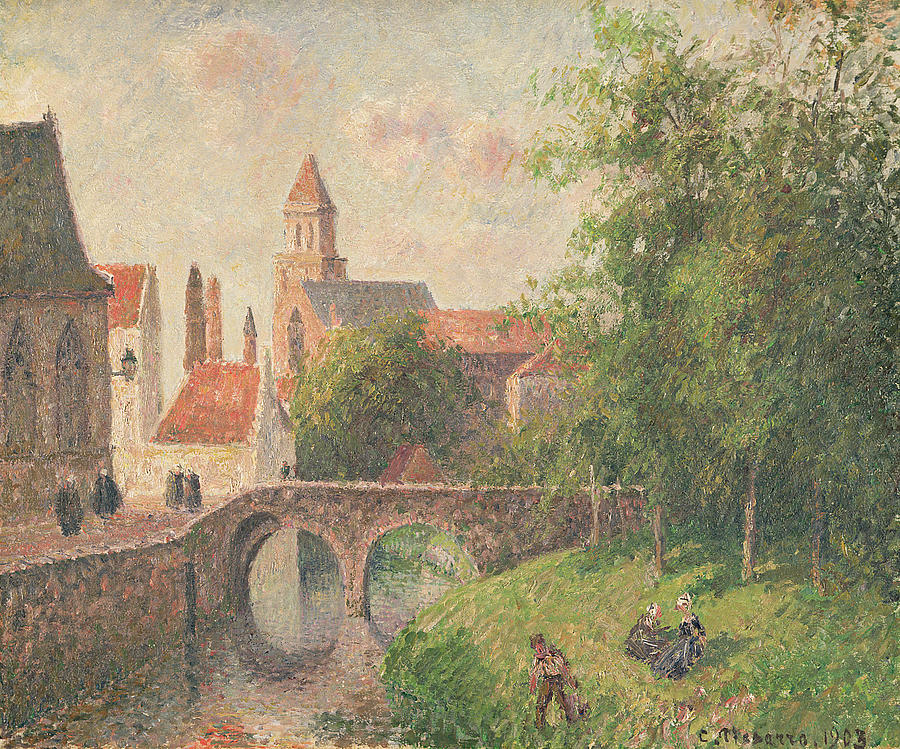
A quiet canal in Bruges, a bridge, a bright church tower and women in white caps on the grass. Pissarro saw it while hiding from the police in 1894, and painted it only weeks before he died.
The story behind the painting
On 24 June 1894 the French president Sadi Carnot was stabbed by an anarchist. Fearing reprisals for his own anarchist views, Pissarro went into exile for some months with his wife Julie and son Félix, accompanied by the Belgian painter Théo van Rysselberghe, to medieval Bruges and the seaside town of Knokke. He was fascinated that Bruges had kept its historic look with little of modern life, and it reminded him of the countryside around Rouen. On the spot he only made a drawing, which became the etching Quai des Ménétriers à Bruges that same year.
What to look for
At the centre is the canal bridge, the Sleutelbrug, whose Dutch name became Pont de la Clef. On the left edge the dark Speelmanskapel, the musicians' chapel built in 1421, is painted in greys, browns and reds; behind the bridge rises the much friendlier light-brick Sint-Jakobskerk. Green trees fill the right half. Short dabs of colour on the grass, the bridge and the water show the influence of Pointillism, though not on the sky, where clouds are swept in red, blue and white. Two women in white caps sit on the grass, a man goes to the water perhaps with a bucket, and no face can be made out.
Meaning and intent
Pissarro painted most of the picture in an Impressionist style while letting Pointillist touches appear in parts, so the canvas holds both of the manners he had worked in. The etching took its title from the quay; nine years later, in the painting, the bridge moved to the centre of the title. The contrast inside the picture is also telling: the dark, gloomy chapel on the edge against the bright, welcoming church in the middle, with the faceless villagers going about their quiet tasks.
Legacy
The painting is signed and dated C.Pissarro.1903, so the German Wikipedia dates it 1903, while Wikidata gives 1894, the year of the Bruges stay. Pissarro died in November 1903, a few weeks after finishing it. It passed to his son Lucien Pissarro, a painter who lived for decades in England, and in 1946 Lucien's widow Esther gave it to Manchester Art Gallery, where it has remained ever since, a late gift from the painter's family.
Le saviez-vous ?
- Based on a drawing made in Bruges in 1894.
- Signed and dated 1903, weeks before Pissarro's death.
- Oil on canvas, 46.4 by 55.2 cm.
- In Manchester Art Gallery since 1946.
À propos de l'artiste
Camille Pissarro (1830-1903)
paysage · Manchester City Art Galleries
Autres œuvres de Camille Pissarro
 Le Pont Boieldieu à Rouen, temps mouillé - Camille Pissarro (1896)
 Rue Saint-Honoré, Après-midi, Effet de Pluie - Camille Pissarro (1897)
 Boulevard Montmartre, Mardi Gras - Camille Pissarro (1897)
 Côte des Bœufs à L'Hermitage, Pontoise - Camille Pissarro (1877)
 La Maison de La Sourde et Le Clocher D'Éragny - Camille Pissarro (1886)
 Place du Théâtre Français à Paris, printemps - Camille Pissarro (1898)
 Boulevard Montmartre un matin d'hiver - Camille Pissarro (1897)
 Le Repos, paysanne couchée dans l´herbe, Pontoise - Camille Pissarro (1882)
Œuvres d'artistes liés
 Impression, soleil levant - Claude Monet (1872)
 Nymphéas - Claude Monet (1906)
 Le Déjeuner sur l'herbe - Édouard Manet (1863)
 Olympia - Édouard Manet (1863)
 Bal du moulin de la Galette - Pierre-Auguste Renoir (1876)
 Le Déjeuner des canotiers - Pierre-Auguste Renoir (1881)
 Le Berceau - Berthe Morisot (1872)
 Jour d'été - Berthe Morisot (1879)
 L'Absinthe - Edgar Degas (1875)
 La Famille Bellelli - Edgar Degas (1858)
 Le Canal du Loing - Alfred Sisley (1892)
 L'Abreuvoir à Marly-Le-Roi, gelée blanche - Alfred Sisley (1876)