Vierge d'Ognissanti
Giotto · 1300s
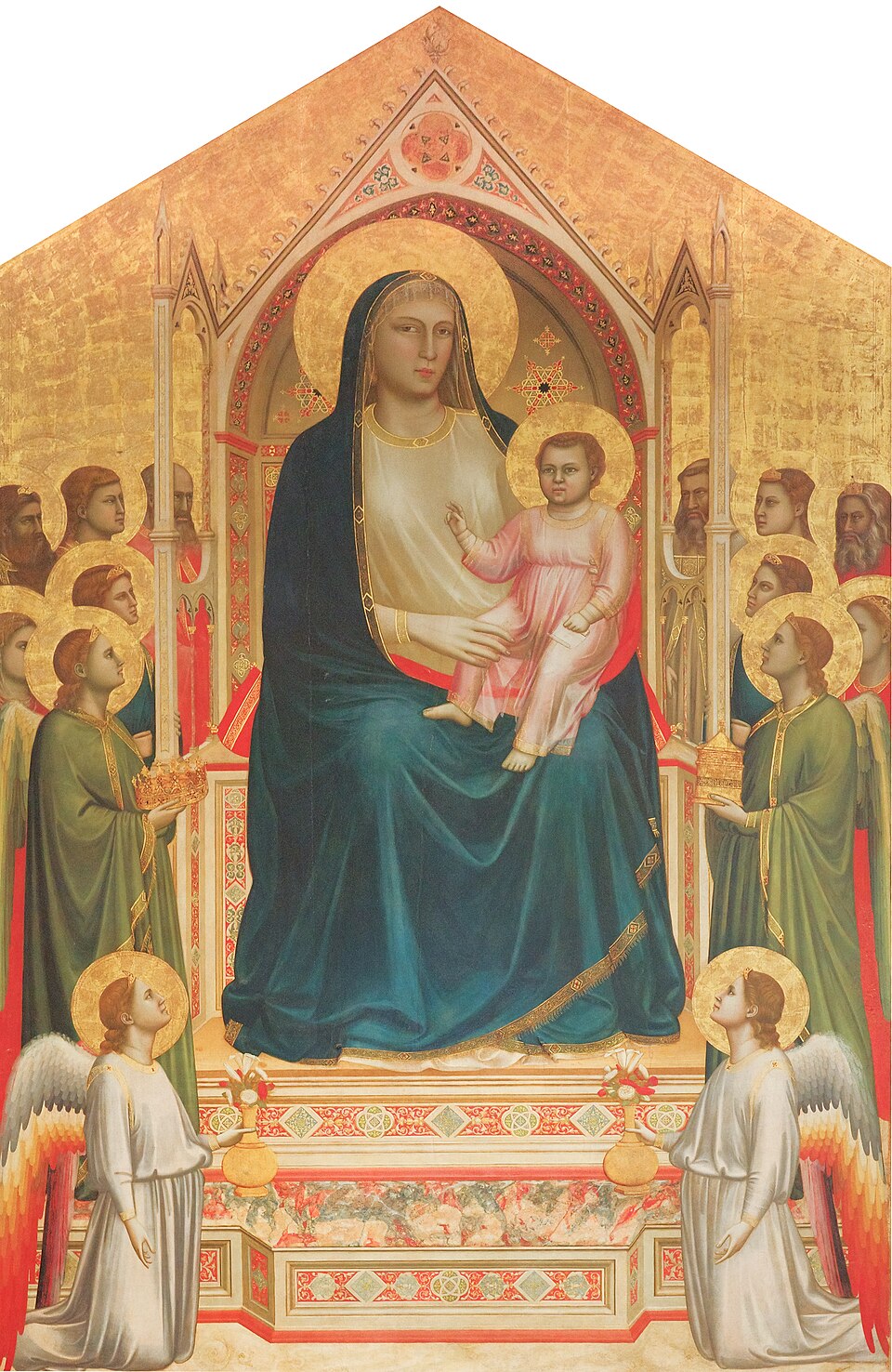
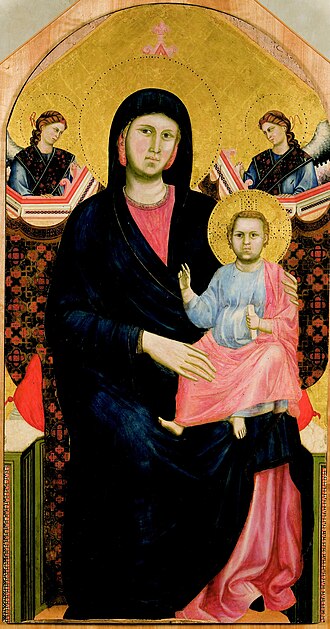
On a gold ground, a weighty, calm Virgin sits on a marble throne, and beneath her robe you can sense real knees. Many call it the first painting of the Italian Renaissance.
The story behind the painting
Madonna Enthroned, also called the Ognissanti Madonna, is a tempera painting on wood panel by Giotto, generally dated around 1310 and now in the Uffizi Gallery in Florence. It was painted for the high altar of the Ognissanti church in Florence, built for the Humiliati, a small religious order. Unusually for Giotto, there are documents supporting its attribution: a manuscript of 1418, and above all Lorenzo Ghiberti's I Commentarii of 1447. It is one of Giotto's later works, made after his return to Florence. The panel is monumental, about 325 by 204 cm.
What to look for
The Virgin and Child sit at the centre, surrounded on all sides by saints and angels like a royal court; this type is called a Maestà. Look at the gold ground and the hierarchy of scale, with Mary and Jesus much larger than the figures around them, both inherited from Italo-Byzantine tradition. Then notice what is new: the folds of cloth are built from light, shadow and colour rather than gold lines, and the contours of the body show beneath, especially at the Virgin's knees and breast. The throne is a Gothic design inlaid with coloured marble in the Cosmatesque style.
Meaning and intent
The painting is often celebrated as the first painting of the Italian Renaissance because of its new naturalism and its escape from Byzantine and Gothic constraints. Giotto's figures are weighty, like three-dimensional sculpture. He used a range of light and dark to model volume, and, unlike in his other works, the light here comes from the right; the reason is not known, though it may relate to its place in the church. He also set the figures in a smaller space than his contemporaries, which emphasises the bodies.
Legacy
The work gathers many influences. From Cimabue, traditionally his teacher, Giotto took symmetry and a concern for volume, as a comparison with Cimabue's Santa Trinita Maestà, also in the Uffizi, shows, including the similar angels' wings. From Pietro Cavallini came statuesque calm, and from the sculptors Nicola and Giovanni Pisano came dramatic composition. Hanging today in the Uffizi, the Ognissanti Madonna marks a turning point where the icon begins to become a living presence.
Le saviez-vous ?
- Generally dated around 1310 (Wikipedia); Wikidata gives the 1300s.
- Painted for the high altar of the Ognissanti church, Florence.
- Attributed to Giotto by a 1418 document and Ghiberti's I Commentarii (1447).
- Size: 325 x 204 cm (Wikidata).
À propos de l'artiste
Giotto (1267-1337)
femme · art religieux · Marie · garçon · Enfant Jésus · galerie des Offices · Vierge à l'Enfant
Autres œuvres de Giotto
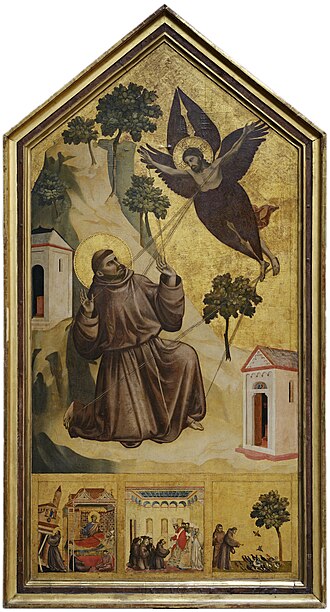 Saint François d'Assise recevant les stigmates - Giotto (1290s)
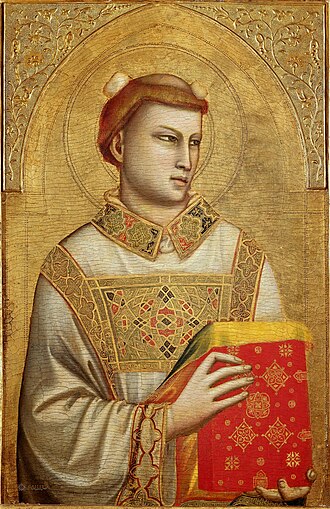 Saint Étienne - Giotto (1320)
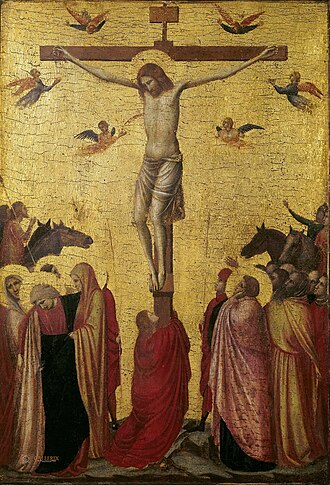 Crucifixion de Strasbourg - Giotto (1315)
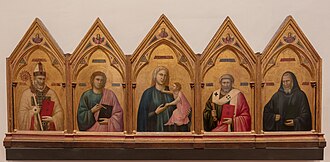 Polyptyque de la Badia - Giotto (1300s)
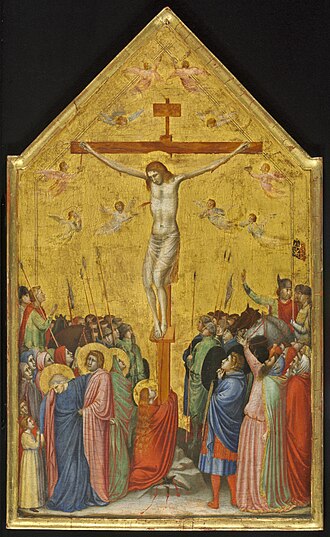 Crucifixion de Berlin - Giotto (1310s)
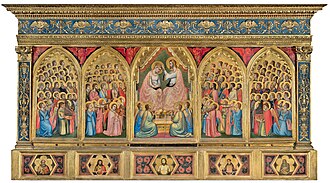 Polyptyque Baroncelli - Giotto (1328)
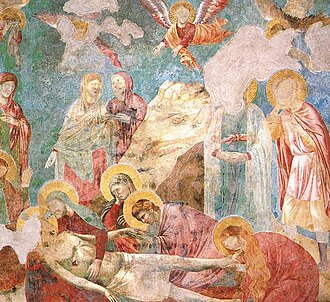 Déposition de la Croix - Giotto (1291)
 Vierge de San Giorgio alla Costa - Giotto (1295)