Polyptyque Baroncelli
Giotto · 1328
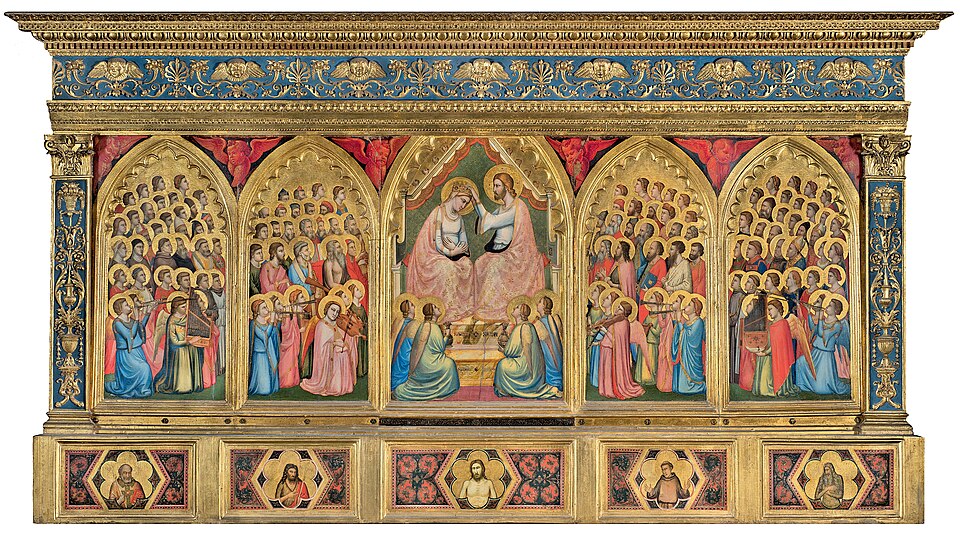
Still standing in the very chapel it was made for, this golden altarpiece shows Christ placing a crown on his mother's bowed head, while ranks of saints and angel musicians look on. Its signature reads Giotto, yet scholars have argued over it for a century.
The story behind the painting
This polyptych, known as the Baroncelli Polyptych, dates from about 1328 and is still displayed in its original setting, the Baroncelli Chapel in the Basilica of Santa Croce in Florence. It measures 185 by 323 centimetres and bears the inscription OPUS MAGISTRI JOCTI, the work of Master Giotto. Lorenzo Ghiberti and Giorgio Vasari both mentioned it in their lives of Giotto, and it was accepted as his until the late nineteenth century. The source notes, however, that it was long attributed to Giotto with a more recent tendency toward his pupil Taddeo Gaddi. The most widely followed view, from Federico Zeri, sees it as a collaboration between the two around 1328.
What to look for
Five compartments form the main tier, framed above and at the sides by a Renaissance cornice; the original top was cut, so the arch of the central panel is truncated. In the centre, the Virgin sits at the left and bows her head as her Son sets the crown upon it. Both sit at the same level on a throne raised on a dais, under a red canopy, with kneeling angels below holding vases. On each side, two panels show saints in glory with angel musicians: the angels kneel in profile at the bottom, saints rise behind them in half-length, and above them only haloed heads remain visible, stacked up to the frame.
Meaning and intent
The structure turns a single moment into a vast heavenly gathering. Christ and Mary share one throne at one height, an image of honour shared between mother and son. Around them, the side panels multiply the audience into a crowd of saints that seems to extend beyond the frames, while angel musicians fill the lower edge with unheard music. Below, the predella adds a quieter devotional note. Each compartment holds a hexagon framed with floral motifs and a sacred figure: at the centre, Christ rising half-length from the tomb; at the sides, a bishop saint, John the Baptist, Saint Francis and a further saint.
Legacy
Few works show so clearly how attributions shift. Early in the twentieth century Adolfo Venturi suggested the signature might have been added in the fifteenth century, when Sebastiano Mainardi painted the seraphim between the small arches. Offner removed it from Giotto's catalogue; others gave it to his workshop or a close collaborator, possibly Taddeo Gaddi. Later scholars restored credibility to the signature, crediting Giotto with the design or the finest passages, especially the central panel. Zeri found the missing pinnacle of the central panel, God the Father with Angels, in the San Diego Museum of Art. The fresco decoration of the chapel itself is attributed entirely to Taddeo Gaddi.
Le saviez-vous ?
- About 1328, still in the Baroncelli Chapel of Santa Croce, Florence
- Inscribed OPUS MAGISTRI JOCTI
- Attribution debated between Giotto, his workshop and Taddeo Gaddi
- Its missing pinnacle is in the San Diego Museum of Art
À propos de l'artiste
Giotto (1267-1337)
femme · art religieux · homme · Marie · Jésus-Christ
Autres œuvres de Giotto
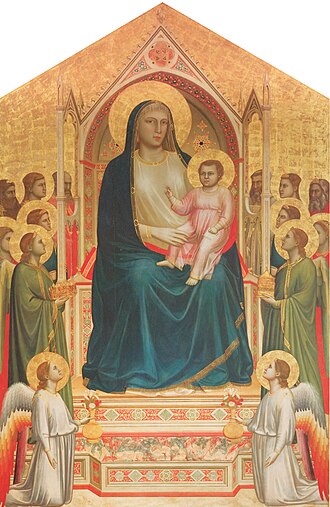 Vierge d'Ognissanti - Giotto (1300s)
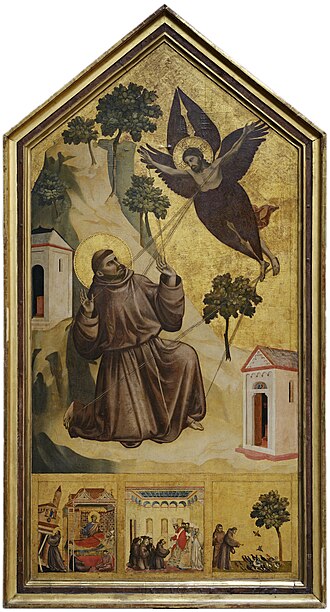 Saint François d'Assise recevant les stigmates - Giotto (1290s)
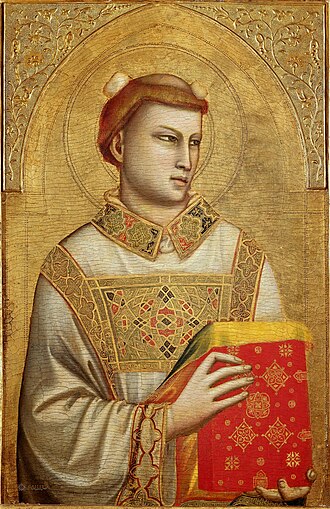 Saint Étienne - Giotto (1320)
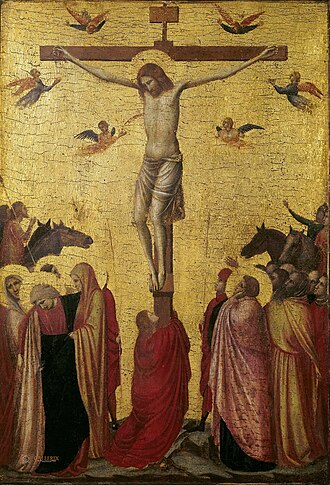 Crucifixion de Strasbourg - Giotto (1315)
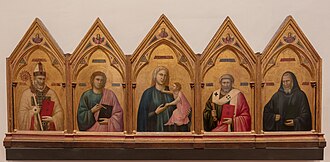 Polyptyque de la Badia - Giotto (1300s)
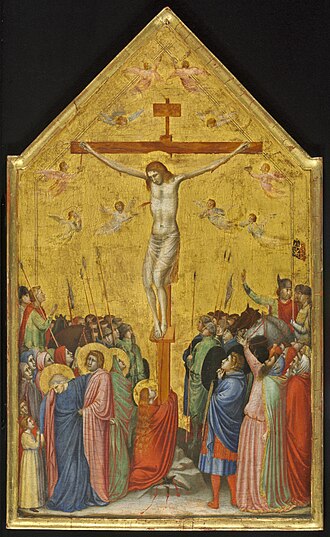 Crucifixion de Berlin - Giotto (1310s)
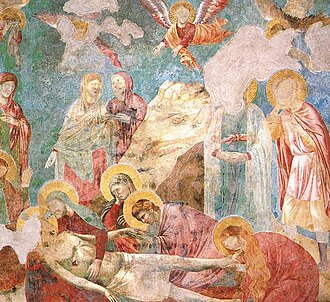 Déposition de la Croix - Giotto (1291)
 Vierge de San Giorgio alla Costa - Giotto (1295)