Le Déjeuner
Gustave Caillebotte · 1876
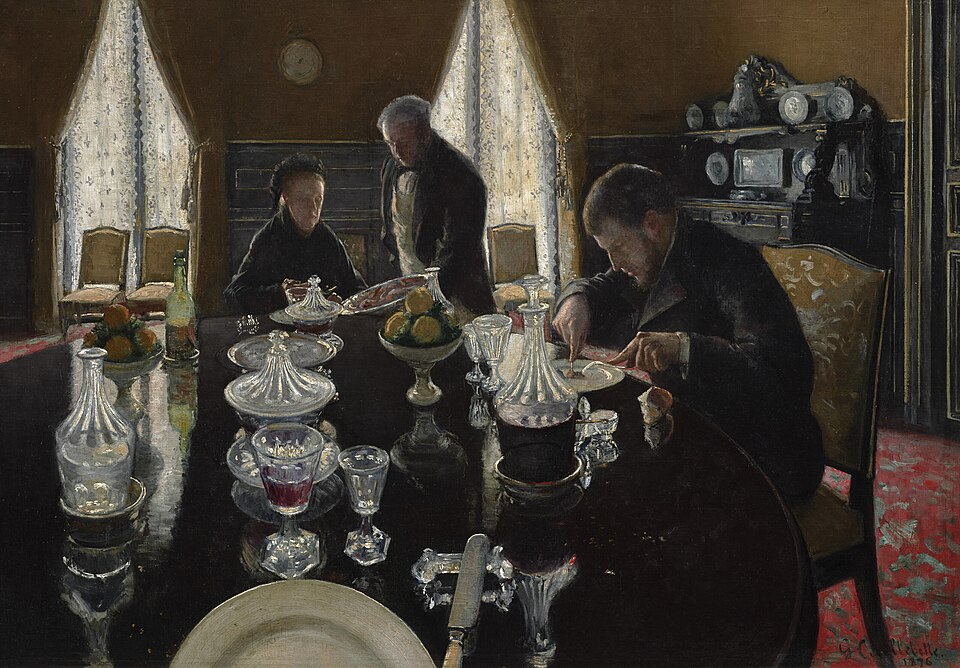
A mother in mourning is served at a dark table, her son eats beside her, and an empty plate waits in front of us. Caillebotte painted his own family's lunch in 1876, and the silence of that room still weighs on the viewer.
The story behind the painting
Le Déjeuner, painted in 1876, shows lunch in the dining room of the Caillebotte family's town house at 77 rue de Miromesnil in Paris, a house that no longer exists. The painter's father, a prosperous businessman who built the house in 1866, had died at Christmas 1874, and his widow was still in deep mourning. The young man on the right is the artist's brother René, also painted that year in Young Man at the Window. René died suddenly very soon afterwards.
What to look for
Madame Caillebotte, born Céleste Daufresne, is served by the butler, while René eats on the right. The ebony table is laid English-style, with no tablecloth. Heavy curtains partly block the windows. Light comes from them and glints on the crystal, while the figures sit against the light. In the foreground lies an empty plate, possibly the painter's own, and the wide-angle view seems to seat us at the table. The composition plays with circles, half circles and the triangles of the windows receding in perspective.
Meaning and intent
The mood is heavy, like the bourgeois décor. Art historian Jérôme Coignard writes that Caillebotte gives a threatening vision of bourgeois life, a room carefully protected from the outside world by heavy hangings. The atmosphere is silent and lonely, and Coignard says the crystal glasses seem to play a game of chess with this sleepwalking family, already dead. Knowing that the father had just died and that René would soon die too, the empty place at the table becomes hard to forget.
Legacy
The picture was shown at the second Impressionist exhibition in 1876, with seven other works by Caillebotte, among them Young Man at the Window, two versions of The Floor Scrapers and Young Man Playing the Piano. French audiences rediscovered it at the Grand Palais in 1994, and in 2011 it was shown at the Musée Jacquemart-André and in Quebec beside photographs by his brother Martial. Classed a National Treasure in January 2020, it is in a private collection. The French article gives 52 by 75 cm; Wikidata gives 52.2 by 76 cm.
Le saviez-vous ?
- Painted in 1876 in the family house on rue de Miromesnil, Paris.
- Shows the artist's mother and his brother René.
- Shown at the second Impressionist exhibition in 1876.
- Classed a French National Treasure in January 2020.
À propos de l'artiste
Gustave Caillebotte (1848-1894)
Autres œuvres de Gustave Caillebotte
 Rue de Paris, temps de pluie - Gustave Caillebotte (1877)
 Les Raboteurs de parquet - Gustave Caillebotte (1875)
 Vue de toits - Gustave Caillebotte (1878)
 Le Pont de l'Europe - Gustave Caillebotte (1876)
 Les Orangers - Gustave Caillebotte (1878)
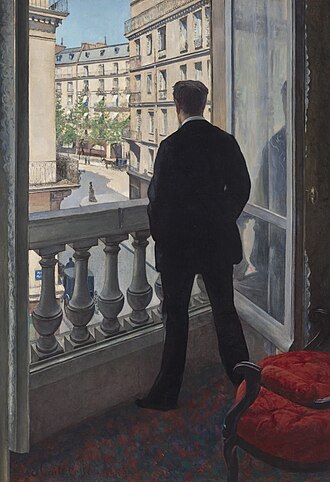 Jeune Homme à sa fenêtre - Gustave Caillebotte (1876)
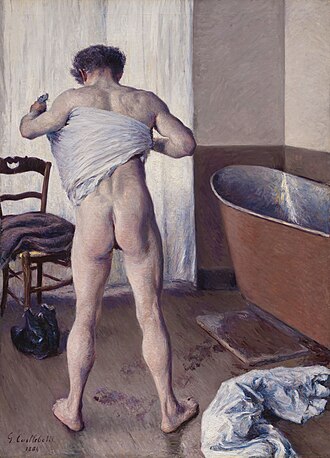 Homme au bain - Gustave Caillebotte (1884)
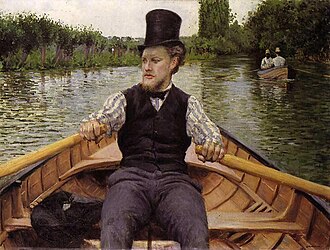 Partie de bateau - Gustave Caillebotte (1878)
Œuvres d'artistes liés
 Impression, soleil levant - Claude Monet (1872)
 Nymphéas - Claude Monet (1906)
 Le Déjeuner sur l'herbe - Édouard Manet (1863)
 Olympia - Édouard Manet (1863)
 Bal du moulin de la Galette - Pierre-Auguste Renoir (1876)
 Le Déjeuner des canotiers - Pierre-Auguste Renoir (1881)
 Le Berceau - Berthe Morisot (1872)
 Jour d'été - Berthe Morisot (1879)
 L'Absinthe - Edgar Degas (1875)
 La Famille Bellelli - Edgar Degas (1858)
 Le Canal du Loing - Alfred Sisley (1892)
 L'Abreuvoir à Marly-Le-Roi, gelée blanche - Alfred Sisley (1876)