La Place du Théâtre Français
Camille Pissarro · 1898
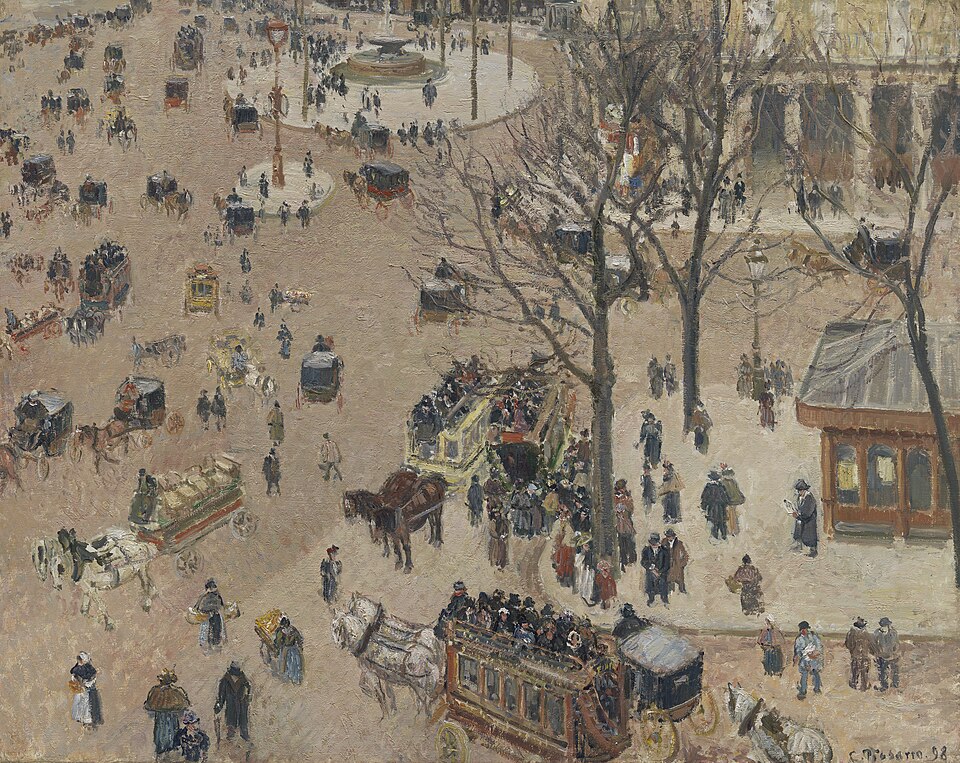
From a hotel window in the winter of 1898, Pissarro looked down on a Paris square full of carriages, horses and people of every class, and painted it as if the city were breathing below him.
The story behind the painting
On 15 December 1897 Pissarro told his son Lucien that he was going to stay at the Grand Hôtel du Louvre in Paris. He thought the view of the avenue de l'Opéra and the corner of the Place du Palais-Royal would make a fine subject, and he described these streets as silvery, luminous and alive. He rented a room with the right view and stayed until April, painting around 15 pictures of the rue Saint-Honoré, the avenue de l'Opéra and the Place du Théâtre Français from different angles and in different weather. This canvas, 72.4 by 92.7 cm, is one of them.
What to look for
We look down from a building a few storeys high. The wide open Place du Théâtre Français fills the foreground, where it turns into the avenue de l'Opéra, whose start is almost hidden. The theatre facade closes the composition on the right, and at the far end stands Charles Garnier's opera house. People from different social classes go about their day. Some figures, horses and carriages are cut off at the edges, which gives a sense of movement. There are no shadows at all, and the sunlight is the same everywhere, so the image looks flattened. Bright clothes appear only in front; further away colours grow subdued and figures lose detail.
Meaning and intent
The cropped figures, the even light and the fading detail make the picture feel like a photograph of a busy street, with the near things sharp and the far things soft. Scholars such as John Rewald, Leopold Reidemeister and Charles Kunstler compared Pissarro's paintings from the Hôtel du Louvre with photographs of the time. The absence of sky and horizon, and the background that seems to rise up the canvas, suggest parallels with Japanese prints. Pissarro was not painting a monument but everyday life, the ordinary flow of Parisians crossing a square, seen from above.
Legacy
Most of the pictures Pissarro made at the hotel that winter were shown in June 1898 at the Exposition d'oeuvres récentes de Camille Pissarro, organised by the dealer Paul Durand-Ruel. The series lets us follow the same streets through changing light and weather, as if Pissarro were keeping a diary from his window. This painting is now in the collection of the Los Angeles County Museum of Art in California, where the silvery, luminous, living Paris he wrote to Lucien about is still on view.
Le saviez-vous ?
- Painted in 1898 from a room at the Grand Hôtel du Louvre.
- One of about 15 views Pissarro made there.
- Garnier's opera house closes the view at the far end.
- Now in the Los Angeles County Museum of Art.
À propos de l'artiste
Camille Pissarro (1830-1903)
arbre · paysage urbain · musée d'Art du comté de Los Angeles · chariot hippomobile · place
Autres œuvres de Camille Pissarro
 Le Pont Boieldieu à Rouen, temps mouillé - Camille Pissarro (1896)
 Rue Saint-Honoré, Après-midi, Effet de Pluie - Camille Pissarro (1897)
 Boulevard Montmartre, Mardi Gras - Camille Pissarro (1897)
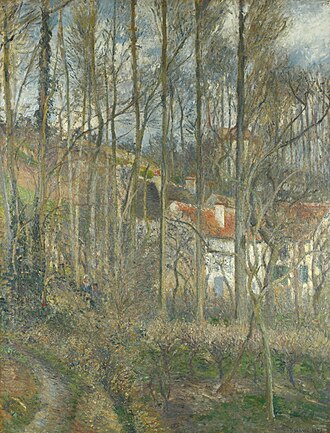 Côte des Bœufs à L'Hermitage, Pontoise - Camille Pissarro (1877)
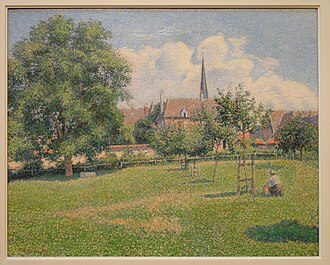 La Maison de La Sourde et Le Clocher D'Éragny - Camille Pissarro (1886)
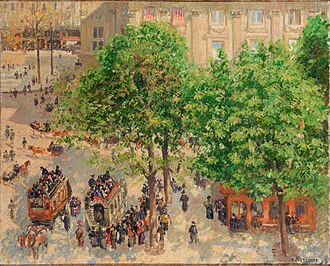 Place du Théâtre Français à Paris, printemps - Camille Pissarro (1898)
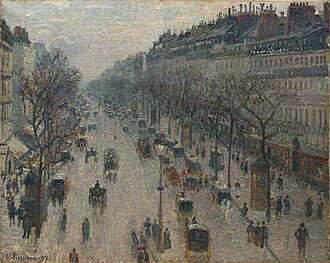 Boulevard Montmartre un matin d'hiver - Camille Pissarro (1897)
 Le Repos, paysanne couchée dans l´herbe, Pontoise - Camille Pissarro (1882)
Œuvres d'artistes liés
 Impression, soleil levant - Claude Monet (1872)
 Nymphéas - Claude Monet (1906)
 Le Déjeuner sur l'herbe - Édouard Manet (1863)
 Olympia - Édouard Manet (1863)
 Bal du moulin de la Galette - Pierre-Auguste Renoir (1876)
 Le Déjeuner des canotiers - Pierre-Auguste Renoir (1881)
 Le Berceau - Berthe Morisot (1872)
 Jour d'été - Berthe Morisot (1879)
 L'Absinthe - Edgar Degas (1875)
 La Famille Bellelli - Edgar Degas (1858)
 Le Canal du Loing - Alfred Sisley (1892)
 L'Abreuvoir à Marly-Le-Roi, gelée blanche - Alfred Sisley (1876)