Scène de cuisine
Diego Velázquez · 1618
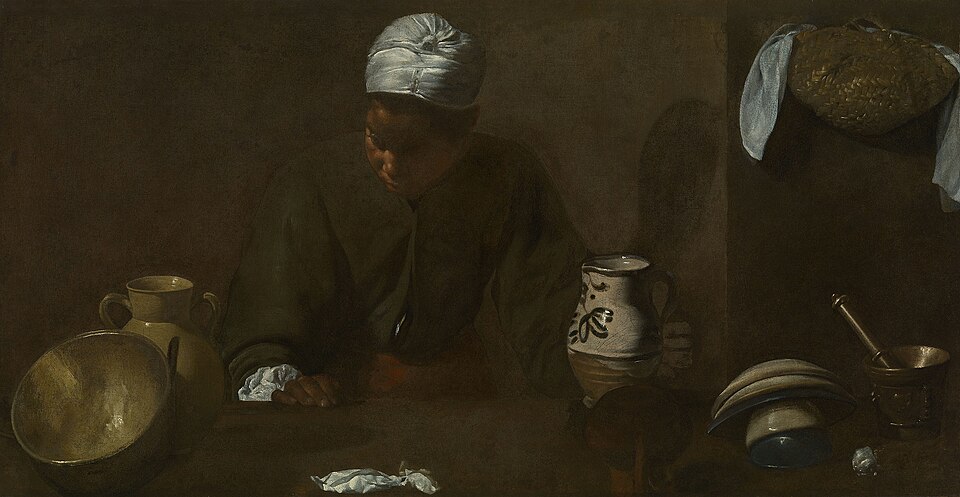
A young kitchen maid leans over her table of jugs and a mortar, absorbed in her work. Is this Chicago picture by the young Velázquez, a copy, or his own improved second try? Experts still disagree.
The story behind the painting
Velázquez painted two paired domestic scenes of a kitchen maid in his early Seville period. The first version is this one in the Art Institute of Chicago; the second, with the Supper at Emmaus in the background, is in the National Gallery of Ireland. Wikipedia notes a wide range of suggested dates, most between 1620 and 1622, while Wikidata gives 1618. José López-Rey linked the subject to a lost Velázquez kitchen still life described by Antonio Palomino, full of pots, jugs, a mortar and pestle and a head of garlic.
What to look for
The scene shows a mulatto maid working in a kitchen, with no religious episode at all. Look at her coif: the Chicago version has more folds at the top, with light and shadow handled with great care, as in the crumpled cloth in the foreground. The light on the objects is especially fine, above all on the glazed jug in her hand, where you can see the shine of the crackle glaze and the marks left when it was turned on a potter's wheel. Despite paint losses, the best preserved parts match or even surpass the Dublin picture.
Meaning and intent
The attribution has swung back and forth. August L. Mayer bought the picture from the Goudstikker gallery in Amsterdam and gave it to the Institute in 1927, then thought to be the original, with the Dublin painting a copy. Bernardino Pantorba and José Gudiol agreed. López-Rey later recognised the Dublin picture as by Velázquez and doubted Chicago because of its poor condition, and Jonathan Brown called it only possibly by him, perhaps a copy by an artist cashing in on Velázquez's success. One explanation for its finer technique is that Velázquez returned to the theme to improve it, focusing on touch and texture and dropping the religious motif.
Legacy
Frank Zuccari restored the Chicago painting in 1999, revealing the quality that has revived the case for Velázquez's own hand. Suggested influences include Flemish engravings by Jacob Matham. In 2018 the Museum of Fine Arts, Houston, announced the discovery of a third version, close to the Chicago one but cropped at left and right into an almost square format. The quiet maid among her jugs has thus become the centre of one of the liveliest attribution puzzles in Velázquez's early work.
Le saviez-vous ?
- One of two paired kitchen maid scenes from Velázquez's Seville years.
- Most dates suggested fall between 1620 and 1622 (Wikidata: 1618).
- Given to the Art Institute of Chicago in 1927.
- Restored in 1999; a third version was announced in Houston in 2018.
À propos de l'artiste
Diego Velázquez (1599-1660)
scène de genre · Art Institute of Chicago
Autres œuvres de Diego Velázquez
 Les Ménines - Diego Velázquez (1656)
 La Reddition de Bréda - Diego Velázquez (1635)
 Vénus à son miroir - Diego Velázquez (1644)
 Les Fileuses - Diego Velázquez
 Innocent X - Diego Velázquez
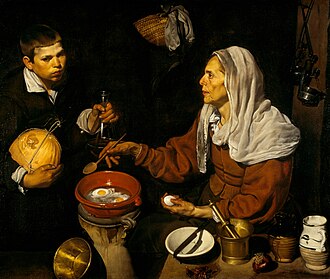 Vieille faisant frire des œufs - Diego Velázquez (1618)
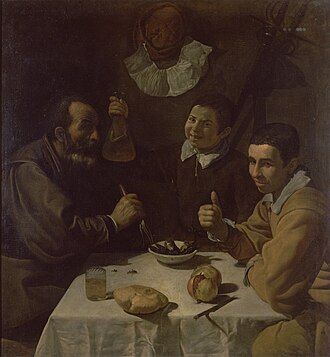 Trois hommes à table, le déjeuner - Diego Velázquez (1617)
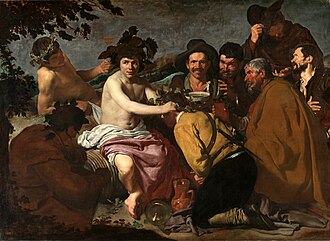 Le Triomphe de Bacchus - Diego Velázquez (1628)
Œuvres d'artistes liés
 Le Souper à Emmaüs - Caravaggio (1601)
 La Vocation de saint Matthieu - Caravaggio (1609)
 Saint Francis in Meditation - Francisco de Zurbarán (1639)
 The Immaculate Conception - Francisco de Zurbarán (1661)
 Triple portrait de Charles Ier - Anthony van Dyck (1635)
 Charles Ier à cheval avec Monsieur de Saint Antoine - Anthony van Dyck (1636)
 L'Érection de la croix - Peter Paul Rubens (1609)
 L'Enlèvement des filles de Leucippe - Peter Paul Rubens (1618)
 La Ronde de nuit - Rembrandt van Rijn (1642)
 Autoportrait - Rembrandt van Rijn (1659)
 Le Joyeux Buveur - Frans Hals (1620s)
 Le Cavalier riant - Frans Hals (1624)