La Tunique de Joseph
Diego Velázquez · 1630
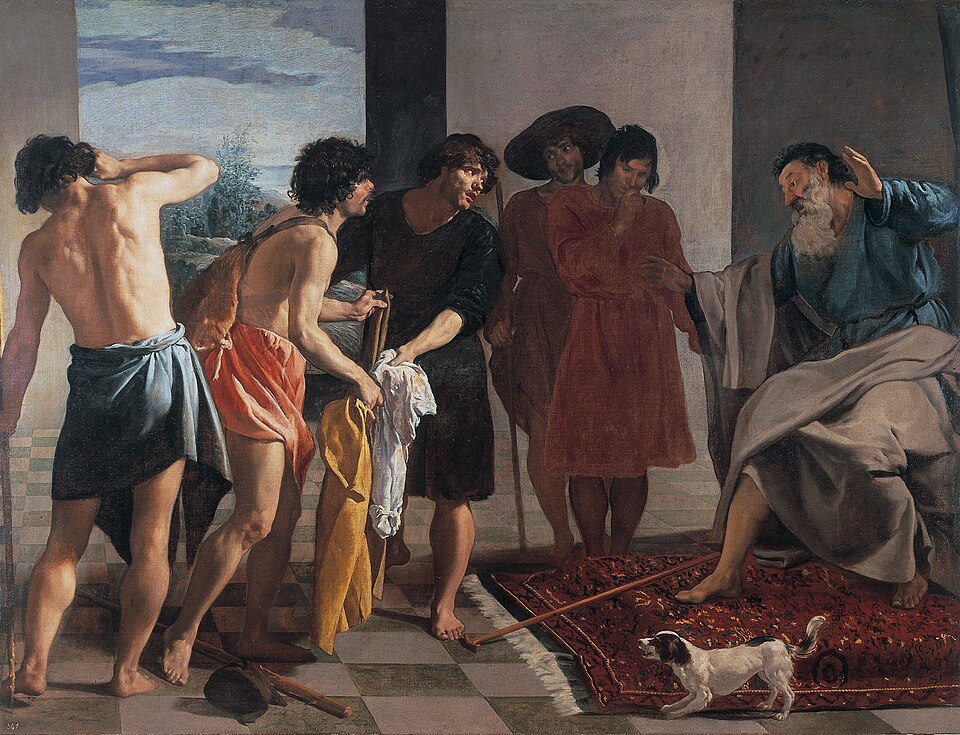
An old father nearly falls from his chair as his sons hold up a bloodied robe and tell him his favourite child is dead. Only a small dog in the corner seems to know they are lying. Velázquez painted this scene of deception during his first stay in Rome.
The story behind the painting
Joseph's Tunic, also known as Joseph's Bloodied Coat Presented to Jacob, is a 1630 oil painting by Velázquez. It tells the story from Genesis of Joseph's brothers, jealous of the favour shown to him, who sold him to an Ishmaelite caravan as a slave. To hide what they had done, they dipped his robe in goat's blood and brought it to their father Jacob. Velázquez painted the work during his first journey to Rome, while staying at the house of Manuel de Fonseca y Zúñiga, sixth Count of Monterrey and Spanish ambassador there. He later brought it back to Spain together with Apollo in the Forge of Vulcan.
What to look for
Two brothers in the centre, thought to be Reuben and Simeon, hold out the coat, their faces mixing concern and unease. To their left another brother turns away completely, as if overcome by guilt. On the far right Jacob almost falls out of his chair, his twisted pose conveying extreme distress. Two vaguely defined brothers stand in the background; some scholars think Velázquez considered turning that space into more landscape. In the bottom right corner a small dog barks at the brothers. Strong chiaroscuro models the bodies, and the checkerboard floor is laid out according to the rules of geometric perspective. The canvas is large, about 223 by 250 cm.
Meaning and intent
The central themes are deception and manipulation. The sons' words and a stained piece of cloth are enough to change Jacob's sense of reality, showing how words and stories can carry more power than actual deeds. The barking dog reinforces this, as if calling out the brothers' lie. Scholars often treat the painting as a pair with Apollo in the Forge of Vulcan, a mythological scene that also turns on the revelation of disturbing news. Both were painted without a royal commission, share a format and dramatic realism, and explore the power of words over human emotion.
Legacy
The painting shows Velázquez absorbing Italy. From Guercino, whose work he could have seen in Cento, came the use of light to single out key figures; from Caravaggio, tenebrism, sculptural bodies and lifelike skin. Tintoretto's Last Supper offers a similar tiled floor opening to landscape, Jacob and a shepherd recall Michelangelo's prophets Ezekiel and Jeremiah in the Sistine Chapel, and the dog echoes one in Guido Reni's Abduction of Helen. Both this work and its pendant later entered the Spanish royal collection. Today Joseph's Tunic hangs in the Sacristía Mayor of the Monastery of San Lorenzo de El Escorial.
Le saviez-vous ?
- Painted in 1630 during Velázquez's first stay in Rome.
- About 223 x 250 cm.
- Often paired with Apollo in the Forge of Vulcan.
- Now in the Monastery of San Lorenzo de El Escorial.
À propos de l'artiste
Diego Velázquez (1599-1660)
art religieux · baroque · chien · monastère royal de San Lorenzo de El Escorial
Autres œuvres de Diego Velázquez
 Les Ménines - Diego Velázquez (1656)
 La Reddition de Bréda - Diego Velázquez (1635)
 Vénus à son miroir - Diego Velázquez (1644)
 Les Fileuses - Diego Velázquez
 Innocent X - Diego Velázquez
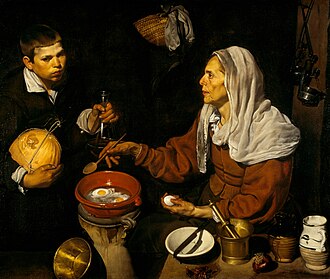 Vieille faisant frire des œufs - Diego Velázquez (1618)
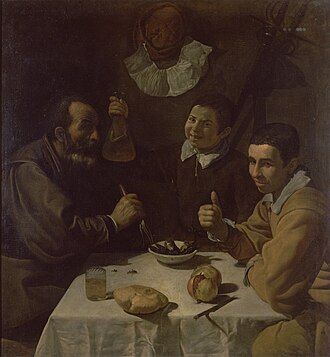 Trois hommes à table, le déjeuner - Diego Velázquez (1617)
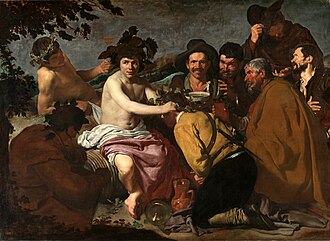 Le Triomphe de Bacchus - Diego Velázquez (1628)
Œuvres d'artistes liés
 Le Souper à Emmaüs - Caravaggio (1601)
 La Vocation de saint Matthieu - Caravaggio (1609)
 Saint Francis in Meditation - Francisco de Zurbarán (1639)
 The Immaculate Conception - Francisco de Zurbarán (1661)
 Triple portrait de Charles Ier - Anthony van Dyck (1635)
 Charles Ier à cheval avec Monsieur de Saint Antoine - Anthony van Dyck (1636)
 L'Érection de la croix - Peter Paul Rubens (1609)
 L'Enlèvement des filles de Leucippe - Peter Paul Rubens (1618)
 La Ronde de nuit - Rembrandt van Rijn (1642)
 Autoportrait - Rembrandt van Rijn (1659)
 Le Joyeux Buveur - Frans Hals (1620s)
 Le Cavalier riant - Frans Hals (1624)