Hercule et Omphale
Pierre Paul Rubens · 1602
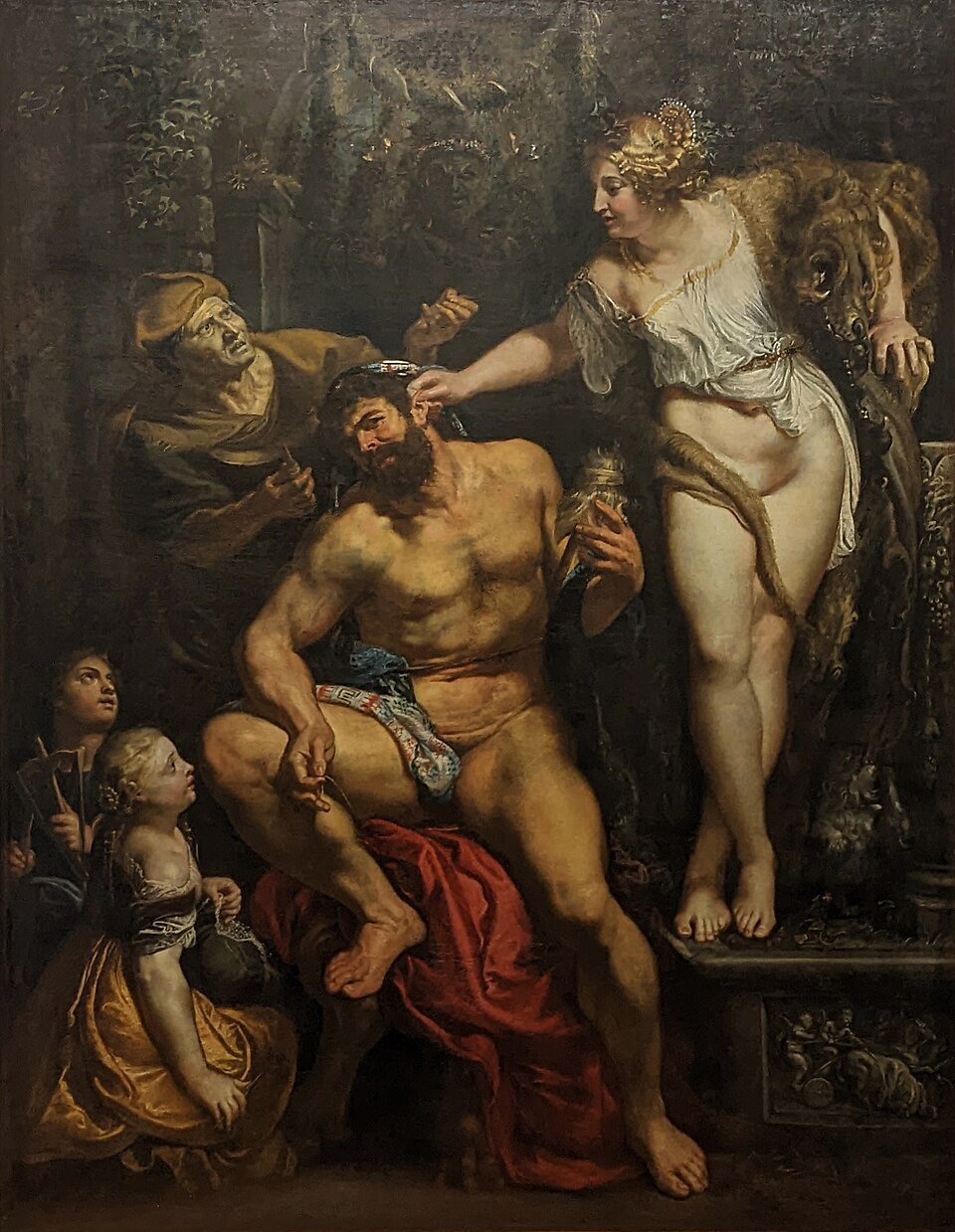
The strongest hero of myth sits spinning wool in a woman's headscarf while a queen in his lion skin pinches his ear. The young Rubens painted this role reversal in Italy for a Genoese patron.
The story behind the painting
Rubens painted Hercules and Omphale for the Genoese patron Giovanni Vincenzo Imperiale, who kept it until 1648; it was the companion piece to a Death of Adonis. The French Wikipedia dates it 1603, Wikidata 1602. It is large, 278 by 215 cm. It then passed through famous hands: Imperiale Francesco Maria in 1661, Charles II of Gonzaga, Queen Christina of Sweden by 1685, Livio Odescalchi, Duke of Bracciano, in 1721, the Duke of Orléans, and finally King Louis XVI, who acquired it with the château of Saint-Cloud in 1785.
What to look for
Both are nude. Queen Omphale dominates, standing on the right on the base of a sarcophagus, wearing the lion skin and leaning on the hero's club. Hercules, in a woman's scarf, sits at the centre on a seat with animal feet, over the queen's red cloak, holding a distaff in one hand and thread in the other, while she pinches his ear. A servant dressed as a woman spins behind him, young servants kneel at left, a white dog, a symbol of fidelity, lies by her feet, and a bust of Pan watches from the ancient architecture.
Meaning and intent
After his labours, and after a madness in which he killed his family, Hercules was sentenced by the Delphic oracle to a year of servitude and bought as a slave by Omphale, queen of Lydia. In the most common version she admired him, took him as lover, freed him and married him. But Ovid, Lucian, Propertius and Seneca tell how she made him wear women's clothes and spin wool, while she took his lion skin and club; in Seneca she even slaps him with her slipper. Painters loved this playful reversal of male and female roles in love.
Legacy
The theme was taken up in the seventeenth and above all the eighteenth century, when interest moved from Hercules's labours to his loves, and the works of Rubens, Boucher and François Lemoyne are among its most famous images. Rubens's canvas entered the French royal collection with Louis XVI and is now in the Louvre. It was restored from 1973 to 1983. On the sarcophagus near the hero's feet, a relief shows a bull brought down by a chariot, a small detail worth seeking out.
Le saviez-vous ?
- Painted for Giovanni Vincenzo Imperiale of Genoa as a pair to a Death of Adonis.
- Dated 1603 by French Wikipedia, 1602 by Wikidata.
- Owned by Queen Christina of Sweden and acquired by Louis XVI in 1785.
- Restored between 1973 and 1983.
À propos de l'artiste
Pierre Paul Rubens (1577-1640)
département des peintures du musée du Louvre · peinture mythologique · nu · nudité · fille · regard vers le spectateur · domestique · Héraclès
Autres œuvres de Pierre Paul Rubens
.jpg) L'Érection de la croix - Peter Paul Rubens (1609)
L'Érection de la croix - Peter Paul Rubens (1609)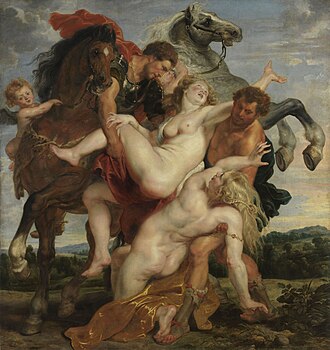 L'Enlèvement des filles de Leucippe - Peter Paul Rubens (1618)
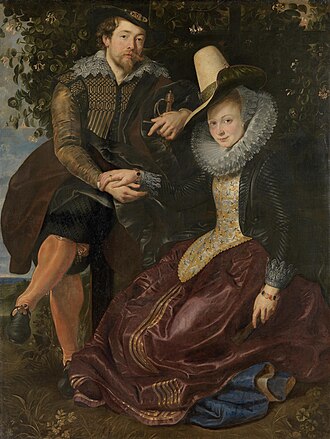 Sous la tonnelle de chèvrefeuille - Peter Paul Rubens (1600s)
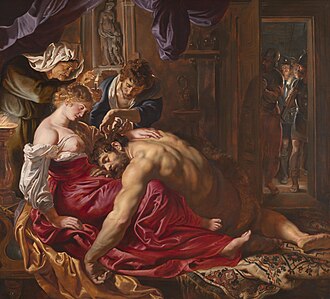 Samson et Dalila - Peter Paul Rubens (1600s)
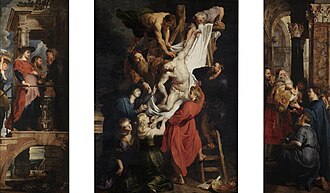 La Descente de Croix - Peter Paul Rubens (1611)
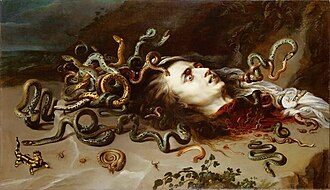 Tête de Méduse - Peter Paul Rubens (1618)
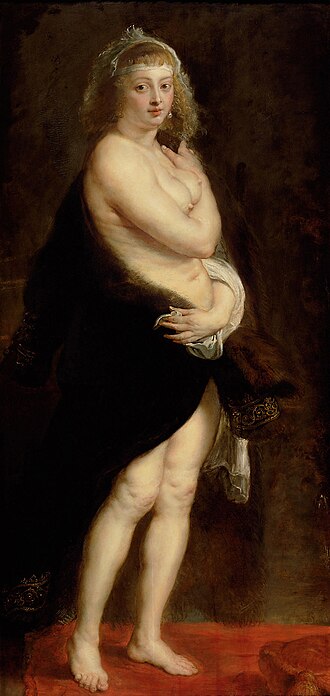 Hélène Fourment sortant du bain - Peter Paul Rubens (1638)
.jpg) Le Jardin d'Amour - Peter Paul Rubens (1632)
Le Jardin d'Amour - Peter Paul Rubens (1632)
Œuvres d'artistes liés
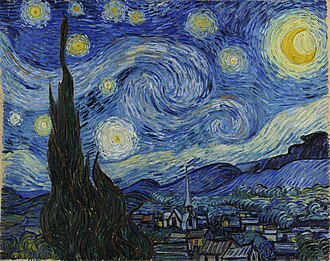 La Nuit étoilée - Vincent van Gogh (1889)
.jpg) Terrasse du café le soir - Vincent van Gogh (1888)
Terrasse du café le soir - Vincent van Gogh (1888) Le Souper à Emmaüs - Caravaggio (1601)
 La Vocation de saint Matthieu - Caravaggio (1609)
 Les Ménines - Diego Velázquez (1656)
 La Reddition de Bréda - Diego Velázquez (1635)
%20-%20Google%20Art%20Project.jpg) Triple portrait de Charles Ier - Anthony van Dyck (1635)
Triple portrait de Charles Ier - Anthony van Dyck (1635)%20with%20M.%20de%20St%20Antoine%20-%20Google%20Art%20Project.jpg) Charles Ier à cheval avec Monsieur de Saint Antoine - Anthony van Dyck (1636)
Charles Ier à cheval avec Monsieur de Saint Antoine - Anthony van Dyck (1636) La Ronde de nuit - Rembrandt van Rijn (1642)
 Autoportrait - Rembrandt van Rijn (1659)
 La Jeune Fille à la perle - Johannes Vermeer (1665)
 La Laitière - Johannes Vermeer (c. 1658)