Trophée de chasse
Diego Velázquez · 1627
.jpg)
A stag's head, alive and alert, glows out of a dark ground, caught in a few quick, confident strokes. Most critics give it to Velázquez, yet nobody agrees on when he painted it, or whether it is the stag named in the old royal inventories.
The story behind the painting
Known in Spanish as Cabeza de venado, head of a stag, this oil on canvas is attributed to Velázquez by almost all critics. The exceptions are Enriqueta Harris, who does not mention it, and Bernardino de Pantorba, who doubted its authenticity in 1955. Its date is disputed. Most critics place it at the end of the 1630s, but José López-Rey argued for 1626 to 1628, citing a 1636 inventory of the royal Alcázar that records a stag's antler painted by Velázquez, inscribed as killed by King Philip IV in 1626. The Prado's technical study of the canvas preparation and paint handling is said to support López-Rey, and Wikidata gives the year 1627.
What to look for
The canvas measures about 66 by 52 cm and is in good condition, despite some paint losses at the edges; it may have been cut down. Look at how the paint is laid on: fast, precise brushstrokes with hardly any corrections, and bright touches of light loaded with paint that create a luminous halo around the animal's coat. This handling has been compared to Velázquez's Prince Baltasar Carlos on Horseback of 1636. The animal here is alive, not a trophy hung on a wall, which is one reason some scholars think the description of a horn or antler in the inventories fits a different picture better.
Meaning and intent
The painting sits at the edge of the royal hunt, a world in which a stag killed by the king could be worth recording in paint. Yet the identification with the inventories is problematic. The 1636 inventory gives dimensions of about 105 by 105 cm, the 1700 inventory says the picture was too damaged to be valued, and a stag's head with its antler was rescued from the Alcázar fire of 1734 with slightly larger dimensions. After 1747 it is no longer mentioned in the royal collections. The smaller, well-preserved Prado canvas is hard to match with that damaged record.
Legacy
Another candidate is a stag's head in the Spanish National Heritage collection at the Palace of El Pardo, bought for Isabella II from the Marquis of Salamanca and linked to Velázquez by Antonio Ponz. Alfonso E. Pérez Sánchez suggested that an original Velázquez antler was heavily restored and enlarged there by another painter, perhaps Juan García de Miranda. José López-Rey and Jonathan Brown left that picture out of their catalogues. The Prado canvas was bought in 1920 by Fernando de Aragón y Carrillo de Albornoz, Marquis of Casa Torres, and has been in the Museo del Prado since his donation in 1975.
Le saviez-vous ?
- Attributed to Velázquez by almost all critics.
- Dated late 1630s by most critics, 1626-1628 by López-Rey; Wikidata gives 1627.
- About 66 x 52 cm.
- In the Museo del Prado since a 1975 donation.
À propos de l'artiste
Diego Velázquez (1599-1660)
musée du Prado · baroque · ciel · nuage · art animalier · tête
Autres œuvres de Diego Velázquez
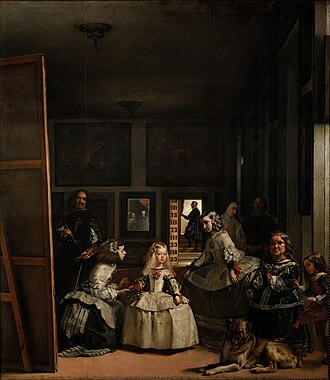 Les Ménines - Diego Velázquez (1656)
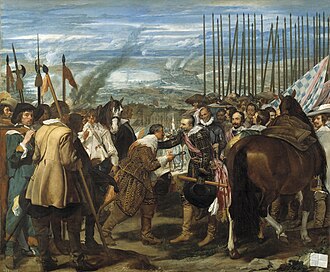 La Reddition de Bréda - Diego Velázquez (1635)
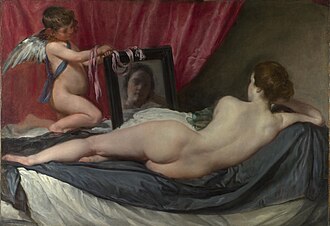 Vénus à son miroir - Diego Velázquez (1644)
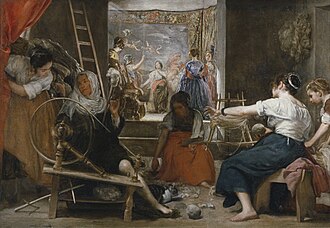 Les Fileuses - Diego Velázquez
.jpg) Innocent X - Diego Velázquez
Innocent X - Diego Velázquez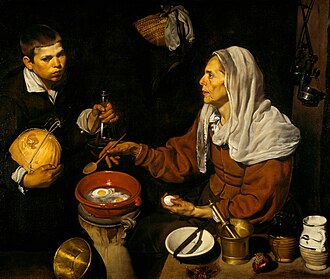 Vieille faisant frire des œufs - Diego Velázquez (1618)
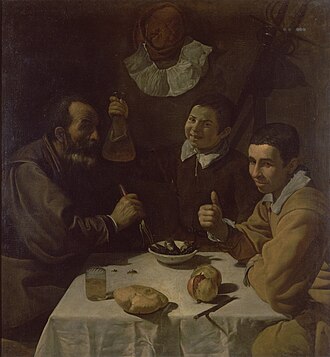 Trois hommes à table, le déjeuner - Diego Velázquez (1617)
.jpg) Le Triomphe de Bacchus - Diego Velázquez (1628)
Le Triomphe de Bacchus - Diego Velázquez (1628)
Œuvres d'artistes liés
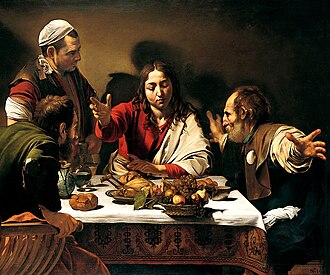 Le Souper à Emmaüs - Caravaggio (1601)
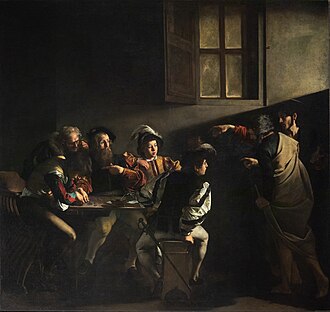 La Vocation de saint Matthieu - Caravaggio (1609)
.jpg) L'Érection de la croix - Peter Paul Rubens (1609)
L'Érection de la croix - Peter Paul Rubens (1609)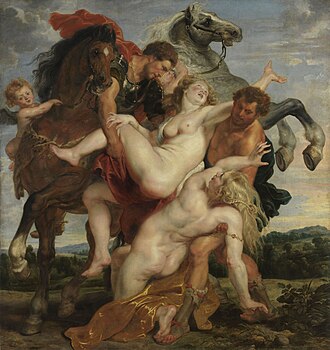 L'Enlèvement des filles de Leucippe - Peter Paul Rubens (1618)
%20-%20Google%20Art%20Project.jpg) Triple portrait de Charles Ier - Anthony van Dyck (1635)
Triple portrait de Charles Ier - Anthony van Dyck (1635)%20with%20M.%20de%20St%20Antoine%20-%20Google%20Art%20Project.jpg) Charles Ier à cheval avec Monsieur de Saint Antoine - Anthony van Dyck (1636)
Charles Ier à cheval avec Monsieur de Saint Antoine - Anthony van Dyck (1636)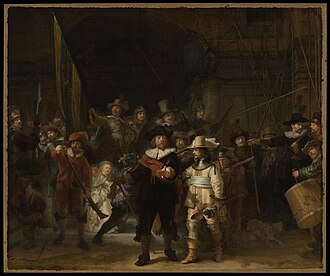 La Ronde de nuit - Rembrandt van Rijn (1642)
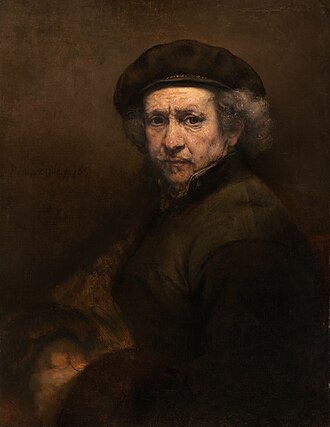 Autoportrait - Rembrandt van Rijn (1659)
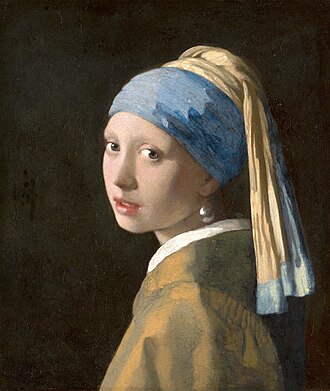 La Jeune Fille à la perle - Johannes Vermeer (1665)
 La Laitière - Johannes Vermeer (c. 1658)