La Récolte des pommes de terre
Camille Pissarro · 1874
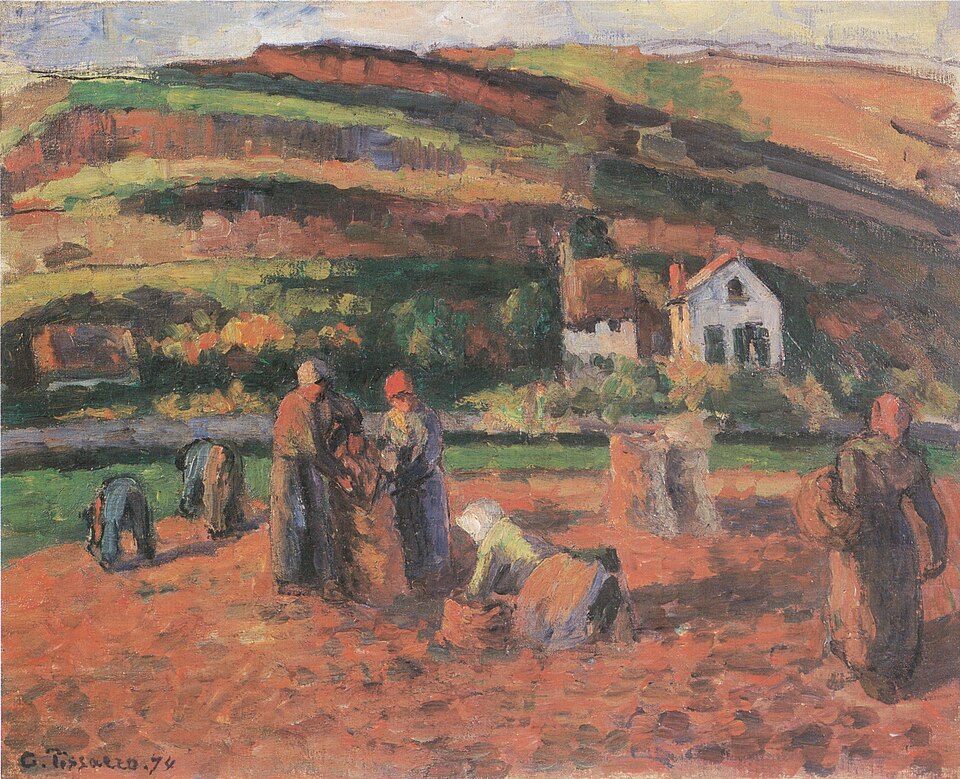
Six figures bend and fill baskets in a potato field by the Oise. In 1874 Pissarro laid on the colour with a knife instead of a brush, building a rough relief that later painters would follow.
The story behind the painting
La Récolte des pommes de terre, Pontoise was painted by Camille Pissarro in 1874 in Pontoise, where several artists lived at the time. It belongs to a phase in which he experimented with a new technique, applying paint roughly with a knife rather than a brush to create new effects. On 11 December 1874 he wrote to his friend Théodore Duret about this new technique, and Duret encouraged him to keep working on the subject. Over the next three years Pissarro made many similar pictures.
What to look for
In the foreground six people, four women and two men, harvest potatoes in a field in the Oise valley. Some bend to take potatoes from the loosened soil, others fill baskets and sacks. Behind them a group of farm buildings dominates the middle ground, with a village further back on the left. The hill was raised to serve as a backdrop for the figures, which look arranged, as if placed on a chessboard. Look at the strong, bright colours, laid on in an uneven layer that forms a relief. The canvas is small, about 33 by 41 cm.
Meaning and intent
The scene shows a division of labour that was modern for its time, unlike the traditional farming in the pictures of Jean-François Millet. The subject still recalls Millet, whose famous Angelus, with only two figures, was also inspired by the potato harvest; Pissarro probably knew it from Durand-Ruel's gallery. Courbet had used the palette knife too, but to smooth the surface for his realism, while Pissarro used it to build texture. With this he anticipated the landscapes of Gauguin, Van Gogh and the Fauves. Critics of the time often misread these pictures as following Millet rather than Renoir, Monet and Degas.
Legacy
The painting came from the artist's estate and passed through his eldest son, Lucien Pissarro, into a London private collection, where it stayed until about 1940. It was auctioned at Christie's in 1995 and is today in an unknown private collection. It has been widely exhibited: at the Kunsthalle Bremen in 1910, in London in 1911, in a Paris retrospective in 1914, at the Tate and other British galleries in 1931 to 1932, and in 2005 to 2006 in Pioneering Modern Painting: Cézanne and Pissarro at MoMA, Los Angeles and the Musée d'Orsay.
Le saviez-vous ?
- Painted by Pissarro in Pontoise in 1874, about 33 x 41 cm.
- Paint applied with a palette knife, building a relief-like surface.
- Six figures: four women and two men harvesting potatoes.
- Today in an unknown private collection.
À propos de l'artiste
Camille Pissarro (1830-1903)
femme · maison · champ · colline
Autres œuvres de Camille Pissarro
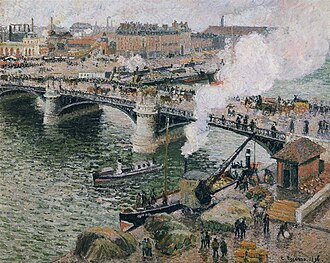 Le Pont Boieldieu à Rouen, temps mouillé - Camille Pissarro (1896)
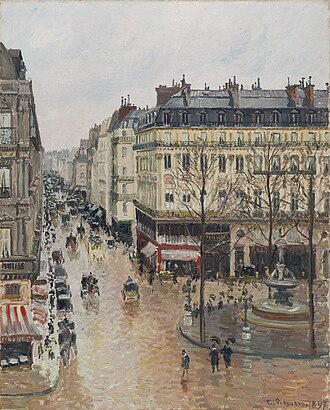 Rue Saint-Honoré, Après-midi, Effet de Pluie - Camille Pissarro (1897)
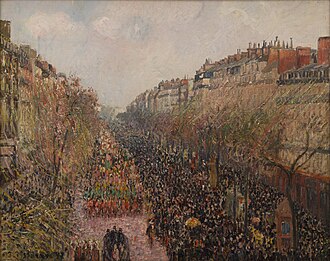 Boulevard Montmartre, Mardi Gras - Camille Pissarro (1897)
 Côte des Bœufs à L'Hermitage, Pontoise - Camille Pissarro (1877)
 La Maison de La Sourde et Le Clocher D'Éragny - Camille Pissarro (1886)
 Place du Théâtre Français à Paris, printemps - Camille Pissarro (1898)
 Boulevard Montmartre un matin d'hiver - Camille Pissarro (1897)
 Le Repos, paysanne couchée dans l´herbe, Pontoise - Camille Pissarro (1882)
Œuvres d'artistes liés
 Impression, soleil levant - Claude Monet (1872)
 Nymphéas - Claude Monet (1906)
 Le Déjeuner sur l'herbe - Édouard Manet (1863)
 Olympia - Édouard Manet (1863)
 Bal du moulin de la Galette - Pierre-Auguste Renoir (1876)
 Le Déjeuner des canotiers - Pierre-Auguste Renoir (1881)
 Le Berceau - Berthe Morisot (1872)
 Jour d'été - Berthe Morisot (1879)
 L'Absinthe - Edgar Degas (1875)
 La Famille Bellelli - Edgar Degas (1858)
 Le Canal du Loing - Alfred Sisley (1892)
 L'Abreuvoir à Marly-Le-Roi, gelée blanche - Alfred Sisley (1876)