Francisco de Ocáriz y Ochoa
Diego Velázquez · 1630s
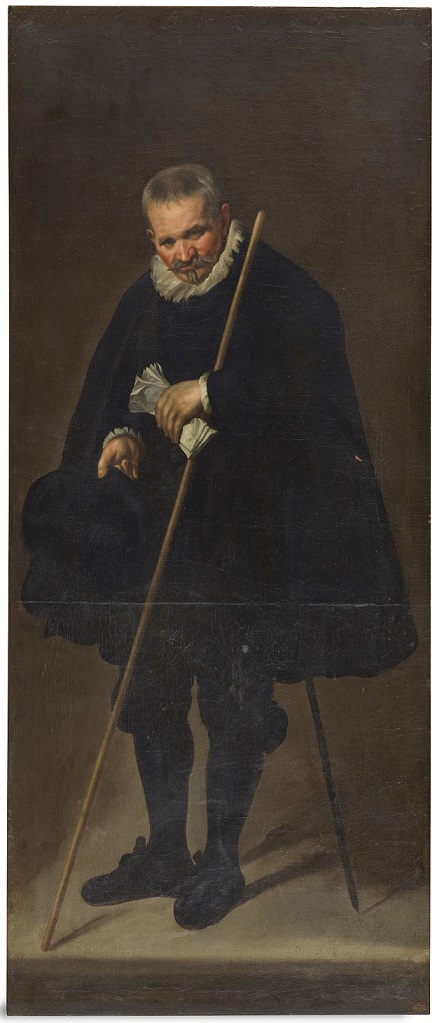
A man in strict black lifts his hat in greeting, a staff and papers in his other hand, standing in a space with no line between floor and wall. Velázquez's portrait of this court entertainer is lost, and we know it only through Goya and an old copy.
The story behind the painting
Diego Velázquez painted this oil on canvas portrait in the 1630s. It showed Francisco de Ocáriz y Ochoa, a buffoon, or as they were called at the time a man of pleasure, of King Philip IV, between 1633 and 1638. It belonged to a set of five or six portraits of buffoons, the strangest group of images among those that decorated the Buen Retiro Palace. The set was probably ordered by the king to keep a memory of their wit. The original is lost today, and its whereabouts are unknown.
What to look for
The figure stands in a space built the same way as in Pablo de Valladolid, probably the finest portrait of the series, with no line separating floor and wall. Staff, feet and sword are the three points of Ocáriz's shadow, the only spatial clue in a continuous, enigmatic space. He is dressed in strict black, as performing before the king required elegance, with a short cape. He holds a staff and petitions in one hand and with the other takes off his hat in greeting. We know this appearance from an etching by Goya of around 1778 to 1785 and an anonymous copy.
Meaning and intent
The archive records and his costume let scholars identify him: all of it points to the office of portero de vara, the staff-bearing usher who attended the court magistrates at trials. According to the scholar Cruz Valdovinos, the buffoon portraits were probably all painted showing each man in his own act, in his typical character and in a pose linked to his routine. In this case Ocáriz y Ochoa would have performed a comic act about trials and judges, and Velázquez preserved the role as much as the man.
Legacy
For a long time the picture was known as Alcalde Ronquillo, perhaps because Antonio Ponz used that name in his Viage de España after seeing it in the royal collections. One inventory even called it Alcalde de Zalamea, also wrongly. The anonymous copy belonged to the collection of the Marquis of Casa-Torres and then, by inheritance, to Queen Fabiola of Belgium. Missing for decades, it was bought by the Spanish Ministry of Culture for the Museo del Prado and deposited there in December 2020, so visitors can now see the lost portrait's likeness.
Le saviez-vous ?
- Painted by Velázquez in the 1630s; the original is lost.
- Part of the series of court buffoon portraits for the Buen Retiro Palace.
- Known through a Goya etching and an anonymous copy.
- The copy was deposited at the Prado in December 2020.
À propos de l'artiste
Diego Velázquez (1599-1660)
Autres œuvres de Diego Velázquez
 Les Ménines - Diego Velázquez (1656)
 La Reddition de Bréda - Diego Velázquez (1635)
 Vénus à son miroir - Diego Velázquez (1644)
 Les Fileuses - Diego Velázquez
 Innocent X - Diego Velázquez
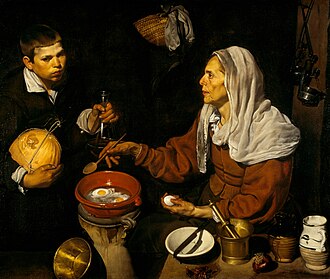 Vieille faisant frire des œufs - Diego Velázquez (1618)
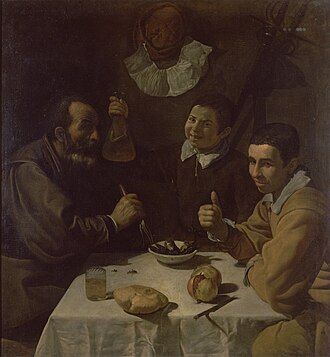 Trois hommes à table, le déjeuner - Diego Velázquez (1617)
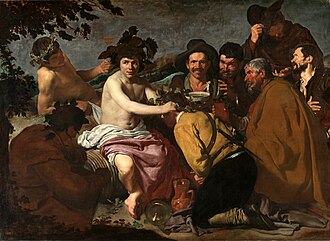 Le Triomphe de Bacchus - Diego Velázquez (1628)
Œuvres d'artistes liés
 Le Souper à Emmaüs - Caravaggio (1601)
 La Vocation de saint Matthieu - Caravaggio (1609)
 Saint Francis in Meditation - Francisco de Zurbarán (1639)
 The Immaculate Conception - Francisco de Zurbarán (1661)
 Triple portrait de Charles Ier - Anthony van Dyck (1635)
 Charles Ier à cheval avec Monsieur de Saint Antoine - Anthony van Dyck (1636)
 L'Érection de la croix - Peter Paul Rubens (1609)
 L'Enlèvement des filles de Leucippe - Peter Paul Rubens (1618)
 La Ronde de nuit - Rembrandt van Rijn (1642)
 Autoportrait - Rembrandt van Rijn (1659)
 Le Joyeux Buveur - Frans Hals (1620s)
 Le Cavalier riant - Frans Hals (1624)