Esther devant Assuérus
Le Tintoret · 1547
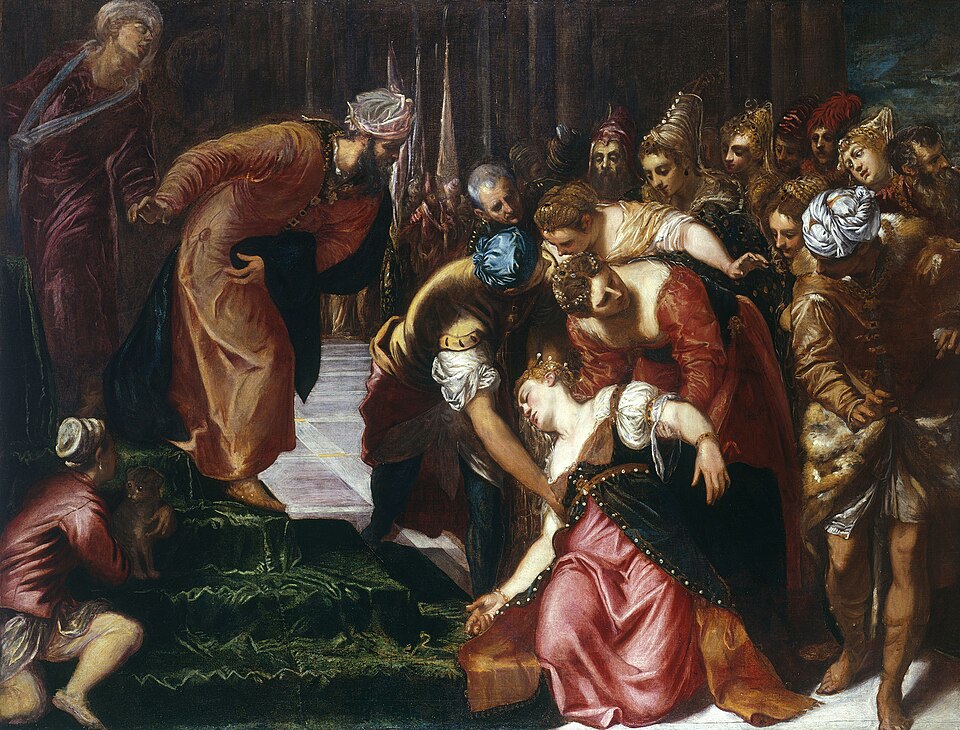
A queen collapses at the feet of a king who could have her killed for coming uninvited. Tintoretto, still in his late twenties, turned that dangerous moment into a large Venetian canvas full of colour and sudden light.
The story behind the painting
Tintoretto painted this large canvas around 1546 to 1547, early in his career, when he was still in his late twenties, shortly before his first major commission, Saint Mark Rescuing the Slave. The date rests largely on style; Wikidata gives 1547. The scene comes only from the Greek additions to the Book of Esther, which the Catholic Church confirmed as canonical at the Council of Trent in April 1546, around the time the picture is thought to have been made, which may have shaped the choice of subject. The first owner is unknown, and it was probably made for a secular setting despite its religious theme.
What to look for
Queen Esther goes to her husband, King Ahasuerus of Persia, to plead for the Jewish people, knowing that entering his inner court uninvited is punishable by death, and she faints. Notice how unevenly finished the canvas is, with intense colour and dramatic contrasts of light typical of Venetian painting. The king's robe has changed over time: its orange yellow orpiment pigment has altered, though it once matched the splendid gold robe of the biblical text. Look behind the king, too. Haman now appears twice, once as a faint overpainted figure and once among the distant figures with soldiers and banners on the right.
Meaning and intent
Few artists had painted Esther's faint before Tintoretto, although Botticelli showed it in a series of cassone scenes in the 1470s. Catholic theology saw Esther as a forerunner of the Virgin Mary: both were intercessors, and the exception the king made for Esther was read as a parallel to Mary's Immaculate Conception. Viewers of the time would probably have recognised in the fainting queen the familiar Swoon of the Virgin from scenes of the Crucifixion. So the painting joins a tense court drama to a quiet, devotional idea of mercy won through courage.
Legacy
Tintoretto himself changed the composition, painting a boy in armour over two figures behind the king. Later a restorer removed that boy, and another figure of clearly inferior quality was added back; in 1950 the restorer Sebastian Isepp's proposal to remove it was accepted, leaving what we see today. The painting hung in the Gonzaga collection in Mantua by 1627, was acquired by Charles I, sold after his execution and recovered by the royal family at the Restoration. It has been in the Royal Collection since the 1620s, and Esther's faint became far more popular in Baroque art, as in Artemisia Gentileschi's version.
Le saviez-vous ?
- Painted around 1546-1547, early in Tintoretto's career.
- The scene comes from the Greek additions to the Book of Esther.
- Haman appears twice after centuries of overpainting and restoration.
- In the Royal Collection of the United Kingdom since the 1620s.
À propos de l'artiste
Le Tintoret (1518-1594)
art religieux · National Gallery · Royal Collection · Assuérus · Esther
Autres œuvres de Le Tintoret
 La Cène - Jacopo Tintoretto (1563)
 Miracle de l'esclave - Jacopo Tintoretto (1540s)
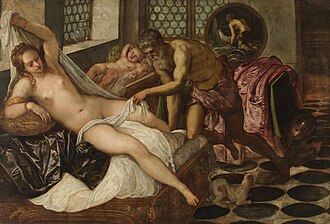 Vénus, Mars et Vulcain - Jacopo Tintoretto (1555)
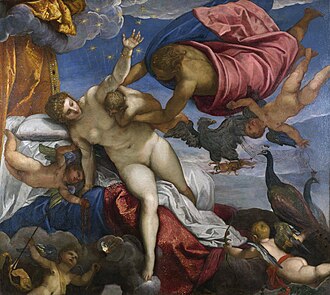 L'Origine de la Voie lactée - Jacopo Tintoretto (1575)
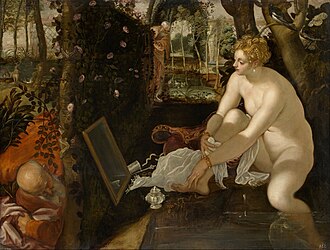 Suzanne et les Vieillards - Jacopo Tintoretto (1550s)
 Le corps de saint Marc ramené à Venise - Jacopo Tintoretto (1560s)
 La Découverte du corps de saint Marc - Jacopo Tintoretto (1562)
 Le Paradis - Jacopo Tintoretto
Œuvres d'artistes liés
 Vénus d'Urbin - Titian (1538)
 L'Assomption de la Vierge - Titian (1510s)
 Les Noces de Cana - Paolo Veronese (1560s)
 Le Repas chez Levi - Paolo Veronese (1573)