La Reine Isabelle de France à cheval
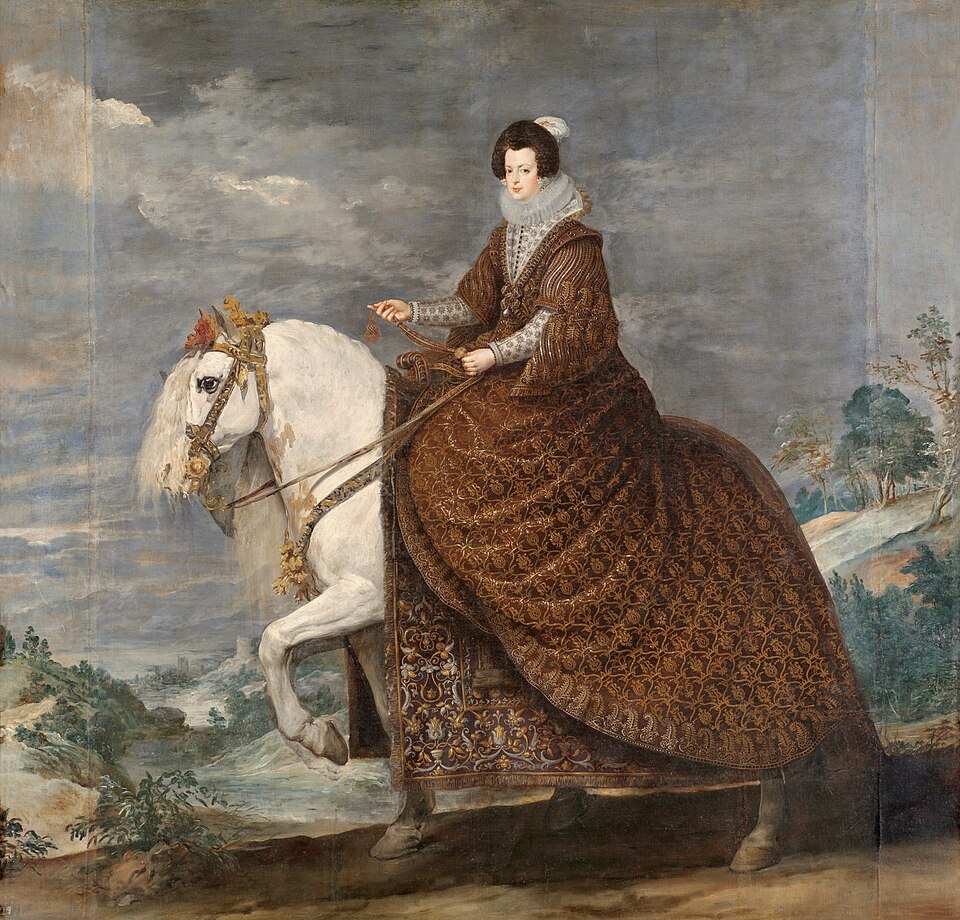
A queen in profile on a dappled horse, her skirt heavy with gold embroidery. X-rays show that under this splendour lies a simpler, earlier painting.
The story behind the painting
Around 1635 Velázquez was commissioned to paint five equestrian portraits of the Spanish royal family for the Hall of Realms in the Buen Retiro Palace in Madrid: Philip III and Queen Margaret of Austria, Philip IV, his wife Elisabeth of France, and their son Balthasar Charles. This is the queen's portrait. Technical studies at the Prado led by Carmen Garrido found that the five were painted at the same time with the same preparation.
What to look for
Elisabeth rides in profile, wearing a jacket embroidered with stars and a gold-embroidered skirt bearing her arms and initials. The horse is a piebald, an overo, with a long mane and a forelock falling over its face, moving in the passage gait. The large canvas measures about 301 by 314 cm. Look closely at the embroidery, so fine it was added by a patient hand after the main painting, and at the forelock hiding the horse's eyes. The profile pose keeps the queen still and composed while the horse moves beneath her.
Meaning and intent
The horse faces left so that it mirrors the portrait of her husband, Philip IV, whose horse faces right; the two were meant to be read together in the hall. Between them hung the smaller portrait of their son. The queen's calm profile and the rich embroidery speak of royal dignity rather than movement. Together the five portraits presented a dynasty: two generations of kings and queens, and the young heir in the middle. The queen's place in that series mattered as much as her likeness.
Legacy
The work had significant input from Velázquez's workshop. Several critics support the idea that Velázquez reworked an earlier painter's canvas: X-rays reveal a painting underneath, where the horse's girth is visible and the queen's dress is simpler. Later, while Velázquez finished the queen's head and the horse's legs, a more patient painter added the fine embroidery, covering earlier passages. The portrait has been in the Prado since it opened in 1819.
Le saviez-vous ?
- Painted around 1635 for the Hall of Realms in the Buen Retiro Palace.
- One of five royal equestrian portraits painted at the same time.
- X-rays reveal a simpler painting underneath.
- In the Prado since the museum opened in 1819.
À propos de l'artiste
Diego Velázquez (1599-1660)
musée du Prado · cheval · équitation · portrait équestre · Toison d'or · gemme
Autres œuvres de Diego Velázquez
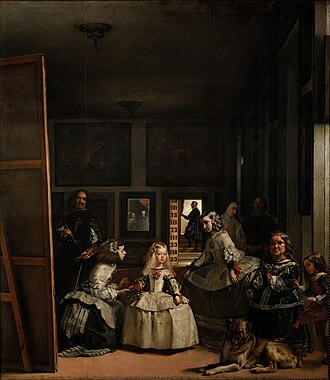 Les Ménines - Diego Velázquez (1656)
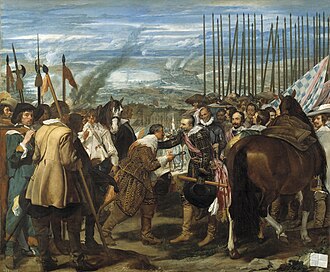 La Reddition de Bréda - Diego Velázquez (1635)
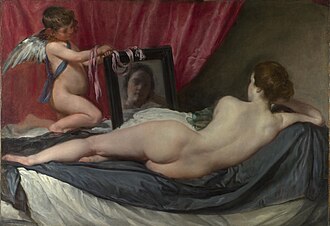 Vénus à son miroir - Diego Velázquez (1644)
 Les Fileuses - Diego Velázquez
.jpg) Innocent X - Diego Velázquez
Innocent X - Diego Velázquez Vieille faisant frire des œufs - Diego Velázquez (1618)
 Trois hommes à table, le déjeuner - Diego Velázquez (1617)
.jpg) Le Triomphe de Bacchus - Diego Velázquez (1628)
Le Triomphe de Bacchus - Diego Velázquez (1628)
Œuvres d'artistes liés
 Le Souper à Emmaüs - Caravaggio (1601)
 La Vocation de saint Matthieu - Caravaggio (1609)
.jpg) L'Érection de la croix - Peter Paul Rubens (1609)
L'Érection de la croix - Peter Paul Rubens (1609) L'Enlèvement des filles de Leucippe - Peter Paul Rubens (1618)
%20-%20Google%20Art%20Project.jpg) Triple portrait de Charles Ier - Anthony van Dyck (1635)
Triple portrait de Charles Ier - Anthony van Dyck (1635)%20with%20M.%20de%20St%20Antoine%20-%20Google%20Art%20Project.jpg) Charles Ier à cheval avec Monsieur de Saint Antoine - Anthony van Dyck (1636)
Charles Ier à cheval avec Monsieur de Saint Antoine - Anthony van Dyck (1636) La Ronde de nuit - Rembrandt van Rijn (1642)
 Autoportrait - Rembrandt van Rijn (1659)
 La Jeune Fille à la perle - Johannes Vermeer (1665)
 La Laitière - Johannes Vermeer (c. 1658)