Portrait de l'empereur Maximilien Ier
Albrecht Dürer · 1519
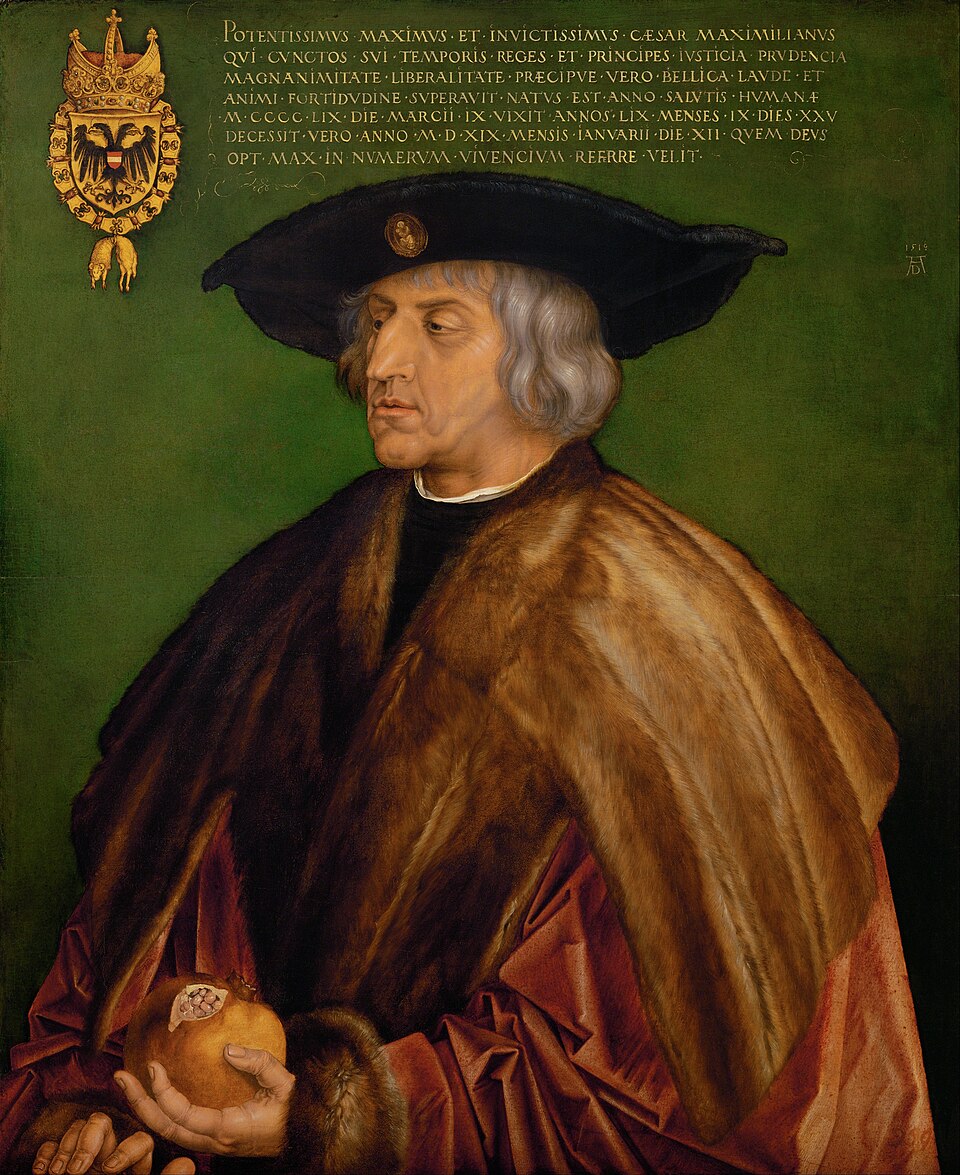
In a small room high in the palace at Augsburg, Dürer sketched the aging emperor from life. By the time the painted portrait was finished, Maximilian was dead.
The story behind the painting
Albrecht Dürer and Emperor Maximilian I first met in the spring of 1512, when the newly elected emperor stayed in Nuremberg. Maximilian used printmaking widely to spread his image, and Dürer was commissioned to create the huge multi-sheet Triumphal Arch woodcut, for which he received an annual reward. In 1518, during the Diet of Augsburg, Maximilian called Dürer to portray him. On the margin of his drawing the artist noted that he portrayed the emperor in Augsburg, up in the high palace, in his small room, on Monday 28 June 1518. From that drawing, now in the Albertina, Dürer later made two paintings and a woodcut, varying the clothes slightly in each.
What to look for
This oil panel, 74 by 61.5 centimetres, shows the emperor in three-quarter view against a green background. His arms rest on an unseen parapet along the lower edge, a device borrowed from Early Netherlandish portraits. In his left hand he holds a large pomegranate. He wears a gown with a very wide fur collar and a broad-brimmed dark hat with a brooch at its centre. Grey hair frames an aging yet still aristocratic face; he was 59. In the upper left are the Habsburg coat of arms and the chain of the Golden Fleece, beside a long Latin inscription in capitals listing his titles and deeds.
Meaning and intent
The pomegranate was Maximilian's personal symbol. Its many seeds, held within one fruit, stood for unity in diversity and so for the Holy Roman Empire, the seeds representing his subjects. His adviser Stabius explained on the Arch of Honour that, although the fruit's outside is neither beautiful nor fragrant, it is sweet within and full of well-shaped seeds, just as the emperor had many hidden qualities that bore fruit day by day. The inscription praises him as surpassing the kings and princes of his time in justice, prudence, generosity and courage, and records his birth in 1459 and his death in January 1519.
Legacy
The panel was completed after the emperor had died, with some changes from the original drawing, so it is both a portrait and a memorial. The woodcut version, unusually for Dürer, does not bear his monogram and carries a grand classicising string of imperial titles. Together, drawing, paintings and print show how one sitting in Augsburg became a series of images for an emperor deeply aware of the power of pictures. Today the painting hangs in the Kunsthistorisches Museum in Vienna, while the drawing that began it all is kept nearby in the Albertina, two witnesses to a single afternoon in 1518.
Le saviez-vous ?
- Oil on panel, 1519, 74 x 61.5 cm, Kunsthistorisches Museum, Vienna
- Based on a drawing made in Augsburg on 28 June 1518, now in the Albertina
- Completed after Maximilian's death in January 1519
- The pomegranate was the emperor's personal symbol
À propos de l'artiste
Albrecht Dürer (1471-1528)
portrait · musée d'Histoire de l'art de Vienne · Renaissance allemande
Autres œuvres de Albrecht Dürer
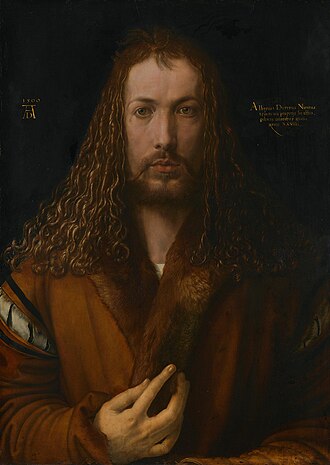 Autoportrait - Albrecht Dürer (1500)
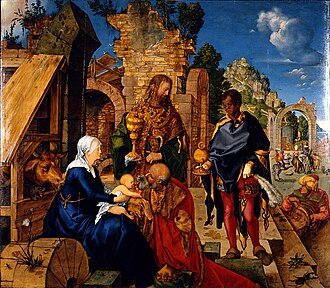 Adoration des mages - Albrecht Dürer (1504)
.jpg) La Vierge de la fête du rosaire - Albrecht Dürer (1506)
La Vierge de la fête du rosaire - Albrecht Dürer (1506)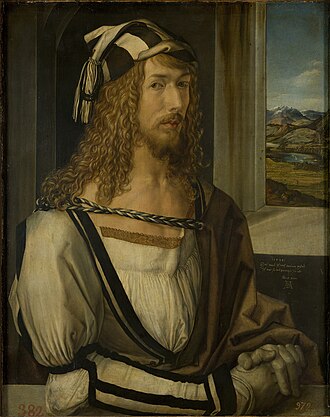 Autoportrait à 26 ans - Albrecht Dürer (1498)
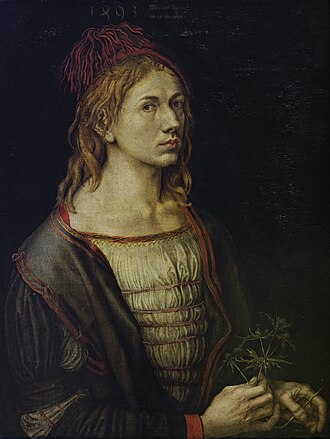 Portrait de l'artiste tenant un chardon - Albrecht Dürer (1493)
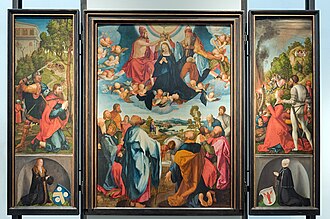 retable Heller - Albrecht Dürer (1500s)
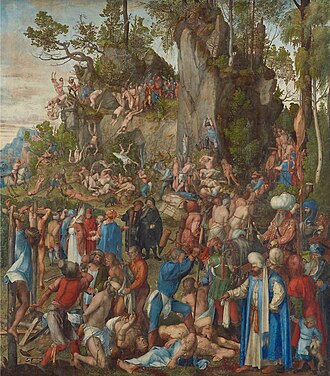 retable des dix mille martyrs - Albrecht Dürer (1508)
%20-%20Google%20Art%20Project.jpg) L'Adoration de la Sainte Trinité - Albrecht Dürer (1511)
L'Adoration de la Sainte Trinité - Albrecht Dürer (1511)