Le Grand-duc
Édouard Manet · 1881
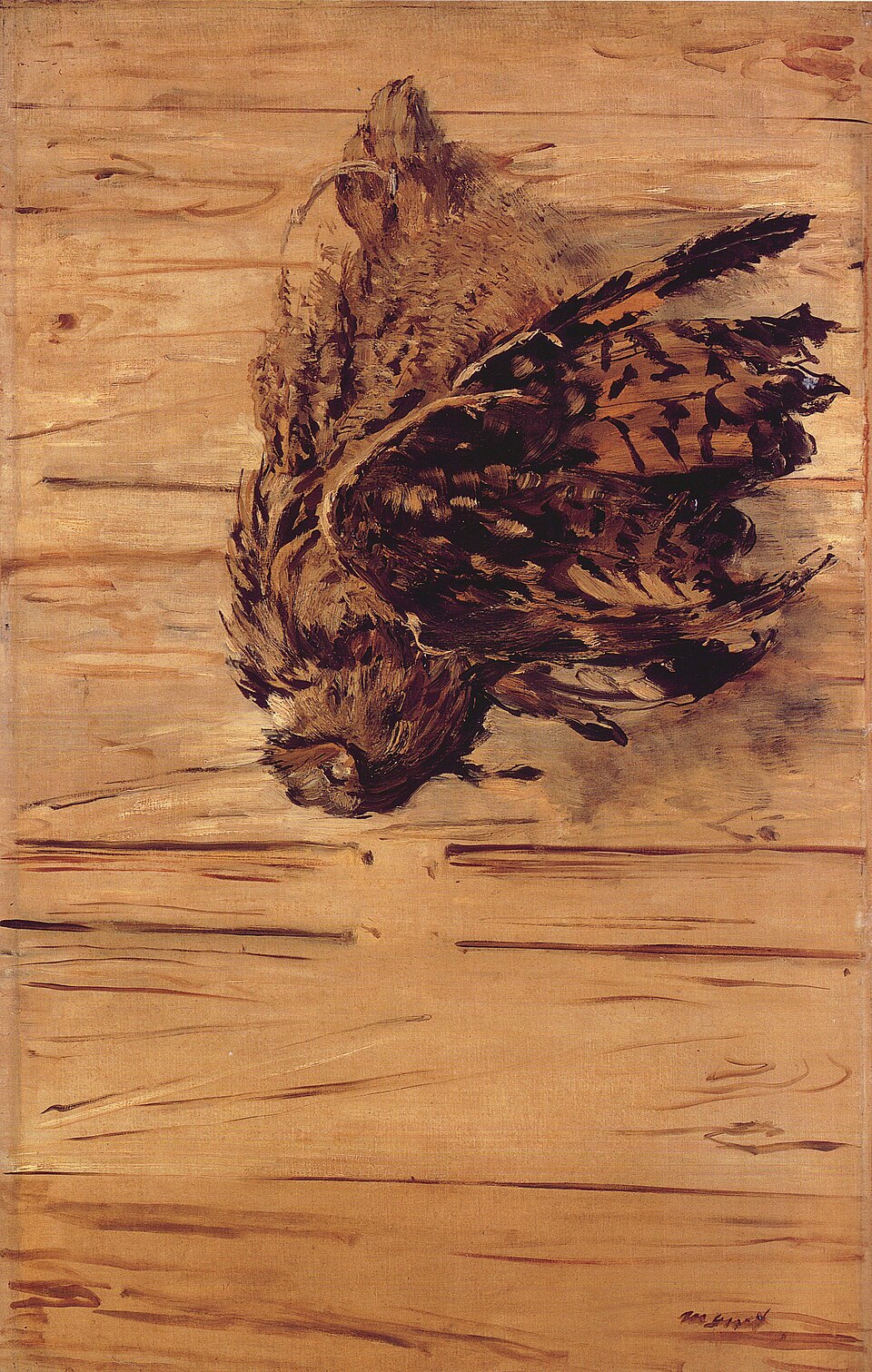
A great eagle owl hangs upside down from a nail on a wooden wall, one eye still visible, its feathers painted in quick living strokes. Manet made this rare hunting still life in 1881, while recovering from a serious illness.
The story behind the painting
Dead Eagle Owl, Le Grand-duc in French, is one of very few hunting still lifes in Manet's work. He painted it in 1881 in Versailles, as one of a group of comparable still lifes made that year while he was recuperating from a serious illness. The subject has precedents in eighteenth century French still life and seventeenth century Dutch still life, in painters such as Chardin and Weenix. It is a quiet, unexpected subject for the painter of modern Paris.
What to look for
The owl hangs head down against wooden boards. Between its feet is a nail with the knotted ends of a small cord, probably used to tie the legs and hang the bird. It is turned to the left, so we see almost only its right side: one eye, and the right wing covering the left. The bird fills the top three fifths of the 97 by 64 cm canvas, while the bottom two fifths show nothing but wood grain, and a soft shadow at right suggests light from the upper left. The signature Manet sits in the lower right corner.
Meaning and intent
Manet used almost only browns and black, for the bird and for the wood alike. The owl is built of short strokes and dabs of colour, and head, body, legs and wings are each distinguished by shape, colour, pattern and brushwork. The boards are painted with long, wave-like strokes that follow the grain. Without any surrounding space, the picture belongs to the tradition of trompe l'oeil still life, and its lively handling stands in striking contrast to the stillness of a dead animal.
Legacy
The work is described as extremely picturesque and almost impressionistic, yet exact in its feathers. It joins a line of hunting trophies that runs back through French and Dutch still life. Today it is part of the Foundation E.G. Bührle Collection in Zürich, which Wikidata also connects with the Kunsthaus Zürich. Seen up close, the brushwork is what keeps the dead bird strangely alive, and that tension between subject and handling is the picture's lasting fascination.
Le saviez-vous ?
- Painted by Manet in 1881 in Versailles.
- One of very few hunting still lifes in his work.
- Made during his recovery from a serious illness.
- In the Foundation E.G. Bührle Collection, Zürich.
À propos de l'artiste
Édouard Manet (1832-1883)
nature morte · Fondation et Collection Emil G. Bührle · Kunsthaus de Zurich · suspension
Autres œuvres de Édouard Manet
 Le Déjeuner sur l'herbe - Édouard Manet (1863)
 Olympia - Édouard Manet (1863)
%20(33539037428).jpg) Un bar aux Folies Bergère - Édouard Manet (1882)
Un bar aux Folies Bergère - Édouard Manet (1882) Le Balcon - Édouard Manet (1868)
.jpg) La Musique aux Tuileries - Édouard Manet (1862)
La Musique aux Tuileries - Édouard Manet (1862).jpg) Le Fifre - Édouard Manet (1866)
Le Fifre - Édouard Manet (1866)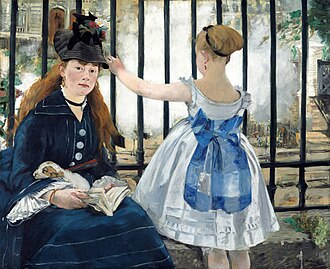 Le Chemin de fer - Édouard Manet (1873)
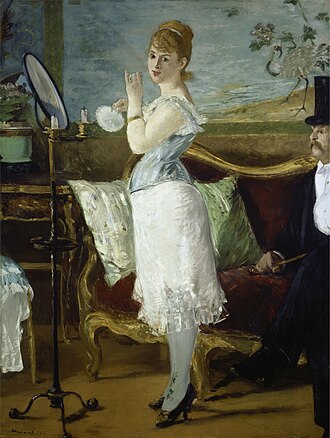 Nana - Édouard Manet (1877)
Œuvres d'artistes liés
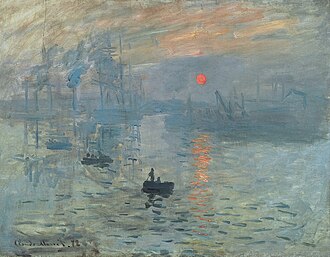 Impression, soleil levant - Claude Monet (1872)
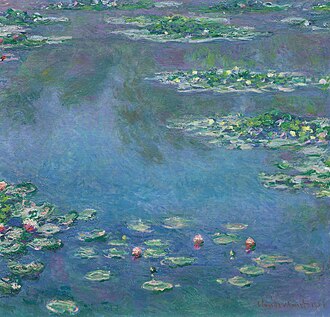 Nymphéas - Claude Monet (1906)
 Bal du moulin de la Galette - Pierre-Auguste Renoir (1876)
 Le Déjeuner des canotiers - Pierre-Auguste Renoir (1881)
 L'Absinthe - Edgar Degas (1875)
 La Famille Bellelli - Edgar Degas (1858)
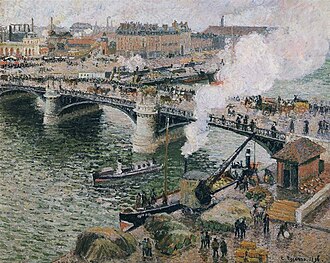 Le Pont Boieldieu à Rouen, temps mouillé - Camille Pissarro (1896)
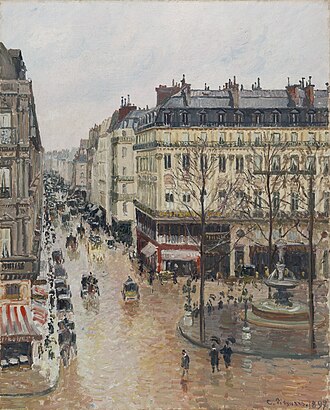 Rue Saint-Honoré, Après-midi, Effet de Pluie - Camille Pissarro (1897)
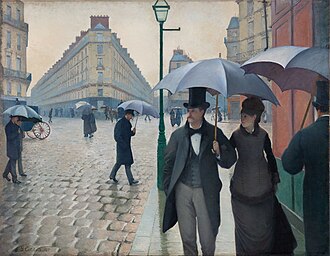 Rue de Paris, temps de pluie - Gustave Caillebotte (1877)
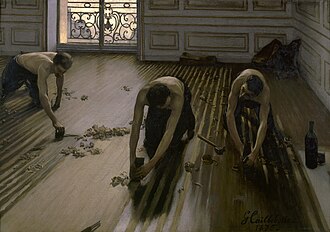 Les Raboteurs de parquet - Gustave Caillebotte (1875)
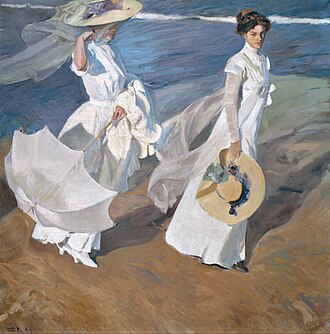 Promenade au bord de la mer - Joaquín Sorolla (1909)
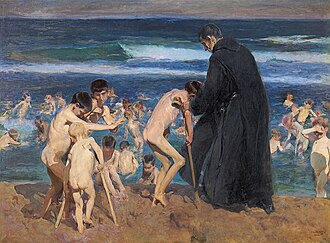 Triste héritage - Joaquín Sorolla (1898)