Christ sur la croix
Diego Velázquez · 1631
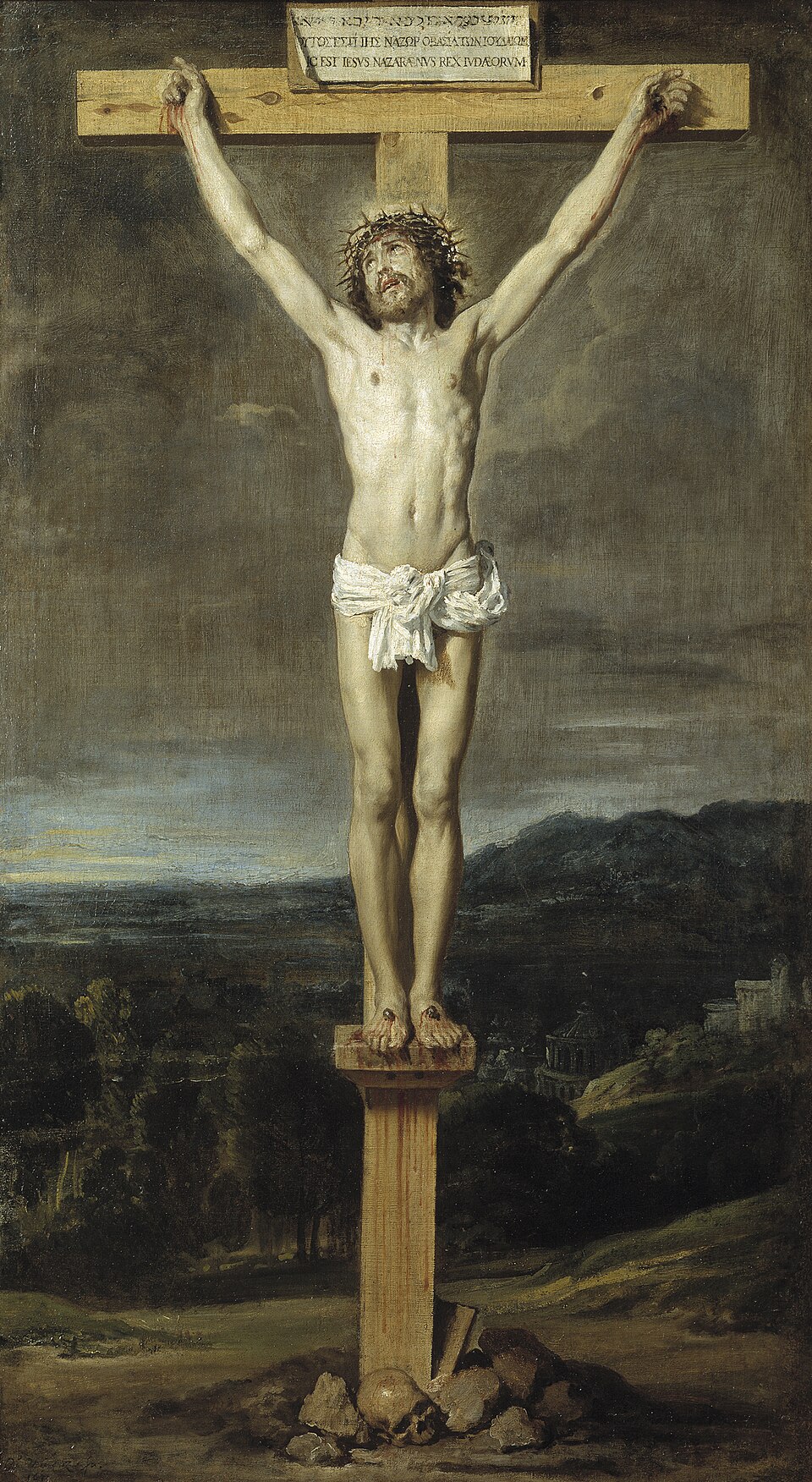
A signature appeared under the dirt during cleaning, reading Velázquez 1631. Was it really his? The Prado's own technical study says no, and the debate makes this quiet Christ even more intriguing.
The story behind the painting
For a long time the canvas hung in the convent of the Bernardas Recoletas del Santísimo Sacramento in Madrid. It suffered during the Spanish Civil War and was given to the Spanish state in exchange for restoring the convent, catalogued as an 18th century Madrid school work. When it was cleaned at the Prado after 1940, the inscription do. Velázquez fa 1631 appeared. That was curious, since Velázquez rarely signed his canvases, let alone a minor one. The Prado acquired it in 1946.
What to look for
Christ hangs alive, looking up to heaven, his feet resting on a support and fixed with four nails, as Velázquez's master Francisco Pacheco advised. The torso, loincloth and legs are close to Velázquez's Christ of San Plácido, but here the arms are tense and form a tight angle. The whole cross stands among stones, with a skull traditionally linked to Adam, before a city view that evokes Jerusalem, and the trilingual inscription at the top. The canvas is about 100 by 57 cm.
Meaning and intent
Experts disagree. José López-Rey and Jonathan Brown rejected the attribution. Julián Gállego found it very close to Velázquez's manner and linked it to a crucified Christ in the painter's inventory, and Maurizio Marini accepted it as perhaps a study for the Christ of San Plácido. The Prado's technical study led by Carmen Garrido ruled Velázquez out: the light side strokes that he would cover are left on the surface here, and the background strokes are mechanical. Its conclusion is a period painting strongly marked by Velázquez, finely executed, perhaps from his workshop.
Legacy
The painting was included in the Prado's 1990 Velázquez exhibition as number 27, despite reservations. The French Wikipedia now describes it as attributed to Velázquez, with an apocryphal signature suggesting his workshop. It is a rare case where a museum's own laboratory changed how a signed picture is read, and it remains in the Prado's collection. Whoever held the brush, the picture shows how closely Velázquez's model of a calm, living Christ was studied and imitated in Madrid in his own time.
Le saviez-vous ?
- A signature dated 1631 appeared during cleaning after 1940.
- Bought by the Prado in 1946.
- The Prado's technical study rejects Velázquez's hand.
- Possibly from his workshop.
À propos de l'artiste
Diego Velázquez (1599-1660)
art religieux · homme · musée du Prado · Jésus-Christ
Autres œuvres de Diego Velázquez
 Les Ménines - Diego Velázquez (1656)
 La Reddition de Bréda - Diego Velázquez (1635)
 Vénus à son miroir - Diego Velázquez (1644)
 Les Fileuses - Diego Velázquez
 Innocent X - Diego Velázquez
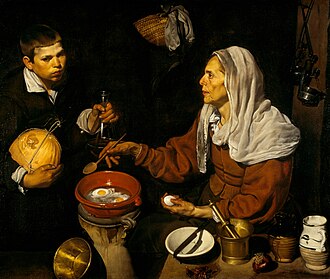 Vieille faisant frire des œufs - Diego Velázquez (1618)
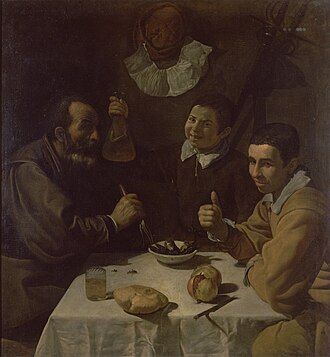 Trois hommes à table, le déjeuner - Diego Velázquez (1617)
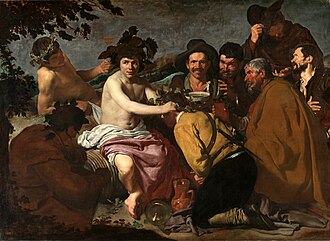 Le Triomphe de Bacchus - Diego Velázquez (1628)
Œuvres d'artistes liés
 Le Souper à Emmaüs - Caravaggio (1601)
 La Vocation de saint Matthieu - Caravaggio (1609)
 Saint Francis in Meditation - Francisco de Zurbarán (1639)
 The Immaculate Conception - Francisco de Zurbarán (1661)
 Triple portrait de Charles Ier - Anthony van Dyck (1635)
 Charles Ier à cheval avec Monsieur de Saint Antoine - Anthony van Dyck (1636)
 L'Érection de la croix - Peter Paul Rubens (1609)
 L'Enlèvement des filles de Leucippe - Peter Paul Rubens (1618)
 La Ronde de nuit - Rembrandt van Rijn (1642)
 Autoportrait - Rembrandt van Rijn (1659)
 Le Joyeux Buveur - Frans Hals (1620s)
 Le Cavalier riant - Frans Hals (1624)