Clair de lune sur le port de Boulogne
Édouard Manet · 1869
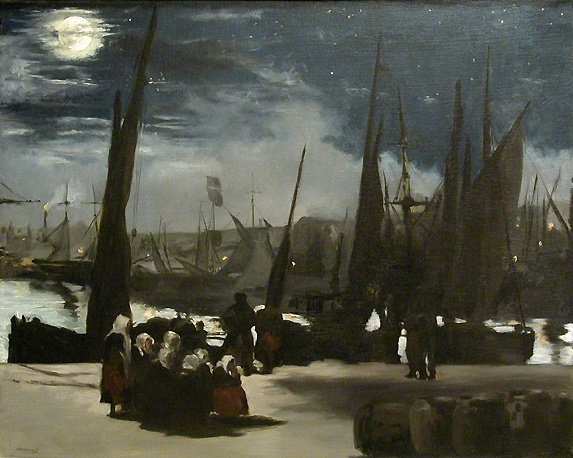
Midnight on a summer harbour: the moon breaks through cloud, masts crowd the sky, and a huddle of women waits on the quay for the fishing boats. Manet watched it from a hotel window in Boulogne.
The story behind the painting
Like much of the Parisian elite before the rise of the Côte d'Azur, Manet, who came from a wealthy family, often spent summers on the Channel coast, and he stayed several times in Boulogne-sur-Mer, where he painted many seascapes. Historical and astronomical research has shown that this scene was observed around midnight on the night of 3 to 4 August 1868 from a window of the Hôtel Folkestone on the quay. Manet later worked it up in his studio. Wikidata and many references date it 1869, but 1868 is more likely, since it was already shown in Brussels at the start of summer 1869.
What to look for
The canvas, about 82 by 101 cm, has a mysterious air. Moonlight falls on a forest of masts and sails in the harbour, while a fishing boat comes back in the dark. On the quay, seven women in traditional costume stand close together, waiting for the boats to return. Nearer the water's edge, a few men are still in shadow. Follow how the light picks out the women's white caps and the shining water, and how everything else sinks into darkness, a play of shadow and light that pays tribute to Rembrandt.
Meaning and intent
The painting is also a tribute to Dutch landscape painting, and especially to Aert van der Neer, a specialist in night scenes. Manet owned a work by him. Yet Manet's casual, free brushwork is far from Van der Neer's precise technique: he takes the old Dutch subject of moonlight on water and paints it in his own modern hand. The waiting women give the scene its quiet tension. It is a picture about work and return, about the people left on shore while others are out at sea.
Legacy
The Port of Boulogne by Moonlight is now in the Musée d'Orsay in Paris. The careful research that fixed its night to early August 1868 shows how closely Manet worked from a real moment, even when he finished the canvas later in Paris. For viewers today it remains one of his most atmospheric pictures, a summer night at a fishing port held still: moon, masts, and a small group of women watching the dark water.
Le saviez-vous ?
- Seen around midnight on 3 to 4 August 1868 from the Hôtel Folkestone, Boulogne.
- Often dated 1869, but 1868 is more likely.
- A tribute to Rembrandt and to Aert van der Neer.
- Oil on canvas, about 82 x 101 cm, in the Musée d'Orsay.
À propos de l'artiste
Édouard Manet (1832-1883)
paysage · musée d'Orsay · paysage · peinture de personnage · voilier · port
Autres œuvres de Édouard Manet
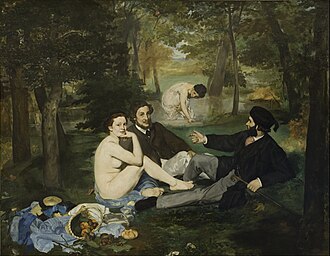 Le Déjeuner sur l'herbe - Édouard Manet (1863)
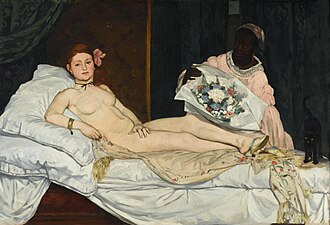 Olympia - Édouard Manet (1863)
%20(33539037428).jpg) Un bar aux Folies Bergère - Édouard Manet (1882)
Un bar aux Folies Bergère - Édouard Manet (1882)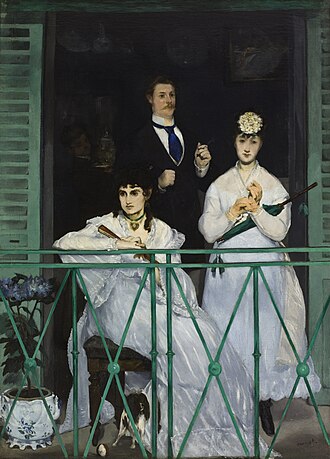 Le Balcon - Édouard Manet (1868)
.jpg) La Musique aux Tuileries - Édouard Manet (1862)
La Musique aux Tuileries - Édouard Manet (1862).jpg) Le Fifre - Édouard Manet (1866)
Le Fifre - Édouard Manet (1866)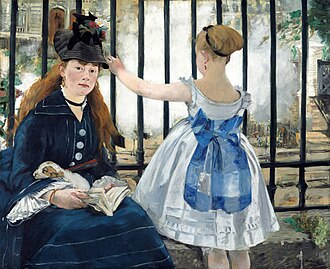 Le Chemin de fer - Édouard Manet (1873)
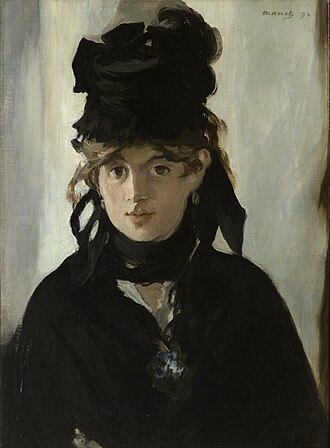 Berthe Morisot au bouquet de violettes - Édouard Manet (1872)
Œuvres d'artistes liés
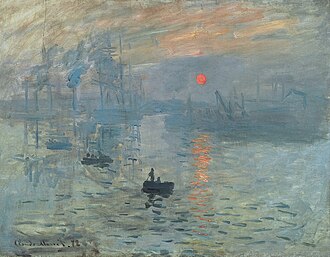 Impression, soleil levant - Claude Monet (1872)
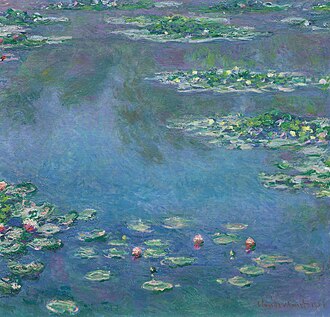 Nymphéas - Claude Monet (1906)
 Bal du moulin de la Galette - Pierre-Auguste Renoir (1876)
 Le Déjeuner des canotiers - Pierre-Auguste Renoir (1881)
 La Nuit étoilée - Vincent van Gogh (1889)
.jpg) Terrasse du café le soir - Vincent van Gogh (1888)
Terrasse du café le soir - Vincent van Gogh (1888) Le Dernier Voyage du Téméraire - J. M. W. Turner (1839)
 Pluie, Vapeur et Vitesse - J. M. W. Turner (1844)
 D'où venons-nous ? Que sommes-nous ? Où allons-nous ? - Paul Gauguin (1897-1898)
%201889.jpg) Le Christ jaune - Paul Gauguin (1889)
Le Christ jaune - Paul Gauguin (1889)