Portrait de Berthe Morisot à l'éventail
Édouard Manet · 1874
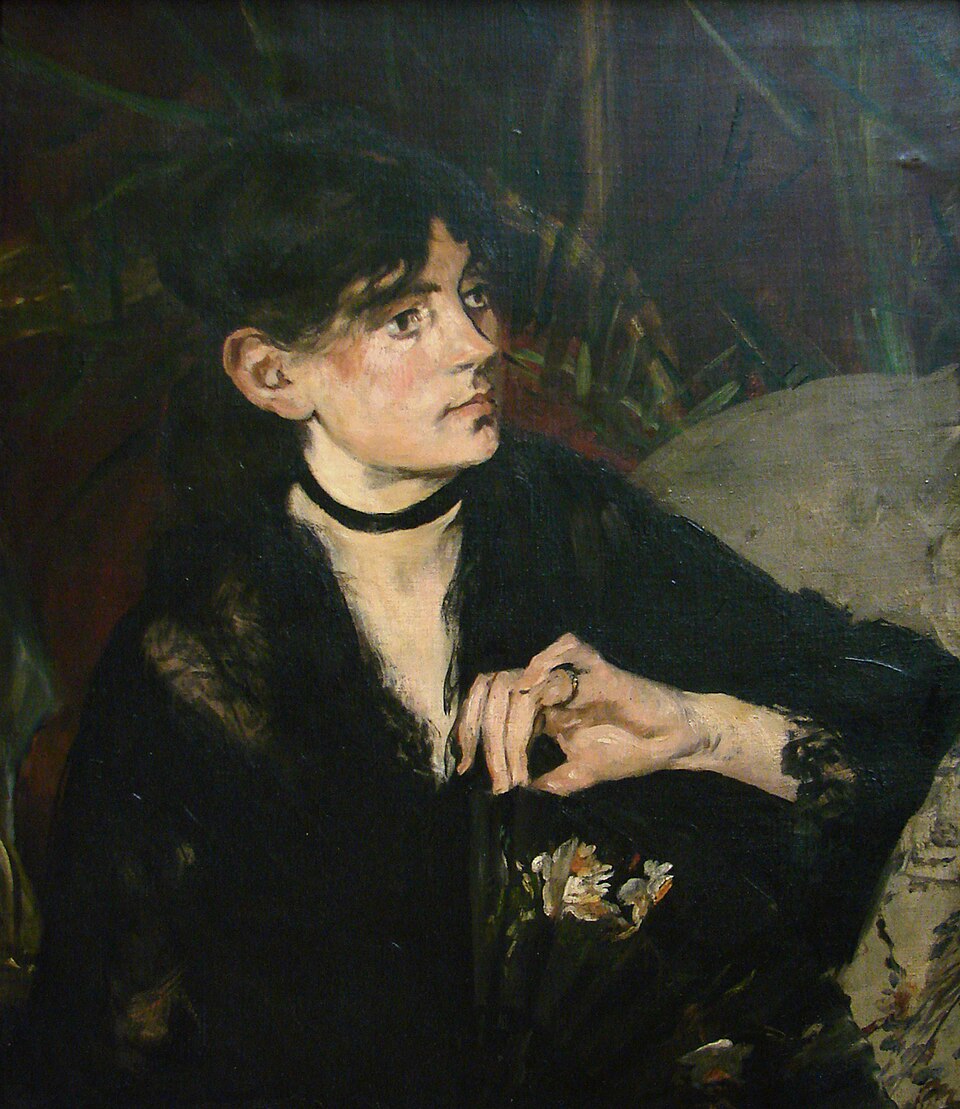
Berthe Morisot in black, a flowered fan in her hand, looking away. It is the last of twelve portraits Manet painted of her, made just after she married his brother, and it feels like a farewell.
The story behind the painting
Between 1868 and 1874 Édouard Manet painted twelve portraits of his fellow painter and model Berthe Morisot. This one, from 1874, is the last. It was made just after her marriage to Manet's brother Eugène, after which she no longer posed for him. She was also in mourning for the death of her father, which is why she is dressed in black. A friendship that had produced a whole series of images comes to a close in this single canvas.
What to look for
Look at the contrasts: the velvet ribbon around her neck and the lace of her dress set off her light skin. Even her eyes are painted black, though they were actually green. On the hand that holds a fan decorated with flowers, a wedding ring is clearly visible, and the source also mentions an engagement ring. The background with its plant motif refers to the Japanese art that was fashionable at the time. The canvas measures about 50 by 61 cm according to Wikidata.
Meaning and intent
The black dress and the visible ring show the influence of Spanish painters Manet admired, such as Diego Velázquez and Francisco Goya, an influence also seen in Berthe Morisot with a Bouquet of Violets. But the most moving detail is her gaze. Unlike in his earlier portraits of her, she does not look in his direction. The portrait seems to have been conceived as a kind of farewell between the painter and his model, a woman now married into his family and turning towards her own life.
Legacy
The portrait entered Morisot's own collection, possibly directly from Manet. It stayed in private hands until it was donated to the French state in 1999. It was first allocated to the Musée d'Orsay in Paris, which still owns it, and in 2000 it was moved on loan to the Palais des Beaux-Arts in Lille, where it hangs today. That the sitter kept this last portrait of herself says something about what it meant to her.
Le saviez-vous ?
- Painted in 1874.
- The last of twelve portraits Manet made of Berthe Morisot.
- Made just after her marriage to Manet's brother Eugène.
- Owned by the Musée d'Orsay, on loan to Lille since 2000.
À propos de l'artiste
Édouard Manet (1832-1883)
femme · portrait · musée d'Orsay · palais des Beaux-Arts de Lille · éventail · artiste peintre · Berthe Morisot · bijou
Autres œuvres de Édouard Manet
 Le Déjeuner sur l'herbe - Édouard Manet (1863)
 Olympia - Édouard Manet (1863)
 Un bar aux Folies Bergère - Édouard Manet (1882)
 Le Balcon - Édouard Manet (1868)
 La Musique aux Tuileries - Édouard Manet (1862)
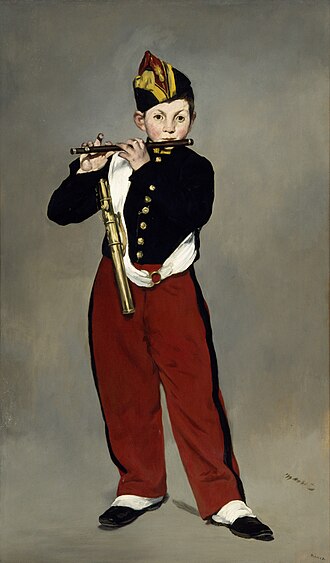 Le Fifre - Édouard Manet (1866)
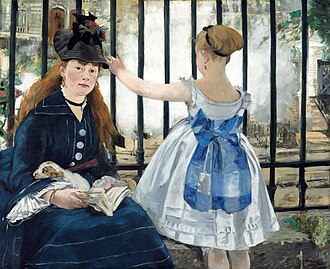 Le Chemin de fer - Édouard Manet (1873)
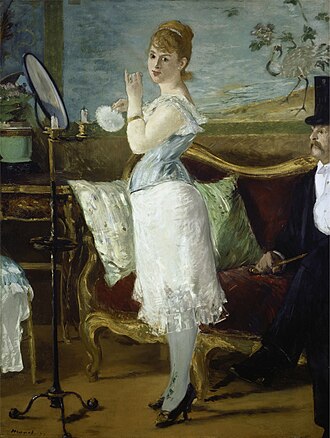 Nana - Édouard Manet (1877)
Œuvres d'artistes liés
 Impression, soleil levant - Claude Monet (1872)
 Nymphéas - Claude Monet (1906)
 Bal du moulin de la Galette - Pierre-Auguste Renoir (1876)
 Le Déjeuner des canotiers - Pierre-Auguste Renoir (1881)
 Le Berceau - Berthe Morisot (1872)
 Jour d'été - Berthe Morisot (1879)
 L'Absinthe - Edgar Degas (1875)
 La Famille Bellelli - Edgar Degas (1858)
 Le Canal du Loing - Alfred Sisley (1892)
 L'Abreuvoir à Marly-Le-Roi, gelée blanche - Alfred Sisley (1876)
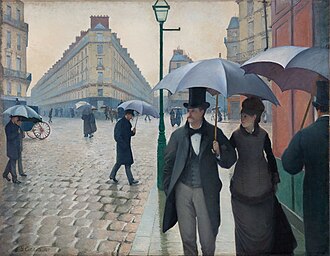 Rue de Paris, temps de pluie - Gustave Caillebotte (1877)
 Les Raboteurs de parquet - Gustave Caillebotte (1875)