Matin, automne, Éragny
Camille Pissarro · 1892
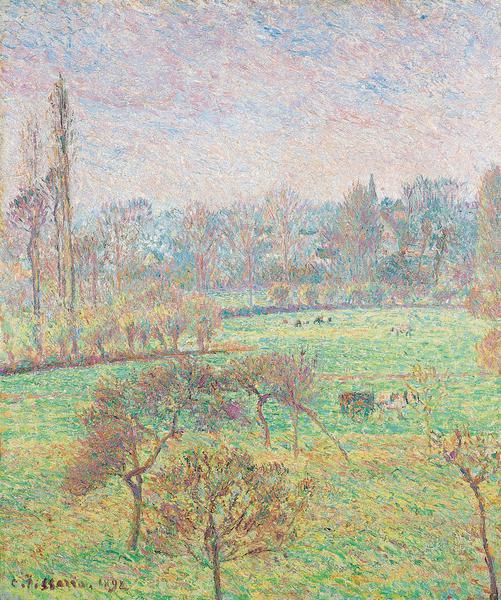
Fruit trees on a green meadow, a golden shimmer of falling leaves, an ox cart, and a purple autumn sky. Pissarro painted this morning in 1892 in the village where he spent the last nineteen years of his life.
The story behind the painting
Éragny, also called Éragny-sur-Epte, is a small village about 100 kilometres north of Paris. Camille Pissarro spent the last 19 years of his life there, travelling often to Paris to sell his pictures and meet his artist friends. Around 160 works were made in and around Éragny in the 1890s, and this canvas of 1892 is one of them. Its French title is Matin, automne, Éragny, autumn morning in Éragny; the newer catalogue raisonné of 2005 lists it as Pommiers à Éragny, automne, apple trees at Éragny in autumn. Pissarro painted another Autumn Morning at Éragny in 1897.
What to look for
In the foreground is a green meadow with a few fruit trees. The grass has a golden to light brown shimmer, which may suggest leaves falling from the trees. A little further back is an ox cart, and further still other animals can be made out, indistinctly. Buildings appear between the trees in the background. The sky is heavily clouded with a purple shimmer, and the hazy horizon underlines the autumn mood. The view looks down on the trees from a raised position: either Pissarro painted outdoors from a hill, or from an upper window of a house. It is signed at lower left: C. Pissarro. 1892.
Meaning and intent
The picture sits at a turning point in Pissarro's style. In the mid 1880s he met Paul Signac and Georges Seurat and tried their pointillist techniques; The Apple Harvest at Éragny probably belongs to that phase. Around 1890 he returned to his own freer Impressionism, yet this autumn morning of 1892 still shows a pointillist influence. (The German article misprints the meeting as the mid 1980s, an obvious slip for the 1880s.) What remains is a calm, almost tender look at an ordinary farm landscape, seen through small, luminous touches of colour.
Legacy
The dealer Paul Durand-Ruel bought the painting in Paris on 17 March 1893 and showed it that month at Pissarro's fourth solo exhibition in his gallery, and again in 1910. In 1913 it passed to Paul Cassirer in Berlin, who sold it in 1917 to Georg Caspari in Munich without Durand-Ruel's knowledge, then bought it back and sold it in 1918 to Fritz Schön in Ascona. Through the Galerie Nierendorf it reached Eduard von der Heydt around 1935, and by his bequest it entered the Von der Heydt Museum in Wuppertal in 1964, where it was shown in 2014 to 2015.
Le saviez-vous ?
- Painted in 1892 at Éragny, about 100 km north of Paris.
- Oil on canvas, 55 by 46 cm, signed C. Pissarro. 1892.
- Shows lingering pointillist influence after Pissarro's return to freer Impressionism.
- In the Von der Heydt Museum, Wuppertal, since 1964.
À propos de l'artiste
Camille Pissarro (1830-1903)
paysage · arbre · jardin · musée Von-der-Heydt
Autres œuvres de Camille Pissarro
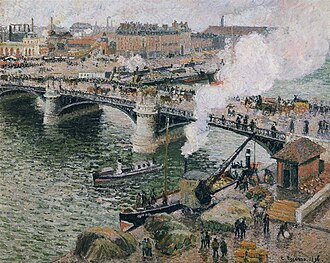 Le Pont Boieldieu à Rouen, temps mouillé - Camille Pissarro (1896)
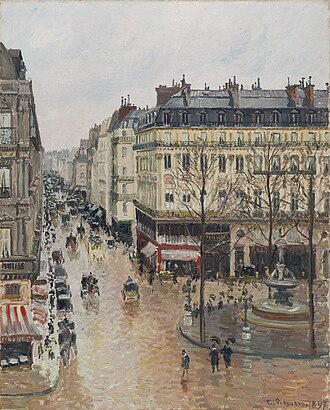 Rue Saint-Honoré, Après-midi, Effet de Pluie - Camille Pissarro (1897)
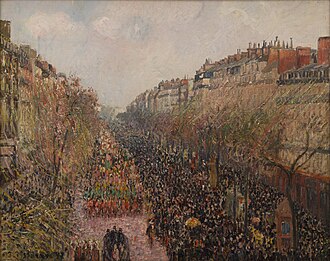 Boulevard Montmartre, Mardi Gras - Camille Pissarro (1897)
 Côte des Bœufs à L'Hermitage, Pontoise - Camille Pissarro (1877)
 La Maison de La Sourde et Le Clocher D'Éragny - Camille Pissarro (1886)
 Place du Théâtre Français à Paris, printemps - Camille Pissarro (1898)
 Boulevard Montmartre un matin d'hiver - Camille Pissarro (1897)
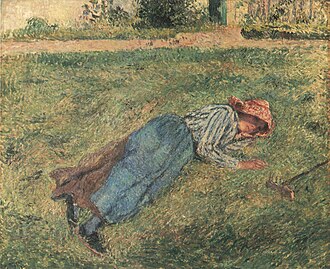 Le Repos, paysanne couchée dans l´herbe, Pontoise - Camille Pissarro (1882)
Œuvres d'artistes liés
 Impression, soleil levant - Claude Monet (1872)
 Nymphéas - Claude Monet (1906)
 Le Déjeuner sur l'herbe - Édouard Manet (1863)
 Olympia - Édouard Manet (1863)
 Bal du moulin de la Galette - Pierre-Auguste Renoir (1876)
 Le Déjeuner des canotiers - Pierre-Auguste Renoir (1881)
 Le Berceau - Berthe Morisot (1872)
 Jour d'été - Berthe Morisot (1879)
 L'Absinthe - Edgar Degas (1875)
 La Famille Bellelli - Edgar Degas (1858)
 Le Canal du Loing - Alfred Sisley (1892)
 L'Abreuvoir à Marly-Le-Roi, gelée blanche - Alfred Sisley (1876)