L'Annonciation
Jan van Eyck · 1440
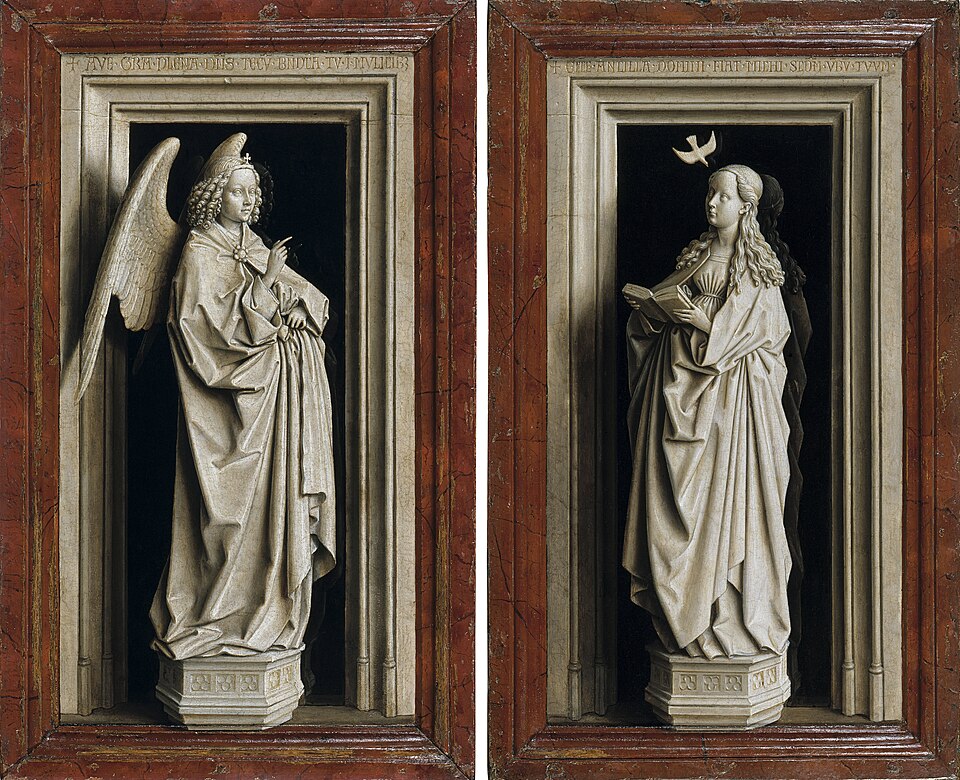
An angel and a young woman stand on pedestals, painted in black and white so they look like carved stone come to life. Jan van Eyck made this small diptych for private prayer, and its painted frames still play tricks on the eye.
The story behind the painting
The Annunciation, sometimes called the Annunciation Diptych, is an oil painting on wood by the Early Netherlandish master Jan van Eyck. Art historians date it to around 1433 to 1435, while Wikidata gives the year 1440, so the exact date is not settled. Its figures and imagery are very close to the outer panels of the Ghent Altarpiece, which van Eyck completed in 1432. Because the panels are small, about 39 by 24 cm each according to Wikidata, scholars think they were commissioned for private worship rather than public celebration in a church.
What to look for
On the left stands the Archangel Gabriel, on the right the Virgin Mary, both in white robes. They are far too large for the little rooms they occupy, a convention taken from International Gothic art and the Byzantine icon, where saints, above all Mary, tower over their surroundings. Each figure rests on a carved, inscribed pedestal against a black marble background. Heavy light falls across the deep folds of the drapery. Mary holds a holy book, her usual attribute, and a dove hovers above her. Despite the stony setting, the poses and gestures are natural and very human.
Meaning and intent
The whole diptych is built as an illusion. Layered shades of white and black imitate stone sculpture, so the figures feel like living statues. The painted frames and mouldings are very early examples of trompe l'oeil, carrying painted inscriptions of the words spoken in the Gospel of Luke. Gabriel says: Hail, full of grace, the Lord is with thee. Mary answers: Behold the handmaiden of the Lord; be it unto me according to thy word. The dialogue seems carved into the frame itself, turning a quiet moment of faith into something almost tangible.
Legacy
If the attribution to van Eyck is accepted, the work belongs very early in his career, and the panels were probably the two outer wings of a triptych. The source compares it with the Annunciation in Washington, which has a far more accomplished treatment and was more likely meant as a complete work on its own. Today the diptych belongs to the Museo Thyssen-Bornemisza in Madrid, linked to the Thyssen-Bornemisza family collection. It remains a rare chance to see the painter of the Ghent Altarpiece working in stone grey, at the scale of a private devotion.
Le saviez-vous ?
- Oil on wood, painted in grisaille to imitate stone sculpture.
- Dated about 1433 to 1435 by historians; Wikidata gives 1440.
- Painted frames carry the words of Gabriel and Mary from Luke 1.
- Held by the Museo Thyssen-Bornemisza in Madrid.
À propos de l'artiste
Jan van Eyck (1390-1441)
art religieux · femme · Marie · Primitifs flamands · musée Thyssen-Bornemisza · Sammlung Schloss Rohoncz
Autres œuvres de Jan van Eyck
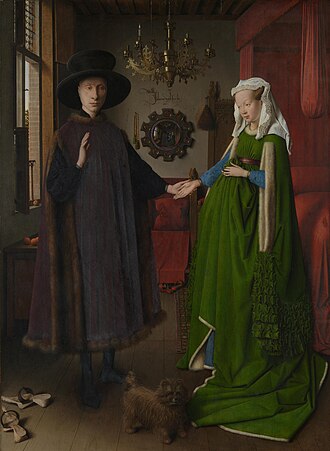 Les Époux Arnolfini - Jan van Eyck (1434)
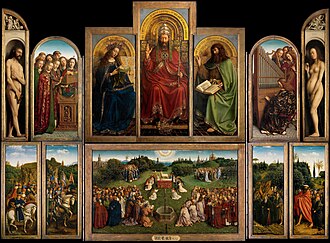 L'Agneau mystique - Jan van Eyck (1432)
.webp) La Vierge du chancelier Rolin - Jan van Eyck
La Vierge du chancelier Rolin - Jan van Eyck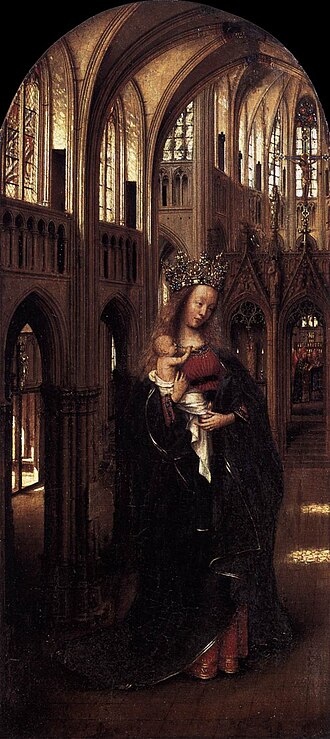 La Vierge dans une église - Jan van Eyck (1440)
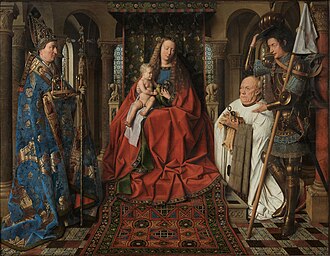 La Vierge au chanoine Van der Paele - Jan van Eyck (1436)
.png) Vierge de Lucques - Jan van Eyck (1437)
Vierge de Lucques - Jan van Eyck (1437)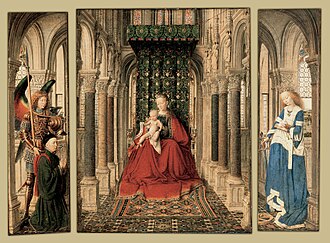 Triptyque de Dresde - Jan van Eyck (1437)
%201433.jpg) Portrait d'un homme - Jan van Eyck (1433)
Portrait d'un homme - Jan van Eyck (1433)
Œuvres d'artistes liés
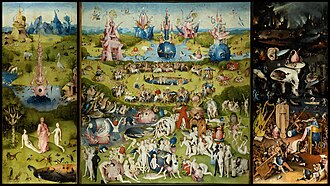 Le Jardin des délices - Hieronymus Bosch
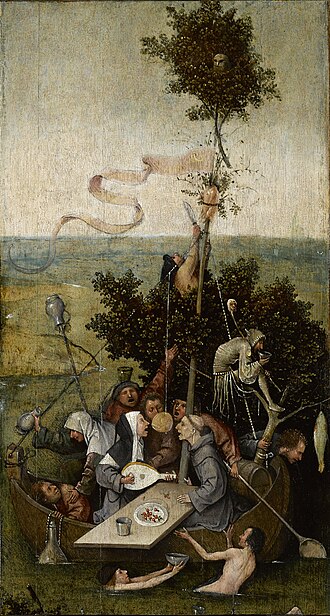 La Nef des fous - Hieronymus Bosch (1500s)
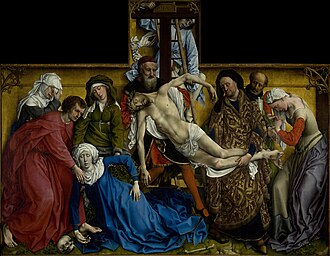 La Descente de Croix - Rogier van der Weyden (1440s)
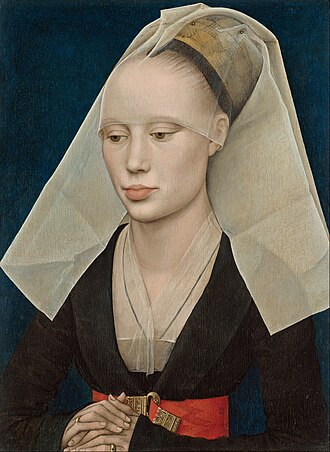 Portrait d'une dame - Rogier van der Weyden (1460)
%20-%20Google%20Art%20Project.jpg) Les Chasseurs dans la neige - Pieter Bruegel the Elder (1565)
Les Chasseurs dans la neige - Pieter Bruegel the Elder (1565)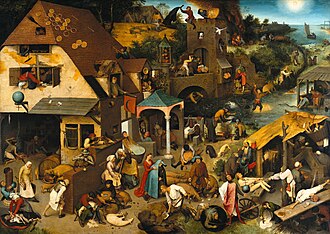 Les Proverbes flamands - Pieter Bruegel the Elder (1551)