Water Castle
Gustav Klimt · 1900s
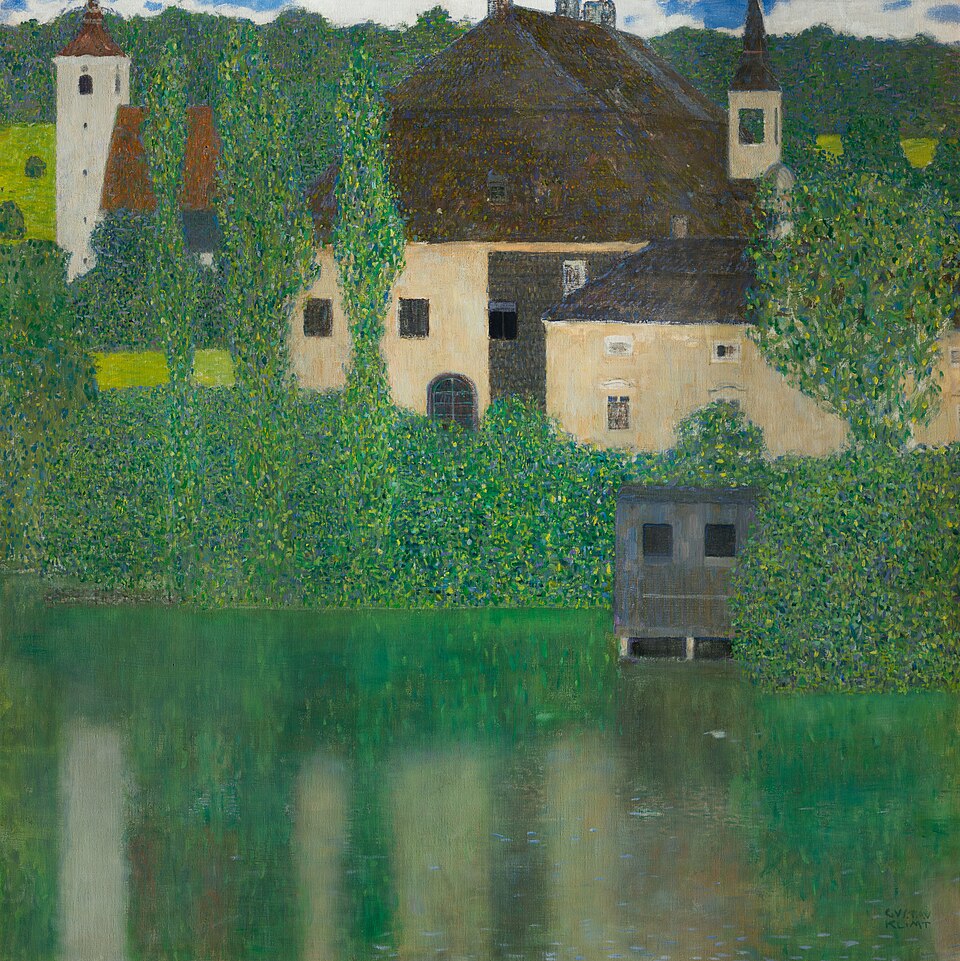
A castle seen across still water, framed by tall poplars, almost flat as a tapestry. Klimt measured the landscape with a cardboard viewfinder and a telescope before he rebuilt it on canvas.
The story behind the painting
Also known as Schloss Kammer on the Attersee I, or Wasserschloss, this oil painting of 1908 shows Kammer Castle in Austria seen from the Attersee lake. It is the first of four canvases in a series Klimt painted between 1908 and 1910 during summer holidays at the Villa Oleander in Schörfling am Attersee. Klimt and the Flöge family rented the villa from the castle's owner, Countess Khevenhüller. Wikidata dates the work only to the 1900s, while the Wikipedia article gives 1908. These summers by the lake became a source of a new kind of landscape for the painter.
What to look for
Klimt chose a viewpoint from the quay by the villa. From there the cubic facade of the castle appears behind the reflective surface of the lake, glimpsed through tall pyramidal poplars. There are no shadows, the horizon line sits right at the top of the canvas, and the palette is limited to white, ochre and green. The reflection doubles the building in the water. Many sources describe the canvas as square, but the National Gallery Prague gives its size as about 110 by 100 cm. Look for the church bell tower, which seems to stand close to the castle.
Meaning and intent
The work marks a change in Klimt's painting: a stronger composition than before and a strictly parallel structure. Using a self-invented cardboard viewfinder, a telescope and opera glasses, he cut the visible landscape into separate areas and then rearranged them into separate planes of lake and shore. That is why the bell tower looks near the castle, although in reality it stands about 800 metres away across the water in Seewalchen. With these means he could flatten the image and still show the landscape in a realistic, illusionistic way, holding depth and surface in balance.
Legacy
The painting was first exhibited at the 1909 Vienna Art Exhibition, where reviews called it the main and most brilliant work in the show. The following year it was shown at the Union of Czech-German Artists in Prague, and it was acquired there by its present owner, the National Gallery Prague, where it is still on display. The three later canvases of the series continued Klimt's study of the same lake and castle over the summers up to 1910, but this first view remains the one that opened the sequence and was hailed on its debut.
¿Sabías que…?
- Painted in 1908, first of four views of Kammer Castle on the Attersee.
- Klimt used a cardboard viewfinder, a telescope and opera glasses.
- Called the most brilliant work of the 1909 Vienna Art Exhibition.
- Acquired by the National Gallery Prague after a 1910 show in Prague.
Sobre el artista
Gustav Klimt (1862-1918)
Más obras de Gustav Klimt
 El beso - Gustav Klimt (1907-1908)
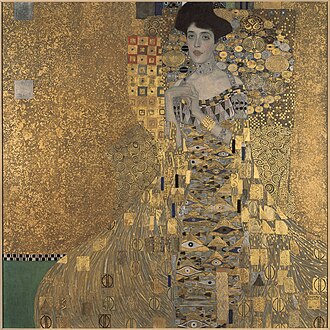 Retrato de Adele Bloch-Bauer I - Gustav Klimt (1907)
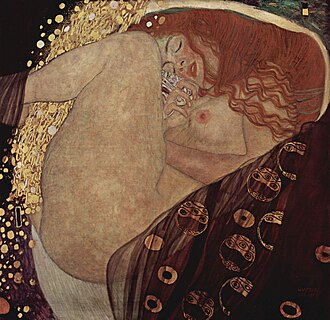 Dánae - Gustav Klimt (1907)
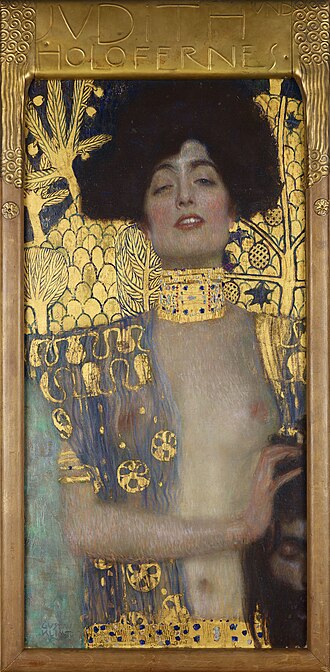 Judit I - Gustav Klimt (1901)
 Las tres edades de la mujer - Gustav Klimt (1905)
 Dama con abanico - Gustav Klimt (1917)
 Retrato de Adele Bloch-Bauer II - Gustav Klimt (1912)
 Retrato de una dama - Gustav Klimt (1910s)