Retrato de Adele Bloch-Bauer I
Gustav Klimt · 1907
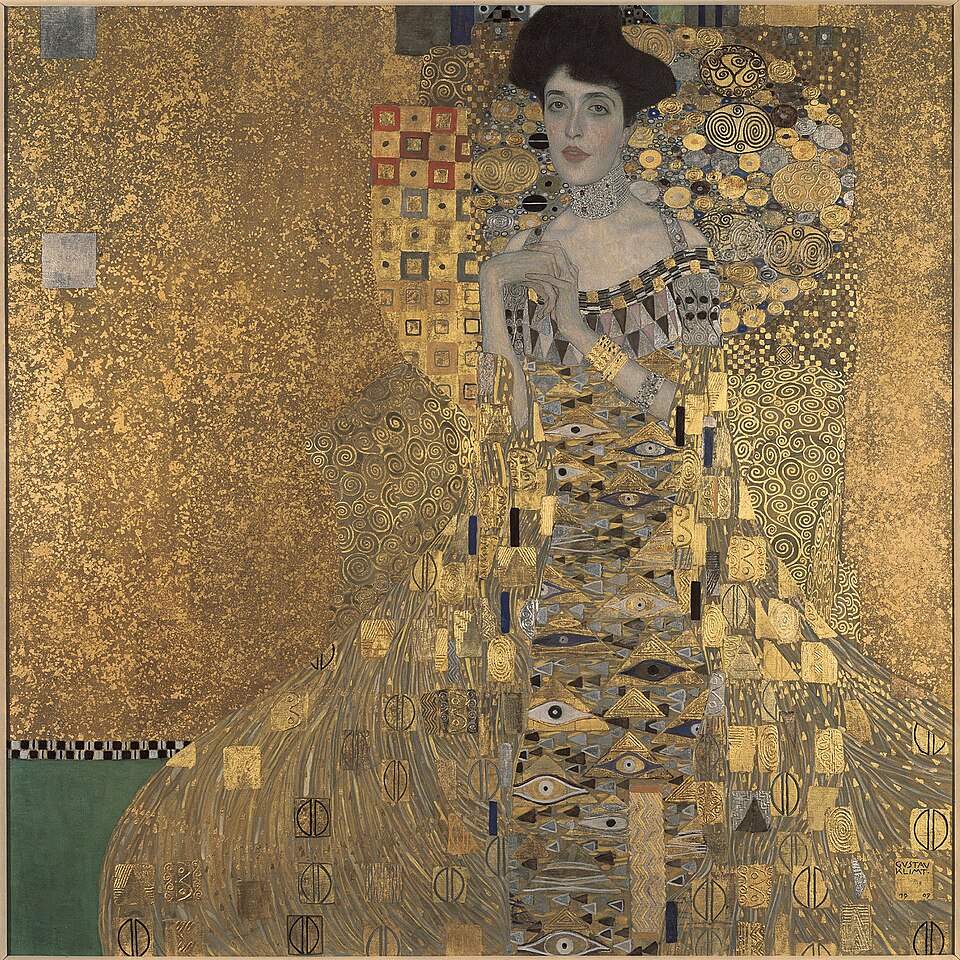
A woman's face and hands float in a sea of gold, her dress dissolving into the shimmering ground around her. Klimt spent years on this portrait, and the painting itself would later live through theft, war and a long fight for justice.
The story behind the painting
In mid-1903 the Viennese banker and sugar producer Ferdinand Bloch-Bauer commissioned Gustav Klimt to paint his wife, Adele, intending it as an anniversary gift for her parents. Klimt prepared for it more thoroughly than for any other work, drawing over a hundred sketches of Adele in 1903 and 1904. In December 1903 he visited the Basilica of San Vitale in Ravenna and studied its Byzantine gold mosaics of Justinian and Empress Theodora; he later called those mosaics of unbelievable splendour a revelation. That experience fed straight into the portrait. Klimt finished it by 1907, and it is regarded as the final and most fully representative work of his golden phase. Adele, a well-connected hostess of salons in Vienna, was painted by Klimt again in 1912.
What to look for
The canvas is square, painted in oil with silver and gold leaf. Adele sits on what appears to be a golden throne or chair before a golden, starry background. Only her face, shoulders and hands are painted naturalistically; almost everything else becomes ornament. Around her neck is the jewelled choker Klimt had already shown in his Judith painting. Her tight golden dress forms a triangle built from rectilinear shapes, and in places it merges so completely with the background that figure and setting are hard to separate. Look closely and the surface is not flat: Klimt applied gold and silver leaf and then raised decorative motifs in low relief using gesso, so the patterns catch the light as you move. Even the gilded frame was designed by the architect Josef Hoffmann.
Meaning and intent
Klimt used gold, the historian Gilles Néret suggests, to give his subjects a sacred or magical quality, and here the Ravenna mosaics are close at hand: Adele is presented almost like an empress in an icon. Yet the painting is also a modern society portrait, made for the wives of the largely Jewish Viennese bourgeoisie who were buying the innovative art that state museums rejected. The tension between living woman and glittering pattern is the heart of the work. Whether Adele and Klimt were lovers remains disputed; some writers believe so, while others note that no evidence has shown their relationship was more than friendship. The painting leaves that question unanswered and instead offers a person transformed into radiance.
Legacy
The portrait's later history is as dramatic as its surface. Adele died in 1925. After the Anschluss, Ferdinand fled Vienna, and in 1941 the Nazis seized his property; the painting was given to the Österreichische Galerie Belvedere. In 1998 the journalist Hubertus Czernin showed that the gallery held works stolen from Jewish owners. Ferdinand's niece Maria Altmann, with the lawyer E. Randol Schoenberg, pursued a claim for seven years, including a hearing before the United States Supreme Court, and in 2006 an arbitration committee in Vienna ordered the painting returned to her. It was then acquired by Ronald Lauder for the Neue Galerie in New York. Also known as The Woman in Gold, it is a landmark of Viennese Art Nouveau and of art restitution.
¿Sabías que…?
- Klimt made more than a hundred preparatory sketches for this portrait.
- The gold-leaf frame was made by the architect Josef Hoffmann.
- Adele wears the same jewelled choker that appears in Klimt's Judith I.
- The painting is also known as The Lady in Gold or The Woman in Gold.
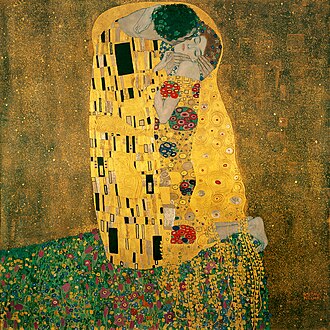 El beso
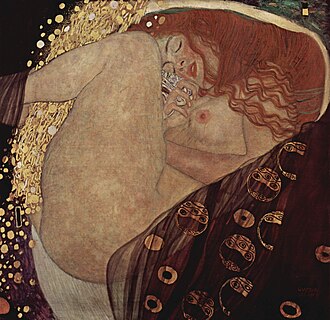 Dánae
Dánae.jpg) Judit I
Judit I