Dos jóvenes a la mesa
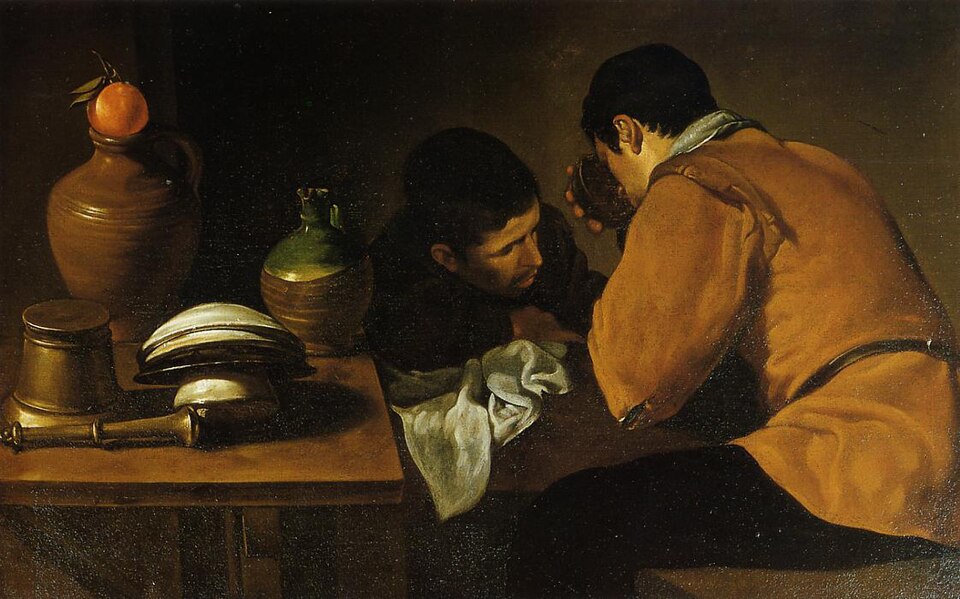
Two poor young men eat at a plain table crowded with clay pots, oranges and bread. Velázquez painted it as a youth in Seville, and the critics all agree it is his, even if they cannot agree on when.
The story behind the painting
Two Young Men at Table is an early work by Diego Velázquez, accepted by critics as authentic. It is probably one of the still lifes that Antonio Palomino listed among the young painter's Seville works: two poor men eating at a humble table with clay pots, oranges, bread and other things, all observed with meticulous precision. Palomino could only know the Seville pictures Velázquez brought to Madrid, so a 1637 inventory of the Duke of Alcalá, listing two half-length men with a glass vase, may describe another version or a copy.
What to look for
Look at the table before the faces. The pots, the oranges and the bread are painted with the same care as the men, and that is the point. Jonathan Brown saw in this apparently harmless composition two drunken men with half-hidden faces, reduced to the scale of the objects around them. The picture is about 65 by 104 cm and hangs today beside The Waterseller of Seville in the Wellington Museum at Apsley House in London.
Meaning and intent
Critics disagree about its place in his growth. Many older writers placed it among his very first works, between 1616 and 1618. José López-Rey links it to The Waterseller of Seville, which he dates two years later, around 1620. Jonathan Brown sees it instead as a step forward after The Waterseller, showing new degrees of boldness. For Fernando Marías it was a work painted to keep his hand in, shortly before he left for Madrid, more independent of known models than his earlier still lifes.
Legacy
King Charles III bought the painting from the Marquis of La Ensenada on 25 August 1768, and it appears in the 1772 inventory of the Royal Palace of Madrid. Four years later Antonio Ponz saw it there and called it a work in the style of Velázquez, but it is missing from the inventories of 1794 and 1814. After the Spanish War of Independence it reached London, where it is shown together with The Waterseller of Seville at Apsley House.
¿Sabías que…?
- An early Seville work by Velázquez, accepted as authentic.
- Dated between about 1616 and 1620, depending on the critic.
- Bought by Charles III in 1768.
- Now at Apsley House in London, beside The Waterseller of Seville.
Sobre el artista
Diego Velázquez (1599-1660)
escena de género · mesa · bodegón · conversación
Más obras de Diego Velázquez
 Las meninas - Diego Velázquez (1656)
 La rendición de Breda - Diego Velázquez (1635)
 Venus del espejo - Diego Velázquez (1644)
 Las Hilanderas - Diego Velázquez
 Inocencio X - Diego Velázquez
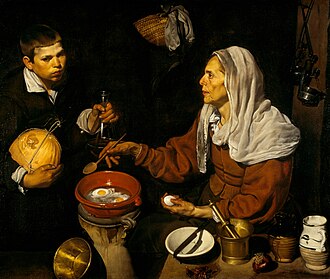 Vieja friendo huevos - Diego Velázquez (1618)
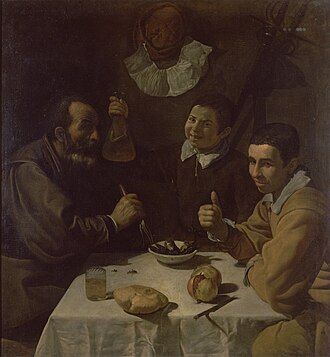 El almuerzo - Diego Velázquez (1617)
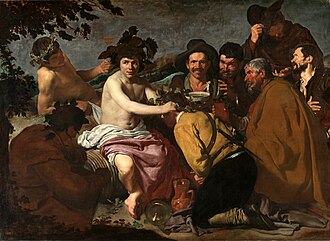 El triunfo de Baco - Diego Velázquez (1628)
Obras de artistas relacionados
 La cena de Emaús - Caravaggio (1601)
 La vocación de San Mateo - Caravaggio (1609)
 Saint Francis in Meditation - Francisco de Zurbarán (1639)
 Inmaculada Concepción - Francisco de Zurbarán (1661)
 Triple retrato de Carlos I - Anthony van Dyck (1635)
 Charles I (1600-1649) with M. de St Antoine - Anthony van Dyck (1636)
 La elevación de la cruz - Peter Paul Rubens (1609)
 Rapto de las hijas de Leucipo - Peter Paul Rubens (1618)
 La ronda de noche - Rembrandt van Rijn (1642)
 Autorretrato - Rembrandt van Rijn (1659)
 El alegre bebedor - Frans Hals (1620s)
 Caballero sonriente - Frans Hals (1624)